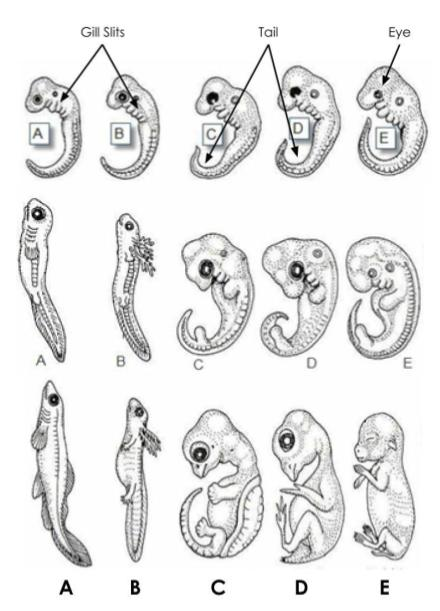
Embryology is a branch of comparative anatomy which studies the development of vertebrate animals (animals with backbones) before birth or hatching. Embryos are offspring in the process of development, before all vital structures have developed. Like adults, embryos show similarities which can support common ancestry. For example, all vertebrate embryos have gill slits and tails, as shown in pictures below. The “gill slits” are not gills, however. They connect the throat to the outside early in development but eventually close in many species; only in fish and larval amphibians do they contribute to the development of gills. In mammals, the tissue between the first gill slits forms part of the lower jaw and the bones of the inner ear. The embryonic tail does not develop into a tail in all species; in humans, it is reduced during development to the coccyx, or tailbone. Similar structures during development support common ancestry.
| Draggable item | arrow_right_alt | Corresponding Item |
|---|---|---|
B | arrow_right_alt | fish |
E | arrow_right_alt | salamander |
A | arrow_right_alt | turtle |
C | arrow_right_alt | chicken |
D | arrow_right_alt | lamb |
What is an embryo?
What is a vertebrate?
Is it easier to distinguish which embryo represents each animal in the earliest stage of development or in the latest stage of development? Explain.
Look at the earliest stage of embryo development at the top of the first picture. List three characteristics that all of these vertebrate embryos share in common
Big Question: How is the comparison of embryos used to determine the relationship between species?
List the following in order from smallest to largest
smallest goes at the top
DNA
mRNA
amino acids
proteins
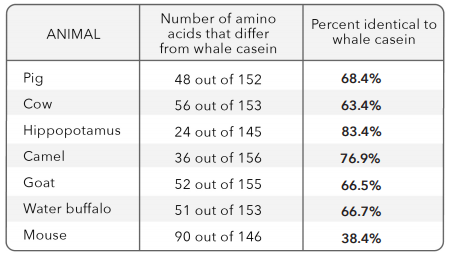
The table above describes the amino acid comparison between seven different animals. All of the amino acids compared are used to build the protein casein.
Which organism is most closely related to the whale?
Which organism is least related to the whale?
Why do you think DNA evidence is the best evidence for determining how related organisms are?
The more closely organisms are , the more similar their is, the more similar their amino acids are, and the more similar their are!
proteins
Similarities among different species can show two different kinds of relationships, both of which support evolution and natural selection. These similar structures are known as homologous structures and analogous structures.
Similarities shared by closely related species (species who share many characteristics) are homologous, because the species have descended from a common ancestor which had that trait. Homologous structures may or may not serve the same function. Figure below shows the forelimbs of mammals, considered homologous because all mammals show the same basic pattern: a single proximal bone joins a pair of more distal bones, which connect to bones of the wrist, “hand,” and digits. With this basic pattern, bats build wings for their lives in the air, whales form fins for their lives in the sea, and horses construct long, hoofed legs for speed on land. Therefore, homologous structures support common ancestry.
The image above shows three types of swimming animals - sharks, penguins, and dolphins. Is this an example of analogous or homologous structures?
The image above shows the limbs of four different organisms, all of which are used for different functions. Are these homologous or analogous structures?
Both the North American opossum and Australian kangaroo carry their young offspring in a pouch until they are fully developed. The fact that these organisms have similar structures suggests which of the following?
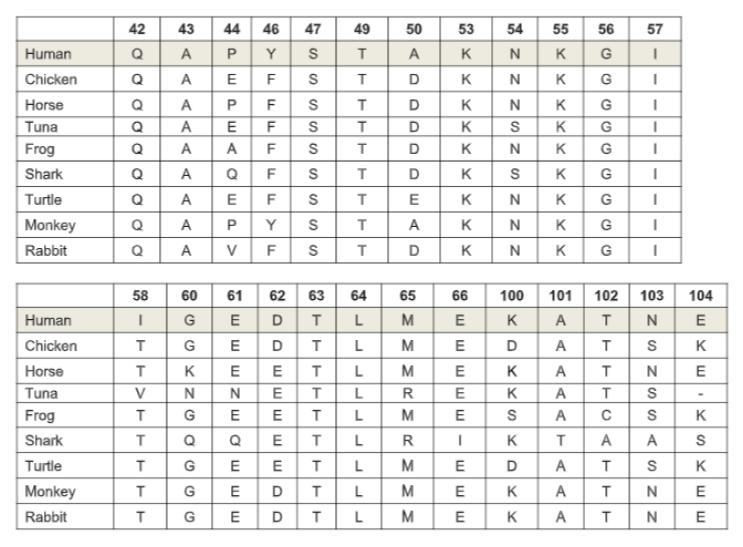
Based on Cytochrome C data, which organism is most closely related to humans?
USING THE CHART, How would you decide which organism is more closely related to humans?
Fossils are preserved remains or traces of organisms that lived in the past. They provide extremely rare but vivid windows into the past. Because most parts of organisms decompose rapidly following death, fossilization is an exceptionally uncommon occurrence and usually preserves only hard body parts such as bones.
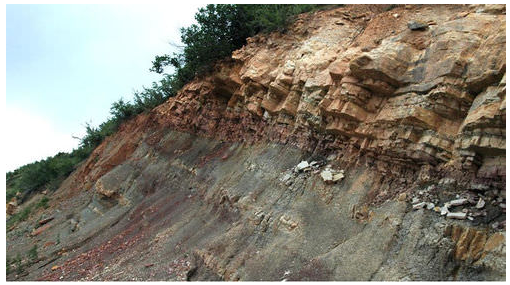
If the rock layers are undisturbed, the deepest layers are the oldest and layers near the surface are the youngest, shown in Figure below. Widespread, short-lived index fossils can help identify rock layers of the same age spread around the Earth. By combining worldwide observations of relative position and composition, a Geologic Time Scale for the Earth can be seen – a column of rock layers which reflects the history of sedimentary rock formation and changing life, stretching back to a time which apparently held no life. The fossil record showed patterns which, combined with his observations of living species, led Charles Darwin to conclude that all life on Earth descended from a single, simple common ancestor.
The formation of fossils is a common event.
When comparing fossil layers, the bottom layers are the oldest.
Structures which are reduced and are perhaps even nonfunctional, such as the human tail and the human appendix, are considered vestigial structures. The tail, of course, functions for balance in many mammals, and the human appendix may have served
digestive functions in herbivorous ancestors. Whales, which evolved from land mammals, do not have legs or hair as adults; both begin to develop in embryos, but then recede. Vestigial leg bones remain, buried deep in their bodies, shown in the figure below.

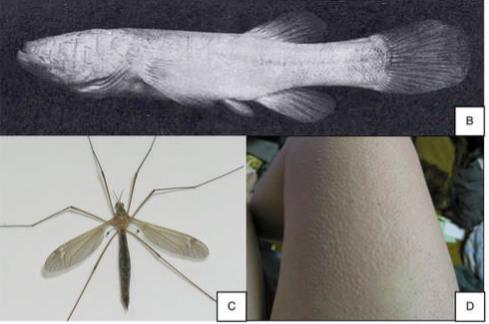
True flies have reduced the second pair of wings found in most insects to halteres for balance shown in Figure C below. Cavefish lose both eyes and pigment, because both would require energy to create, and they are useless in the lightless habitats of caves, as shown in Figure B below. You are probably very familiar with this fine example of a vestigial behavior: goosebumps raise the sparse hairs on your arms even though they are no longer sufficiently dense to insulate you from the cold by trapping warm air next to your skin; in most mammals, this reflex is still quite functional, as shown in Figure D below. Most vestigial structures are homologous to similar, functioning structures in closely related species and, as such, support both common ancestry and natural selection.

What is a vestigial structure?
Give 2 examples of vestigial structures.
How are vestigial structures an example of evidence of evolution?
For each non-human animal, count any amino acids that are different than the human's sequence. When you finish, record how many differences you found in the questions to the right.
Count the Number of Amino Acid Differences of the Human to the Horse
Count the Number of Amino Acid Differences of the Human to the Chicken
Count the Number of Amino Acid Differences of the Human to the Tuna
Count the Number of Amino Acid Differences of the Human to the Frog
Count the Number of Amino Acid Differences of the Human to the Shark
Count the Number of Amino Acid Differences of the Human to the Turtle
Count the Number of Amino Acid Differences of the Human to the Monkey
Count the Number of Amino Acid Differences of the Human to the Rabbit