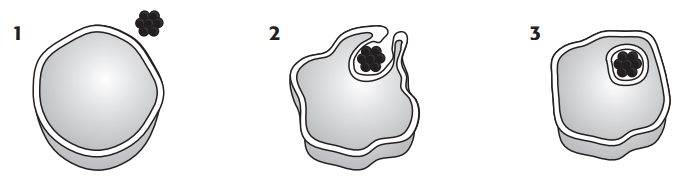
The illustration above shows a cell and a large particle. Many substances, such as proteins and polysaccharides, are too large to be transported into a cell by carrier proteins. In a process called endocytosis, the large particle is brought into the cell. Which of the following statements correctly summarizes this process?
The illustration above shows a cell and a large particle. Many substances, such as proteins and polysaccharides, are too large to be transported into a cell by carrier proteins. In a process called endocytosis, the large particle is brought into the cell. Which of the following statements correctly summarizes this process?