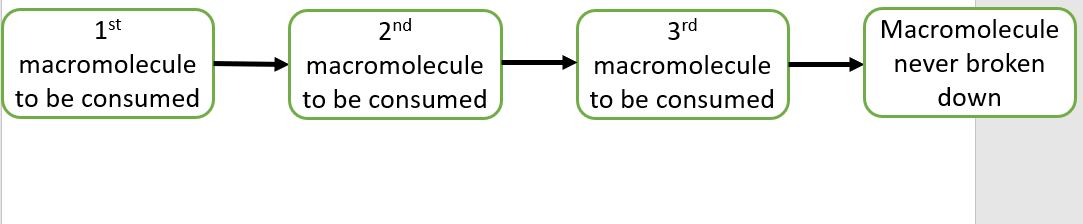
Place the following provided macromolecules in order in which they would be consumed by the body for energy.
Mmuae Afoforo a Wobɛpaw:
Nucleic Acid
Polymer
Protein
Inorganic
Lipid
Carbohydrate
Organic
Monomer
The macromolecules that make up the majority of the cell membrane’s structure are _______________.
Match the correct macromolecule to its identifying characteristic.
| Draggable item | arrow_right_alt | Corresponding Item |
|---|---|---|
carbohydrate | arrow_right_alt | it contains CHON |
lipids | arrow_right_alt | it contains CHO and has a 1:2:1 ratio |
proteins | arrow_right_alt | it contains CHONP |
nucleic acids | arrow_right_alt | it contains CHO |
Place the following provided macromolecules in order in which they would be consumed by the body for energy.
Animals store most of their excess energy reserves as ___________________ because…
If the activation energy of a biochemical reaction is lowered, then
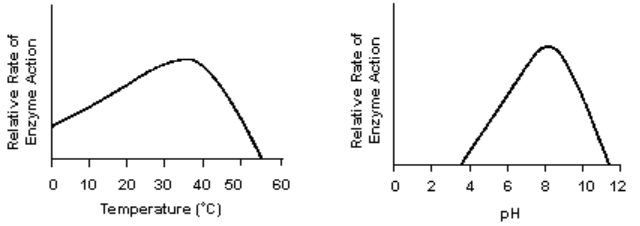
Which statement best describes the enzyme represented in the graphs?
Categorize the following items into their corresponding macromolecules. Each characteristic is used once.
Glucose is a type of this macromolecule.
Glycerol and fatty acids are monomers of this macromolecule.
Cushions our organs.
Sugars, starches, and cellulose.
Nucleotides are the monomer of this macromolecule.
Amino acids connected by peptide bonds create this macromolecule.
Enzymes are this type of macromolecule
Built from monosaccharides
DNA and RNA
Carbohydrate
Lipid
Protein
Nucleic Acid
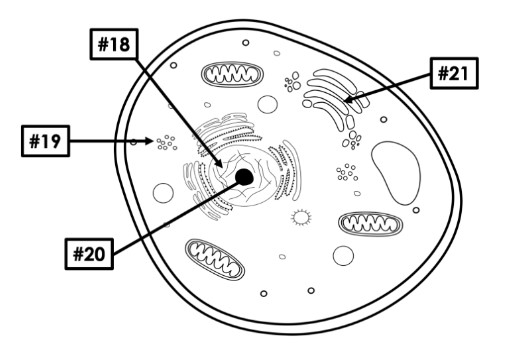
Categorize the following items that fit into either prokaryotes or eukaryotes.
Fungi
Bacteria
No true nucleus is present instead nucleoid region is present.
Plants
Animal
Do not contain membrane bound organelles.
Prokaryotes
Eukaryotes
You observe a cell under the microscope that has a plasma membrane, ribosomes, and a flagellum. It does not have a nucleus or mitochondria. What type of cell is this?
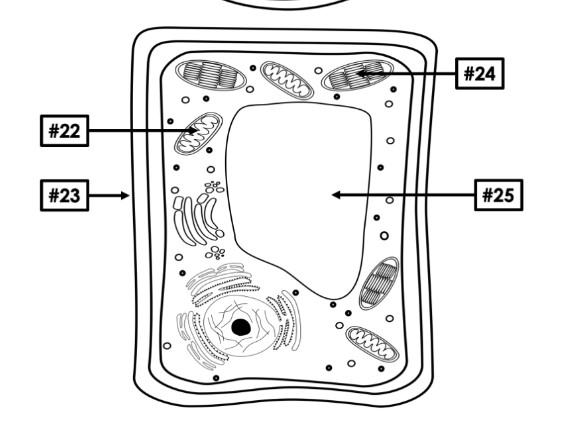
Which of the following organelles or material is NOT found in all types of cells?
| Draggable item | arrow_right_alt | Corresponding Item |
|---|---|---|
Clear gel like fluid in cells that holds the organelles | arrow_right_alt | Prokaryote |
Storage for the cell | arrow_right_alt | Eukaryote |
Where proteins are made | arrow_right_alt | cytoplasm |
Cell with no nucleus or membrane bound organelles | arrow_right_alt | Lysosome |
Contains digestive enzymes to break down harmful substances | arrow_right_alt | Vacuole |
Cell with membrane bound organelles and a nucleus | arrow_right_alt | Ribosome |
| Draggable item | arrow_right_alt | Corresponding Item |
|---|---|---|
Firm, fairly rigid structure found outside of plant cells for support | arrow_right_alt | Flagella |
Organelle of the cell that creates lipids (fats) | arrow_right_alt | Cilia |
Short numerous hair-like projections that move in wave patterns for movement. | arrow_right_alt | Cell membrane |
Organelle that hugs the nucleus and has ribosomes attached to it | arrow_right_alt | Cell Wall |
Long hair-like projection used for movement in cells; uses a whip like motion | arrow_right_alt | Smooth ER |
Serves as a semi-permeable boundary between the cell and its environment | arrow_right_alt | Rough ER |
| Draggable item | arrow_right_alt | Corresponding Item |
|---|---|---|
Organelle in plants that uses light energy to make glucose in a process called photosynthesis | arrow_right_alt | Centrioles |
Aids in cell division (only in animal cells) | arrow_right_alt | Nucleus |
Breaks down food into usable energy in a process called cellular respiration | arrow_right_alt | Nucleolus |
Where ribosomes are formed | arrow_right_alt | Chloroplast |
Where DNA is stored in a eukaryotic cell | arrow_right_alt | Mitochondria |