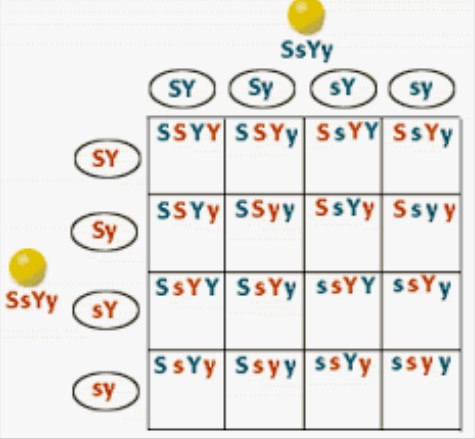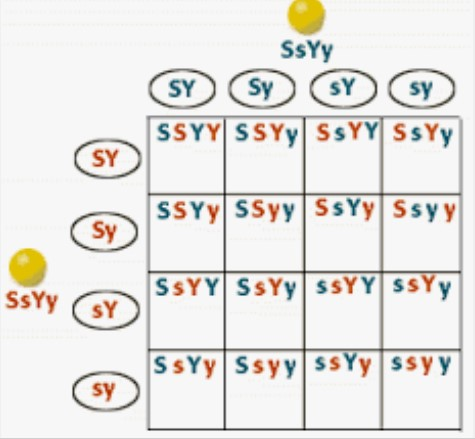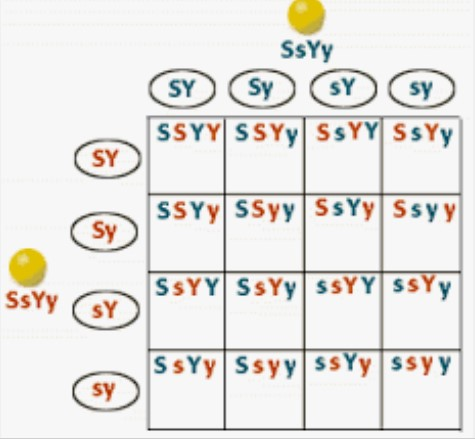
The picture shows what type of cross?
The picture shows what type of cross?
| Draggable item | arrow_right_alt | Corresponding Item |
|---|---|---|
dominant | arrow_right_alt | both alleles for a trait are the same (aka Purebred) |
heterozygous | arrow_right_alt | trait that is always expressed or shown in present (capital letter) |
homozygous | arrow_right_alt | alleles for a trait are different (aka hybrid) |
| Draggable item | arrow_right_alt | Corresponding Item |
|---|---|---|
recessive | arrow_right_alt | physical appearance |
genotype | arrow_right_alt | trait that is not expressed or shown unless the dominant allele is not present at all (lower case letter) |
phenotype | arrow_right_alt | genetic make-up (the letters) |
tt
Tt
HH
Hh
Homozygous
Heterozygous
Yellow color (Y) is dominant to Blue (y).
Tall (T) is dominant to Short (t).
| Draggable item | arrow_right_alt | Corresponding Item |
|---|---|---|
TT | arrow_right_alt | yellow- homozygous dominant |
yy | arrow_right_alt | short - homozygous recessive |
Tt | arrow_right_alt | yellow heterozygous |
Yy | arrow_right_alt | tall- homozygous dominant |
YY | arrow_right_alt | blue - homozygous recessive |
tt | arrow_right_alt | tall heterozygous |
| Draggable item | arrow_right_alt | Corresponding Item |
|---|---|---|
Nucleic Acid | arrow_right_alt | A segment of DNA on a chromosome that codes for a specific trait |
Gene | arrow_right_alt | a threadlike structure of nucleic acids and protein found in the nucleus of most living cells, carrying genetic information in the form of genes. |
Chromosome | arrow_right_alt | a monomer of nucleic acids made up of a 5-carbon sugar, a phosphate group, and a nitrogenous base |
Nucleotide | arrow_right_alt | a macromolecule containing hydrogen, oxygen, nitrogen, carbon, and phosphorus (DNA and RNA) |
| Draggable item | arrow_right_alt | Corresponding Item |
|---|---|---|
Sexual reproduction | arrow_right_alt | An organism or cell having only one complete set of chromosomes. |
Meiosis | arrow_right_alt | an organism or cell having two sets of chromosomes or twice the haploid number |
Diploid | arrow_right_alt | A reproductive process that involves two parents that combine their genetic material to produce a new organism, which differs from both parents |
Haploid | arrow_right_alt | Cell division that produces reproductive cells in sexually reproducing organisms |
| Draggable item | arrow_right_alt | Corresponding Item |
|---|---|---|
Codon | arrow_right_alt | it's a single-stranded nucleic acid that contains the sugar ribose |
RNA (ribonucleic acid) | arrow_right_alt | a self-replicating material present in nearly all living organisms. It is the carrier of genetic information. |
Amino acid | arrow_right_alt | Process by which mRNA is decoded and a protein is produced |
DNA (deoxyribonucleic acid) | arrow_right_alt | Building blocks of protein |
Translation | arrow_right_alt | group of three bases on a mRNA molecule |
| Draggable item | arrow_right_alt | Corresponding Item |
|---|---|---|
Biotechnology | arrow_right_alt | An organism that is created when scientists take one or more specific genes from one organism and introduce them into another organism thus creating a new version |
sister chromatids | arrow_right_alt | A form of technology that uses living organisms, usually genes, to modify products, to make or modify plants and animals, or to develop other microorganisms for specific purposes. |
Fertilization | arrow_right_alt | Identical copies of a chromosome; full sets of these are created during the S subphase of interphase. |
GMO (genetically modified organism) | arrow_right_alt | Fusion of an egg and sperm cell |
The Father of Genetics, , discovered that traits are passed down from to . He used plants because they reproduce quickly and asexually and have obvious traits.
In cocker spaniels, the allele for black coats (B) is dominant over the allele for brown coats (b). If a brown cocker spaniel is crossed with a heterozygous black cocker spaniel, what are the alleles of both parents?
In cocker spaniels, the allele for black coats (B) is dominant over the allele for brown coats (b). If a brown cocker spaniel is crossed with a heterozygous black cocker spaniel, what percentage of puppies can be expected to have black fur?
A man and a woman both have freckles, which is a dominant trait. They have two children- one has freckles and one does not. What are the alleles of the parents?
A man and a woman both have freckles, which is a dominant trait. They have two children- one has freckles and one does not. What is the probability they have a child with no freckles?
DRAW A PUNNET SQUARE!!!
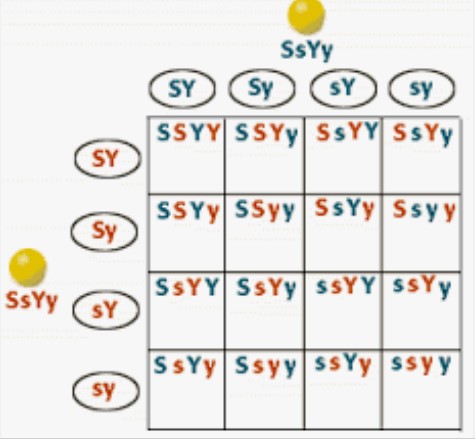
The picture shows what type of cross?
What are the chances of getting offspring that are heterozygous for smooth and yellow peas (SsYy)?
What are the chances of getting offspring that are wrinkled and green (yy and ss)?
What is the ratio among the following phenotypes below:
Round Yellow (Dominant Dominant)
Round Green (Dominant Recessive)
Smooth Yellow (Recessive Dominant)
Smooth Green (Recessive Recessive)
Match the description with the type of dominance.
Heterozygous is a blend of the two homozygous traits
Both traits are equally dominant
With chicken and black chicken make a black and white speckled chicken
Neither trait is dominant
Heterozygous shows both traits side by side
Red flower and white flower create a pink flower
Incomplete Dominance
Codominance
In horses, the allele for a bay coat and the allele for a cream coat can combine to make a buckskin coat (brown with black mane, tail, and legs). The allele BB is used for bay; CC is used for cream. Buckskin horses have one bay and one cream allele BC. The genotype BC makes a buckskin coat, as both alleles are dominant.
This inheritance pattern is called
In horses, the allele for a bay coat and the allele for a cream coat can combine to make a buckskin coat (brown with black mane, tail, and legs). The allele BB is used for bay; CC is used for cream. Buckskin horses have one bay and one cream allele BC.
Cross a bay stallion with a buckskin mare on scratch paper. Match the phenotype with the correct percentage for offspring.
In humans, there are four blood types: A, B, AB and O. The blood type is dependent on the type of antigen present on red blood cells (A, B, or both). Individuals that lack the antigens are type O. This is the recessive trait. A and B are both equally dominant and both antigens can be expressed, which results in AB blood type. This is an example of
The allele for red is R and the allele for white is W. In snapdragons, flower color is controlled by , where the heterozygous offspring are pink.
Hair color in certain breeds of horses can be Brown (B), White (W) or Palomino (a tan color resulting from the heterozygous genotype BW which shows incomplete dominance). Complete a cross between two palomino horses on scratch paper. What percentage of offspring would be white?
If a man who has heterozygous type A blood and a woman with type AB blood have offspring, what are the chances that they will have a baby with type O blood?
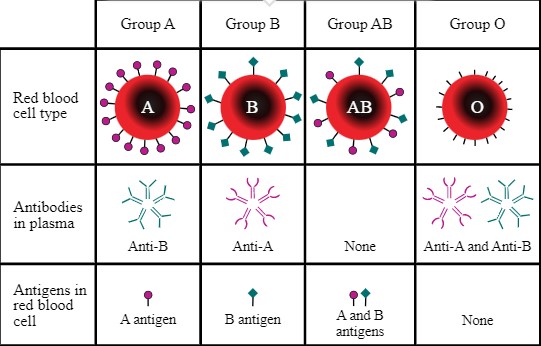
For each symbol below, determine if it is an affected male, unaffected male, affected female, or unaffected female by writing the best description next to each symbol.
| Draggable item | arrow_right_alt | Corresponding Item |
|---|---|---|
| arrow_right_alt | Unaffected female |
| arrow_right_alt | Affected female |
| arrow_right_alt | Carrier (does not have the trait but carries the allele for it) |
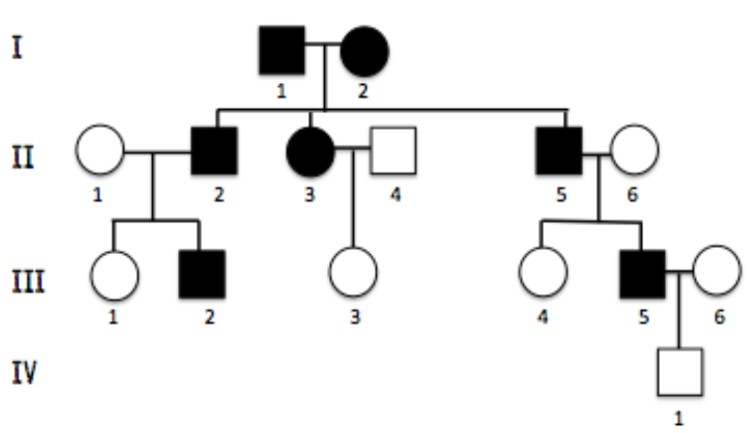
Is the pedigree above mostly likely a pedigree for a dominant or recessive trait?
What is the relationship between I-1 and III-3?
What are the genotypes for II-1, III-1, and IV-1?
| Draggable item | arrow_right_alt | Corresponding Item |
|---|---|---|
translocation | arrow_right_alt | a portion of the chromosome is removed |
inversion | arrow_right_alt | a piece of a chromosome is detached and relocated on another chromosome |
deletion | arrow_right_alt | part of a chromosome appears twice |
duplication | arrow_right_alt | a section of chromosome is flipped in the opposite direction |
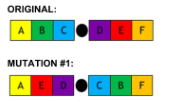
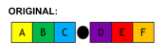
Mutation #1. What type of mutation is shown, when comparing this mutated chromosome with the original?
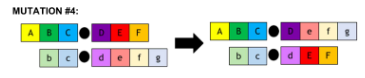
Mutation #4.
What type of mutation is shown, when comparing this mutated chromosome with the original?
Abnormalities could become more common
No genetic variation
Expensive
Rare animal species can be preserved
Increase rate of production and quality of products
Rapid Reproduction
Advantage of Asexual Reproduction (Cloning)
Disadvantage of Cloning
Farmer Brown grows corn for a living. His corn production has steadily declined over the past decade. One day, Farmer Green suggests to Farmer Brown that he should clone his highest-yielding corn plant in order to produce more ears of corn per plant next year. Farmer Brown is not sure about Farmer Green's idea as he has heard both positive and negative outcomes about cloning. Why might Farmer Brown be hesitant to clone his corn?
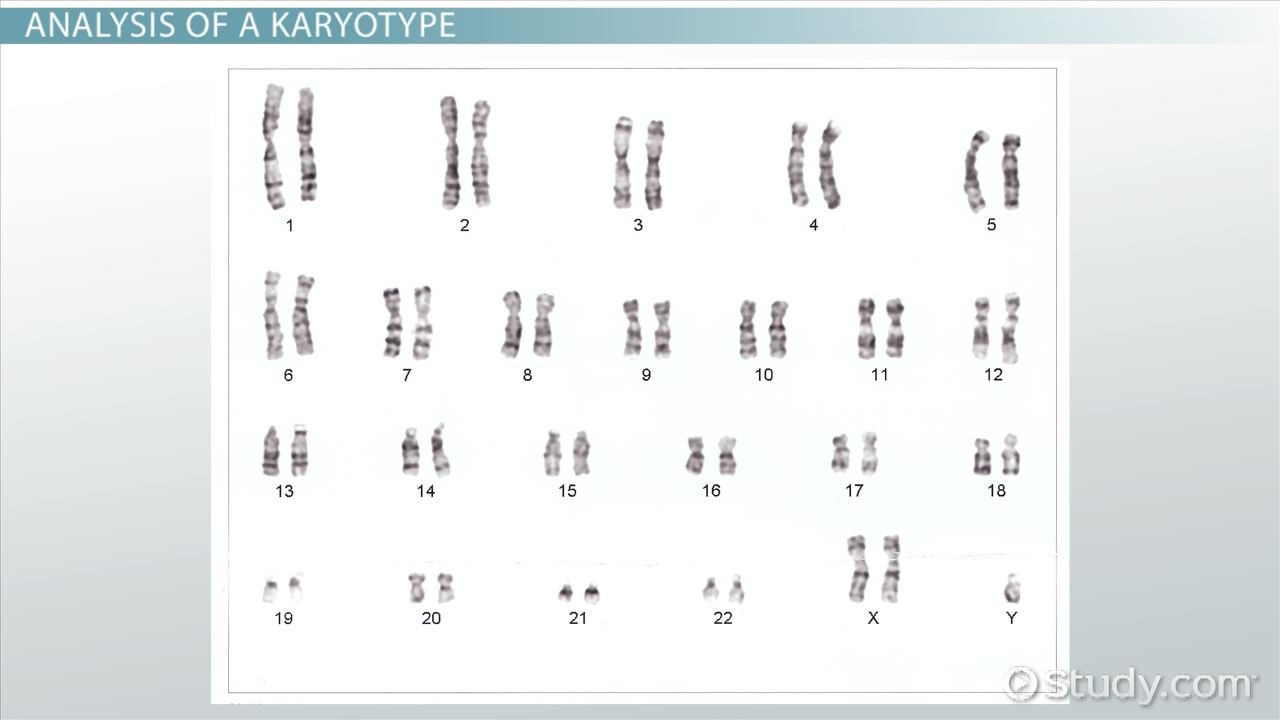
Nondisjunction occurred to cause an unequal division of chromosomes in the gametes. Here is a kayotype with a disorder. Where is this disorder located?