SB6. Obtain, evaluate, and communicate information to assess the theory of evolution.
Theory of Evolution – 17% of the EOC
SB6. Obtain, evaluate, and communicate information to assess the theory of evolution.
Ɛhia
6
Ɛhia
1
Ɛhia
1
Ɛhia
3
Ɛhia
1
Ɛhia
3
Ɛhia
2
Ɛhia
1
Ɛhia
5
Ɛhia
4
Ɛhia
1
Ɛhia
1
Ɛhia
1
Ɛhia
3
Ɛhia
3
Ɛhia
2
Ɛhia
3
Ɛhia
1
Ɛhia
6
1
Ɛhia
1
Ɛhia
1
Ɛhia
1
1
1
Ɛhia
9
Ɛhia
1
Ɛhia
1
Ɛhia
1
Asemmisa {{asɛmmisaAhyɛnsode}}
1.
Types of Evolution:
Match the following terms to their correct definition
Draggable item
arrow_right_alt
Corresponding Item
Divergent Evolution
arrow_right_alt
Evolution toward similar characteristics in unrelated species
coevolution
arrow_right_alt
When closely related species evolve in different directions, and become increasingly different
Convergent Evolution
arrow_right_alt
the process in which two or more species evolve in response to changes in each other.
Fossil Evidence of Evolution
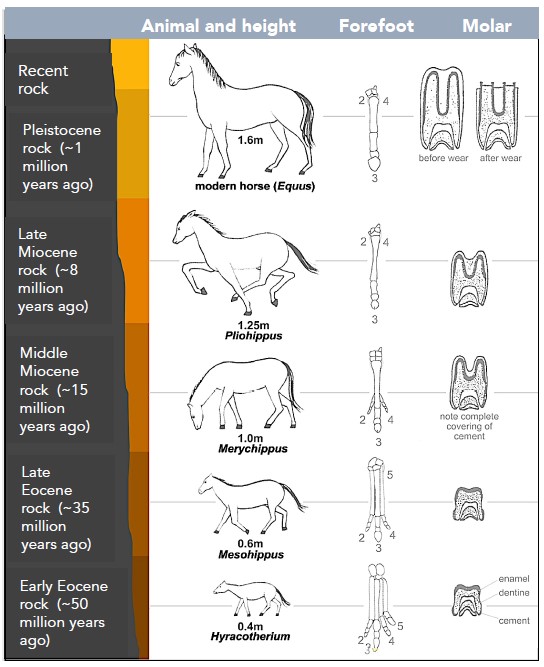
The diagram below represents the evolution of the horse from 50 million years ago until recently.
Ɛhia
3
Ɛhia
1
Asemmisa {{asɛmmisaAhyɛnsode}}
3.
Based on the information shown in the diagram to the left, the common
ancestor of the modern day horse and all the extinct, fossilized species in the
diagram is the (name of ancestor horse)
Ɛhia
1
Asemmisa {{asɛmmisaAhyɛnsode}}
4.
The evolution of the modern day
horse suggest a
Asemmisa {{asɛmmisaAhyɛnsode}}
5.
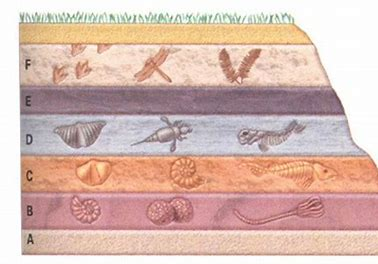
Which is TRUE concerning the relationship between the placement of the fossils (the layer of rock they are found in) and time?
Asemmisa {{asɛmmisaAhyɛnsode}}
6.
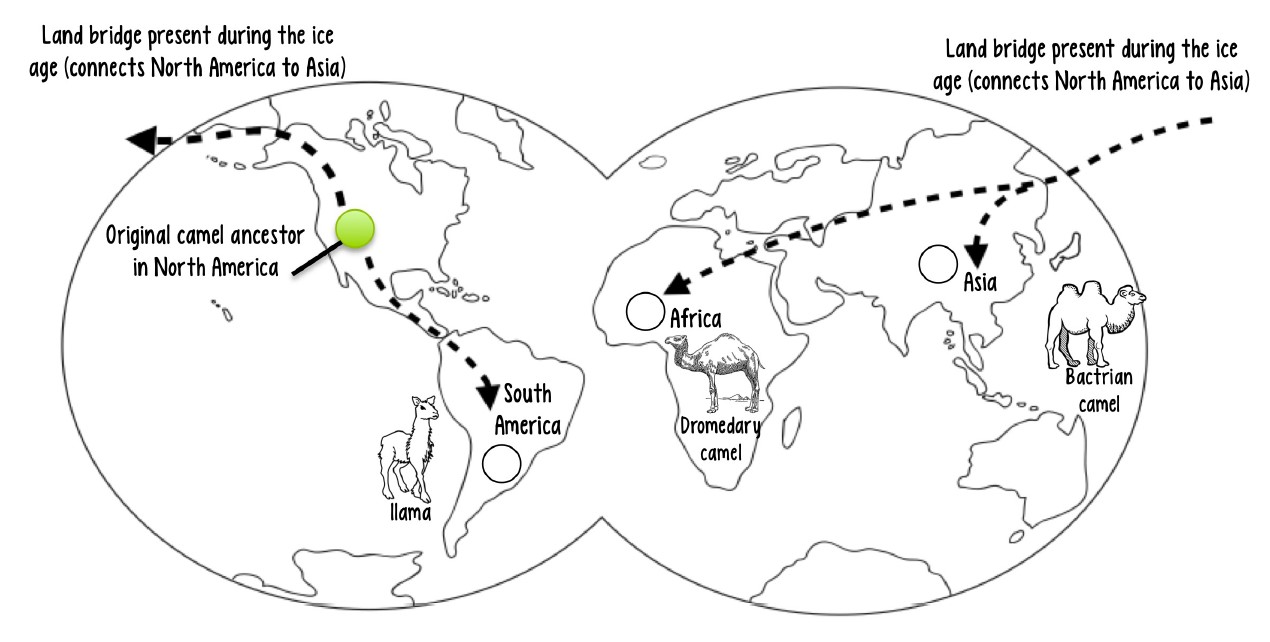
How does the camel example above support the theory of evolution? In other words, why would the migration of a single common ancestor to 3 different areas result in the formation of 3 different species?
Asemmisa {{asɛmmisaAhyɛnsode}}
7.
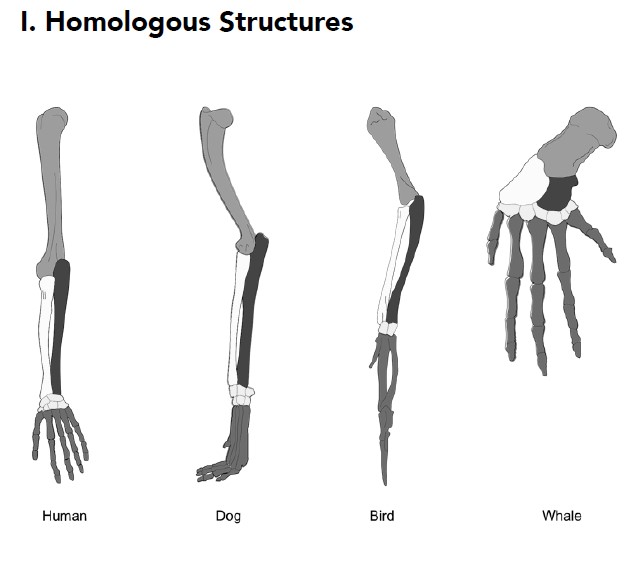
Part I:
A homologous structure like those shown above, is a shared structure among organisms that is is shape, pattern, and location.
Homologous structures that are shared among two or more organisms suggest that the organisms share a ancestor.
Part II:
The common ancestor of humans, dogs, birds, and whales most likely had phalanges (phalanges for humans are fingers).
Asemmisa {{asɛmmisaAhyɛnsode}}
8.
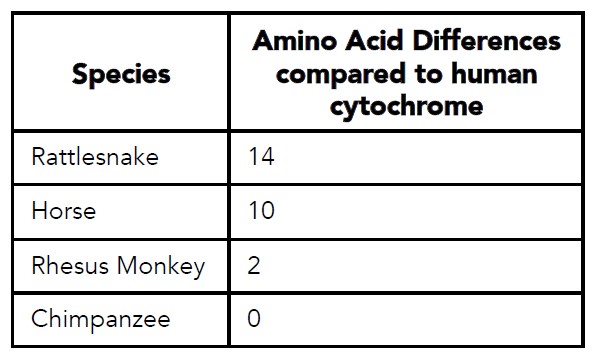
The chart below compares the amino acid sequence of human cytochrome to the amino acid sequence that codes for the cytochrome of other animals. Cytochrome is a protein found in blood.
Part I:
If the amino acid sequence is similar among two groups of organisms, what does that suggest about the shared DNA sequence?
Asemmisa {{asɛmmisaAhyɛnsode}}
9.
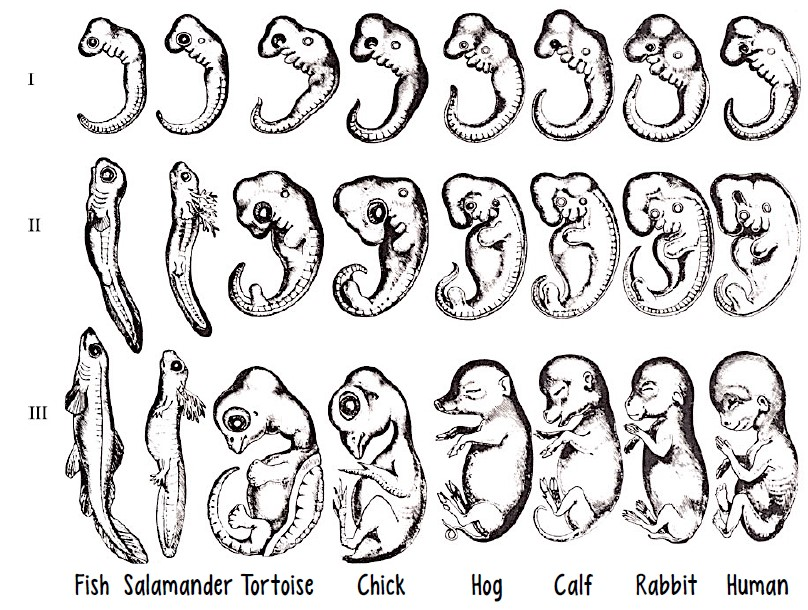
Match each structure below with the correct evidence of common descent among organisms.
Draggable item
arrow_right_alt
Corresponding Item
Pharyngeal pouches
arrow_right_alt
presence suggests all organisms share a vertebrate common ancestor.
Tailbone
arrow_right_alt
presence suggests all organisms share a common ancestor that once had gills.
Notochord
arrow_right_alt
presence suggests all organisms share a common ancestor that once had a tail.
Asemmisa {{asɛmmisaAhyɛnsode}}
10.
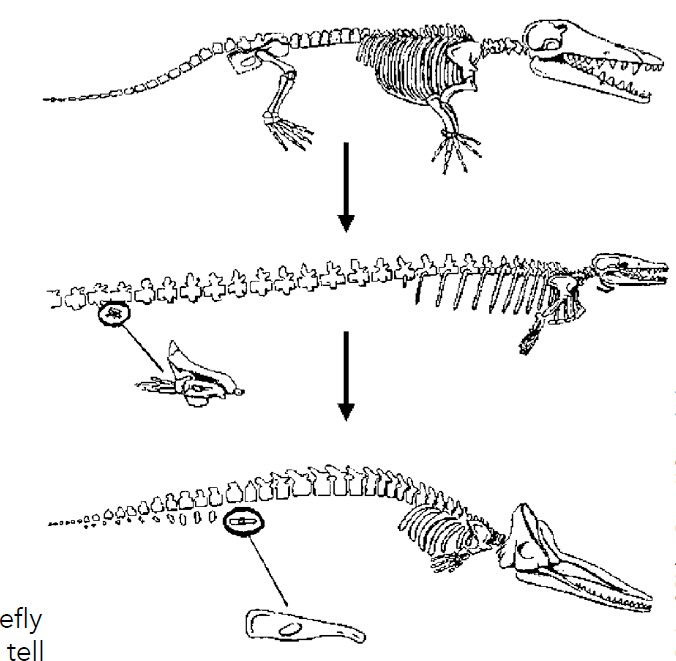
Vestigial structures are structures that an organism. These structures are present but often in size.
Asemmisa {{asɛmmisaAhyɛnsode}}
11.
Check off each structure that would be considered vestigial.
Asemmisa {{asɛmmisaAhyɛnsode}}
12.
Types of Evolutionary Forces:
Match the following mechanisms of evolution to their correct description.
Draggable item
arrow_right_alt
Corresponding Item
Natural Selection
arrow_right_alt
changes in allele frequencies causing a loss of genetic diversity in a population.
Mutation
arrow_right_alt
The movement of alleles from one population
to another
Sexual Selection (Non-Random Mating)
arrow_right_alt
random changes in DNA resulting in new alleles.
Genetic Drift
arrow_right_alt
occurs when certain traits increase reproductive success.
Gene Flow
arrow_right_alt
a mechanism by which individuals that have inherited beneficial adaptations show differential reproductive success.
Asemmisa {{asɛmmisaAhyɛnsode}}
13.
Match the mechanism of evolution to the correct scenario described.
Draggable item
arrow_right_alt
Corresponding Item
Gene flow
arrow_right_alt
The influenza virus comes in different forms. Type A influenza can have slightly different protein structures, which may confuse our immune systems. The slightly different proteins are produced by the accumulation of mutations in the genes that code for these particular proteins.
Genetic drift
arrow_right_alt
During an earthquake, a small group of deer are sepearated from their herd. A long distance away they find a new population of deer and begin interbreeding with the new deer.
Sexual Selection (Recombination)
arrow_right_alt
During a forest fire, a population of rabbits is greatly affected and most of the population dies. This changes the allelic frequency of the population.
Mutation
arrow_right_alt
A random change in the sequence of genes during egg and sperm production produces offspring that are phenotypically different than most of the population.
Asemmisa {{asɛmmisaAhyɛnsode}}
14.
Which of the following describes the relationship among evolutionary mechanisms and genetic diversity?
Asemmisa {{asɛmmisaAhyɛnsode}}
15.
Which of the following describes the relationship among evolutionary mechanisms and natural selection?
Asemmisa {{asɛmmisaAhyɛnsode}}
16.
Natural selections acts upon by selecting the most "fit" traits for the environment.
Asemmisa {{asɛmmisaAhyɛnsode}}
17.
True or Flase: Mark whether the statement is true or flase concerning Natural Selection.
True
False
Competition is a factor of natural selection.
Genetic variation is a factor of natural selection.
Individuals among a population that are better adapted to their environment leave more
offspring.
Asemmisa {{asɛmmisaAhyɛnsode}}
18.
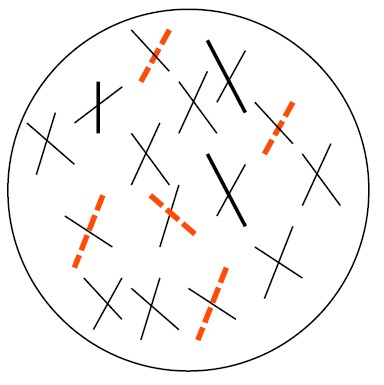
Part I:
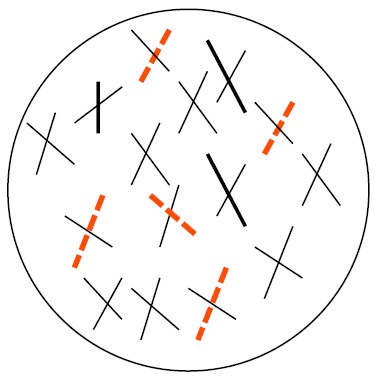
In this population, each individual is represented by an "X" to indicate that the individual has 2 alleles for a gene. There are (#) total alleles in the population sample pictured above. (#) of these alleles are dashed.
The allelic frequency or how often the dashed allele occurs is % (divide number of dashed alleles present by total number of alleles, then multiply by 100 and round to the nearest whole number)
Asemmisa {{asɛmmisaAhyɛnsode}}
19.
Part 2: Suppose that a virus outbreak occurred within the population reflected above. The dashed allele codes for a protein that is present on the cell membrane. The viruses cannot attach to this particular protein, therefore the individuals with the dashed allele are more likely to survive the outbreak. Those that do not possess the allele are more likely to die.
After the outbreak, all of those individuals that contain the dashed allele survived. Half of those that did not contain the dashed allele died off.
Within this population, the allelic frequency of the dashed population (with the mutation) will . This is an example of natural selection because the member(s) of a population with a trait best suited for the environment are likely to survive and pass on those traits to their offspring.
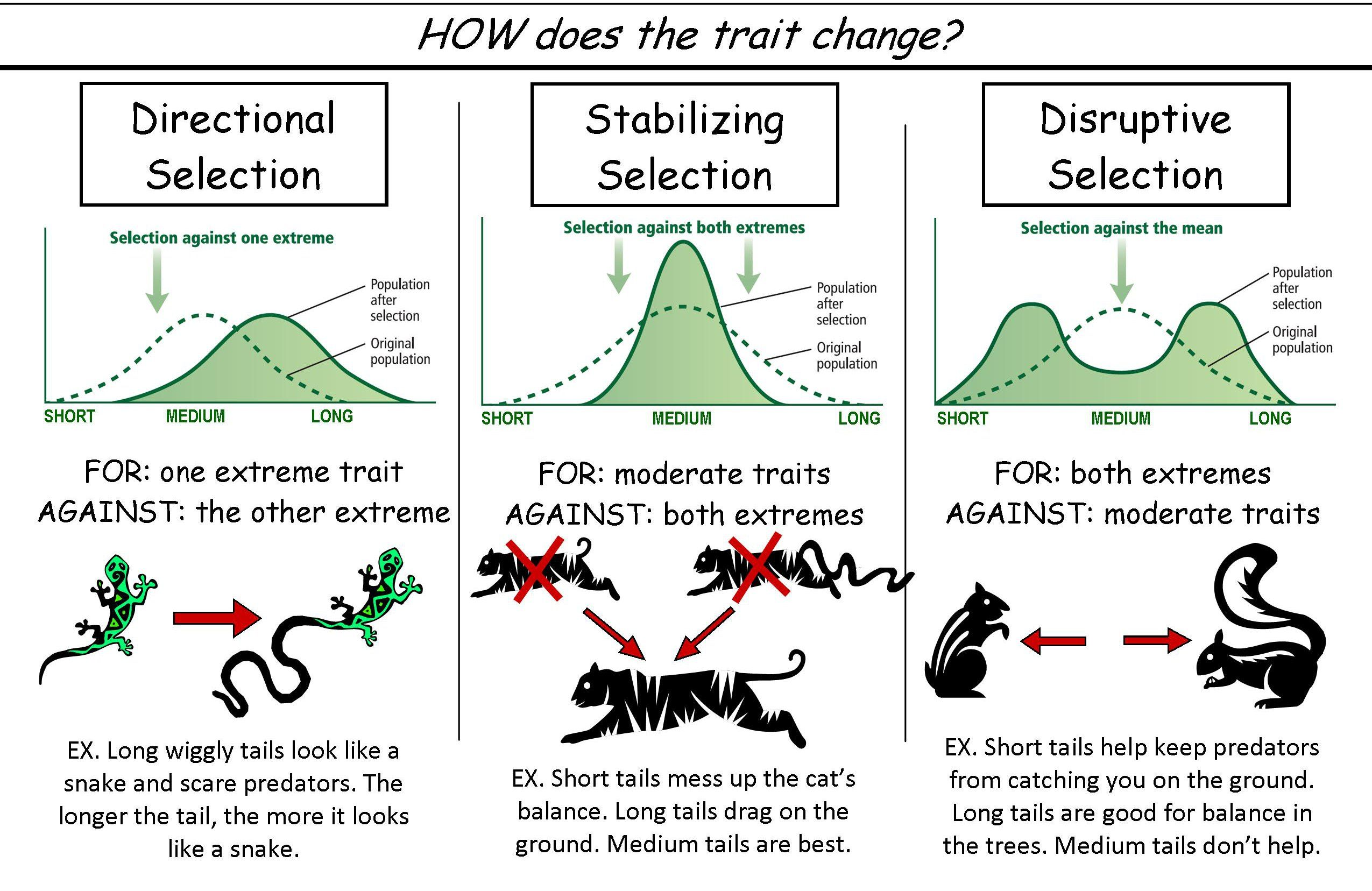
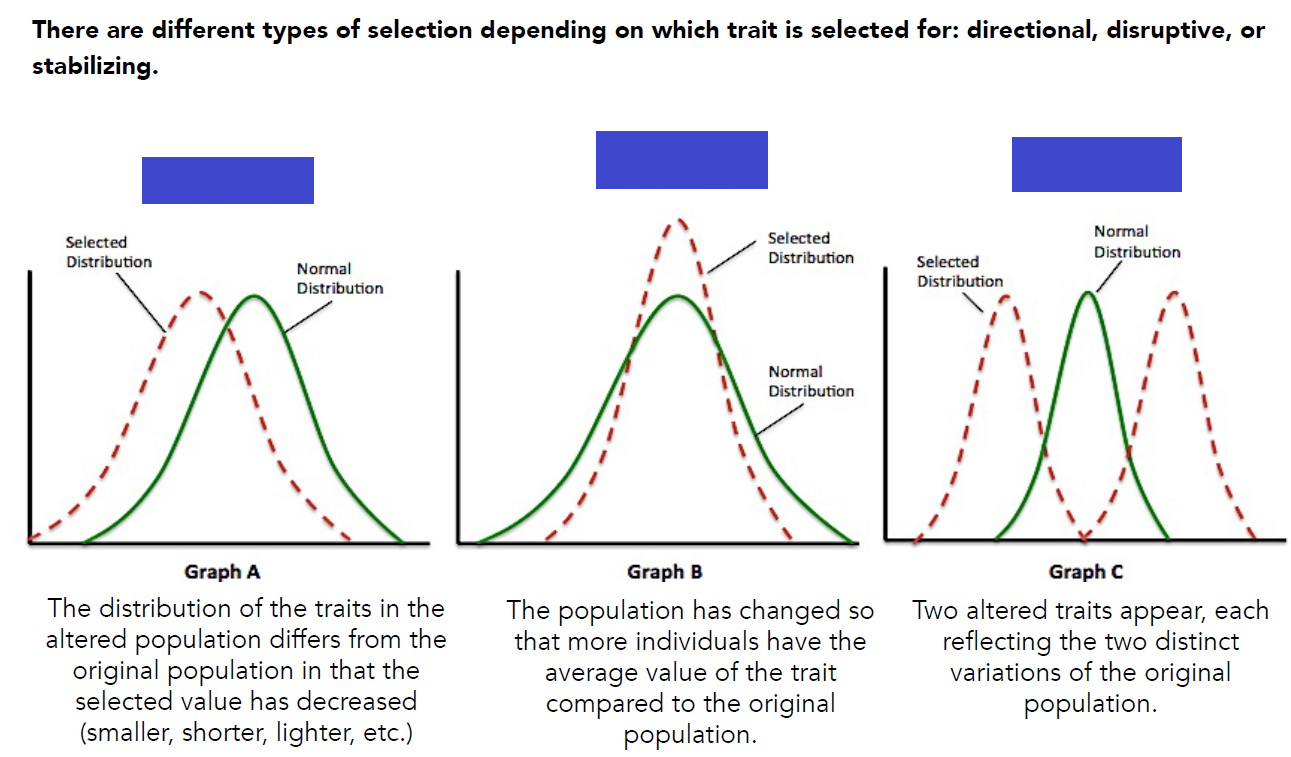
Types of Natural Selection
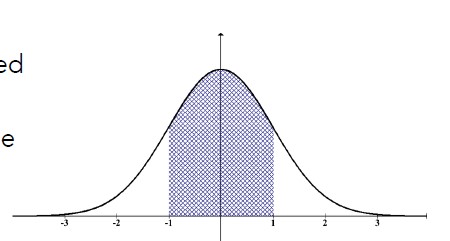
Normal distribution is a type of trait distribution that forms a bell-shaped curve when graphed, because most of the population has the average trait, with the extreme versions of the trait found in fewer members of the population. Human height, for example, would have most people at an average height, and very short or very tall humans would account for a smaller percentage.
Match each scenario described below, to the type of selection that is occurring:
Draggable item
arrow_right_alt
Corresponding Item
Stabilizing
arrow_right_alt
A large valley is flooded and a population of lizards is separated. Over time, they travel in opposite directions to two different places and eventually become so different they can no longer interbreed.
Disruptive
arrow_right_alt
In a population of wheat, variation in the height of the wheat decreases over time.
Directional
arrow_right_alt
In a population of field mice, there are many variations of brown, ranging from a
very light brown to a very dark brown. The population becomes more of a medium-brown over time, as individuals that best blend in to their surroundings are favored.
Asemmisa {{asɛmmisaAhyɛnsode}}
21.
Mmuae Afoforo a Wobɛpaw:
disruptive
stabilizing
directional
Asemmisa {{asɛmmisaAhyɛnsode}}
22.
Adaptation is a process by which a species becomes better suited to its environment. It is the result of natural selection acting upon heritable variation over many generations. Adaptation can also refer to a feature or trait that helps an organism survive, reproduce, and function optimally. Adaptation can occur within an organism's lifetime (physiological adaptation) or across many generations (evolutionary adaptation).
For each description below, determine if it is an adaptation or not.
Adaptation
Not an adaptation
Birds have adapted flight.
Orchid mantises resemble orchids, an example of camouflage so that the are not easily detected by their prey.
Humans breed cattle so that they are larger in size for meat production.
Snakes lost their legs to better fit into tighter spaces or holes in the ground to escape predators.
Dandelion seeds are designed to be carried by the wind randomly.
Humans breed dogs based on favorable traits to create the perfect companions.
Asemmisa {{asɛmmisaAhyɛnsode}}
23.
Natural selection plays a role in diversity because it favors certain , which may result in an . These adaptations give rise to the diversity of life and the development of new .
Mmuae Afoforo a Wobɛpaw:
adaptation
traits
species
Asemmisa {{asɛmmisaAhyɛnsode}}
24.
An example of co-evolution:
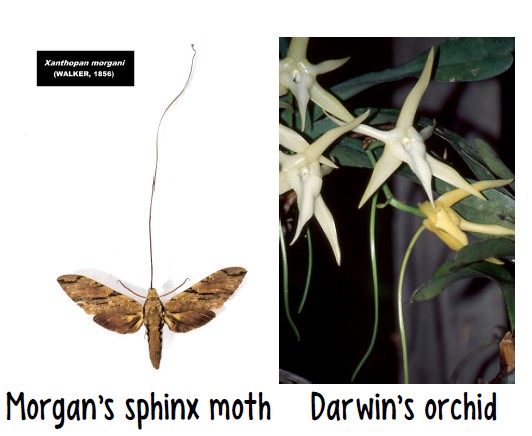
Morgan’s sphinx moth, or Xanthopan morganii, is a moth found in Madagascar that has a long proboscis. The Morgan sphinx moth feeds on an orchid called Darwin’s orchid, which has a very long nectar producing tube, and most insects cannot reach the nectar.
Early ancestors of Morgan’s sphinx moth had a variation in the length of their proboscis- some were shorter than others. The moths with shorter proboscis’ most likely competed for food sources with other insects. However, the moths that had longer proboscis’ were able to get nectar from Darwin’s orchid.
Complete the sentence below based on the moth scenario above to design an explanation that indicates the relationship between adaptations and natural selection.
The sphinx moths with probiscus had access to a food source with which they had competition and improved their ability to and reproduce.
Asemmisa {{asɛmmisaAhyɛnsode}}
25.
Some organisms have genes that improve their ability to survive and reproduce. If the genes also help their offspring survive and reproduce, then which of the following will most likely increase?
Asemmisa {{asɛmmisaAhyɛnsode}}
26.
Hardy Weinberg Principle
The Hardy Weinberg principle states that the allelic frequencies of a population unless an evolutionary force is acting upon it. When the allelic frequencies of a population are stable, the population is said to be in genetic equilibrium. If there is a change in the genetic equilibrium, then the population is evolving.
Match the vocabulary terms with the corresponding definitions.
Draggable item
arrow_right_alt
Corresponding Item
nonrandom mating
arrow_right_alt
can lead to new phenotypes and alter the allelic frequencies
gene flow
arrow_right_alt
allelic frequencies are altered by chance events, such as natural disasters. This usually has the greatest effect on small populations
mutation
arrow_right_alt
movement of individuals into or out of a population
natural selection
arrow_right_alt
a form of sexual selection in which individuals with similar phenotypes mate with one another more frequently than would be expected with a random mating pattern
genetic drift
arrow_right_alt
environment determines favorable conditions
Asemmisa {{asɛmmisaAhyɛnsode}}
27.
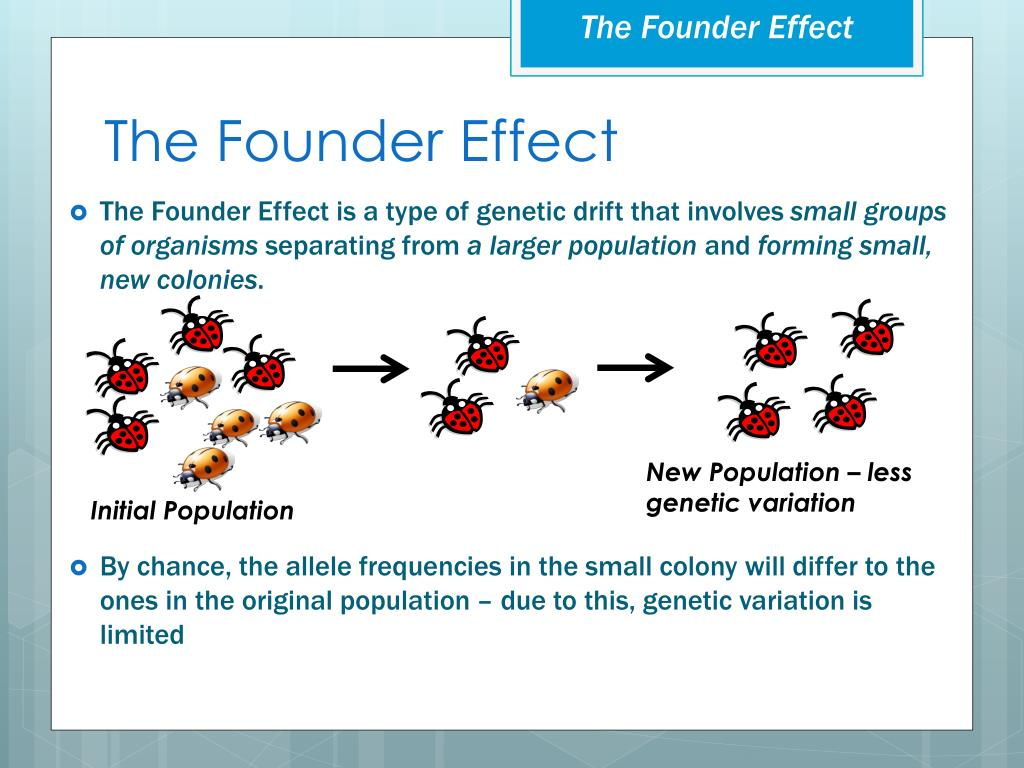
What is the founder effect in evolution?
Asemmisa {{asɛmmisaAhyɛnsode}}
28.
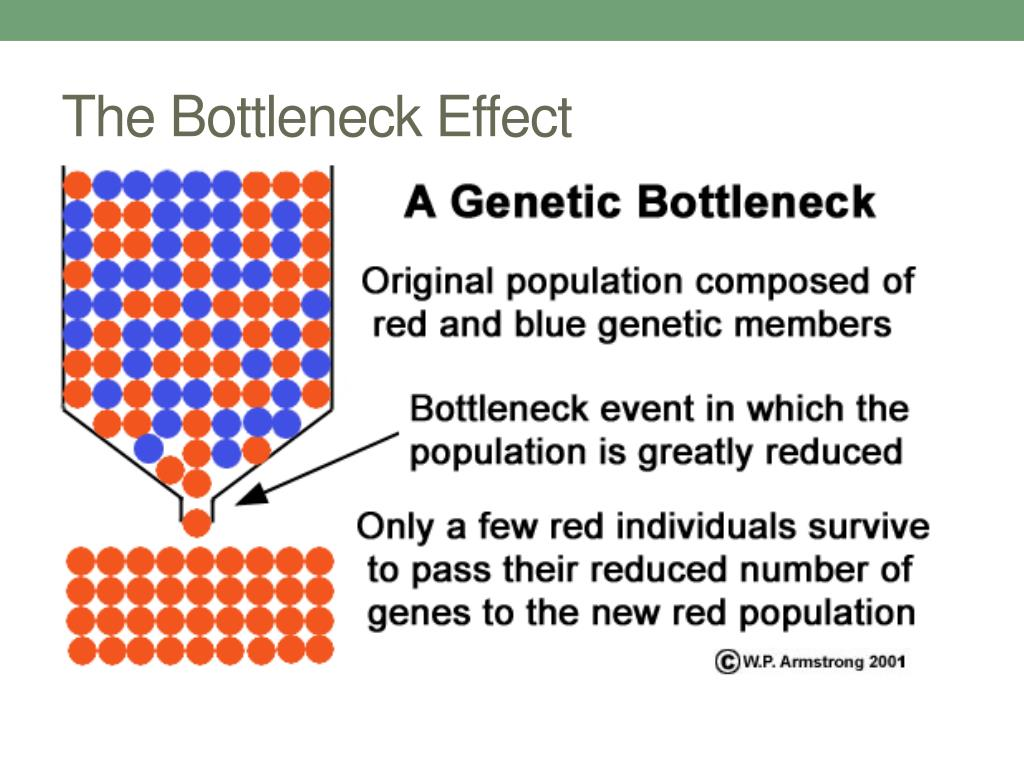
How does the bottleneck effect affect a population's genetic diversity?
Asemmisa {{asɛmmisaAhyɛnsode}}
29.
For each scenario described below, determine if evolution is occurring (Y/N). If so, list the evolutionary force from the table above that best fits the description.
A forest fire devastated a population of wild boars. The event randomly changed their allelic frequencies.
Is Evolution occurring? Possible evolutionary force:
A separate populations of two frogs have merged together which has brought new allelic frequencies.
Is Evolution occurring? Possible evolutionary force:
Over time, a large population of kangaroos are now choosing their mates based on how similar their potential mate’s height is to their own. This has changed the allelic frequencies to have fewer heterozygous individuals.
Is Evolution occurring? Possible evolutionary force:
A population of elk that have been experiencing a snowy tundra over the past 20 years. The elks with the white fur have higher chances of surviving. The population is now yielding more albino baby elks than ever before.
Is evolution occurring? Possible evolutionary force:
The allelic frequencies within a population of rabbits outside the Charles River in Boston has not changed for 50 years.
Is evolution occurring?
Asemmisa {{asɛmmisaAhyɛnsode}}
30.
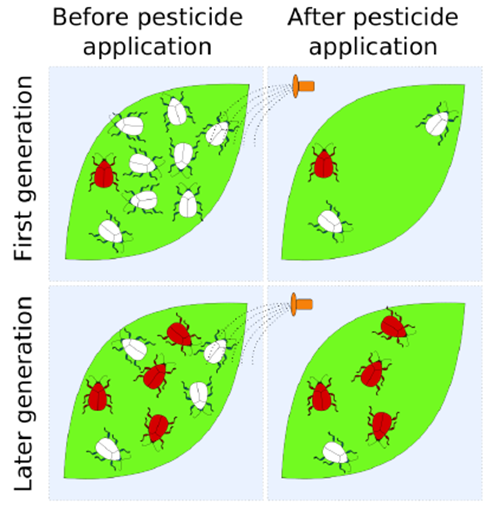
Within 10 years of the introduction of a new pesticide, nearly all of the descendants of the insects are resistant to the usual-sized dose.
What is the best explanation for this change?
Asemmisa {{asɛmmisaAhyɛnsode}}
31.
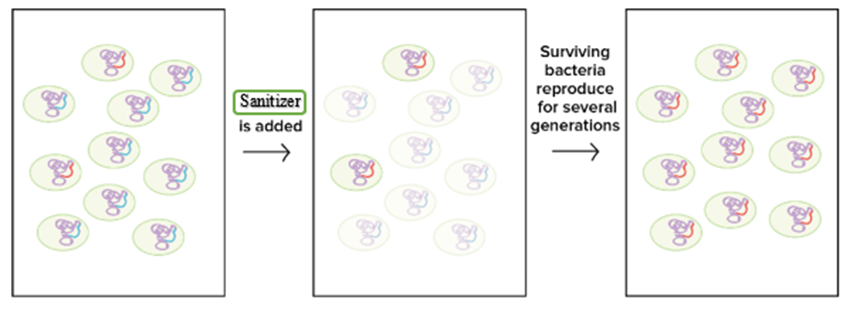
A population of bacteria is treated with hand sanitizer.
Because of genetic variation in the population, what is a possible outcome?
Asemmisa {{asɛmmisaAhyɛnsode}}
32.
This diagram represents a model of how bacteria become resistant to an antibiotic, allowing bacteria to survive treatment. Which of the following statements best explains how the indicated step in the model allows bacteria to develop resistance?
Asemmisa {{asɛmmisaAhyɛnsode}}
2.
Fossils can provide evidence for evolution for the following reasons (check all that apply):