6.4 Types of Evolution Lesson
star
star
star
star
star
Last updated 20 days ago
14 Nsɛmmisa
Hyɛ no nsow a efi ɔkyerɛwfo no hɔ:
1
1
1
1
1
1
1
1
1
Read through the PPT to review: Unit 7 Notes.pptx
Read through the PPT to review: Unit 7 Notes.pptx
**Understanding Evolution: Divergent, Convergent, and Coevolution**
Evolution is a fascinating process that explains how species change over time. Three important concepts in evolution are divergent evolution, convergent evolution, and coevolution.
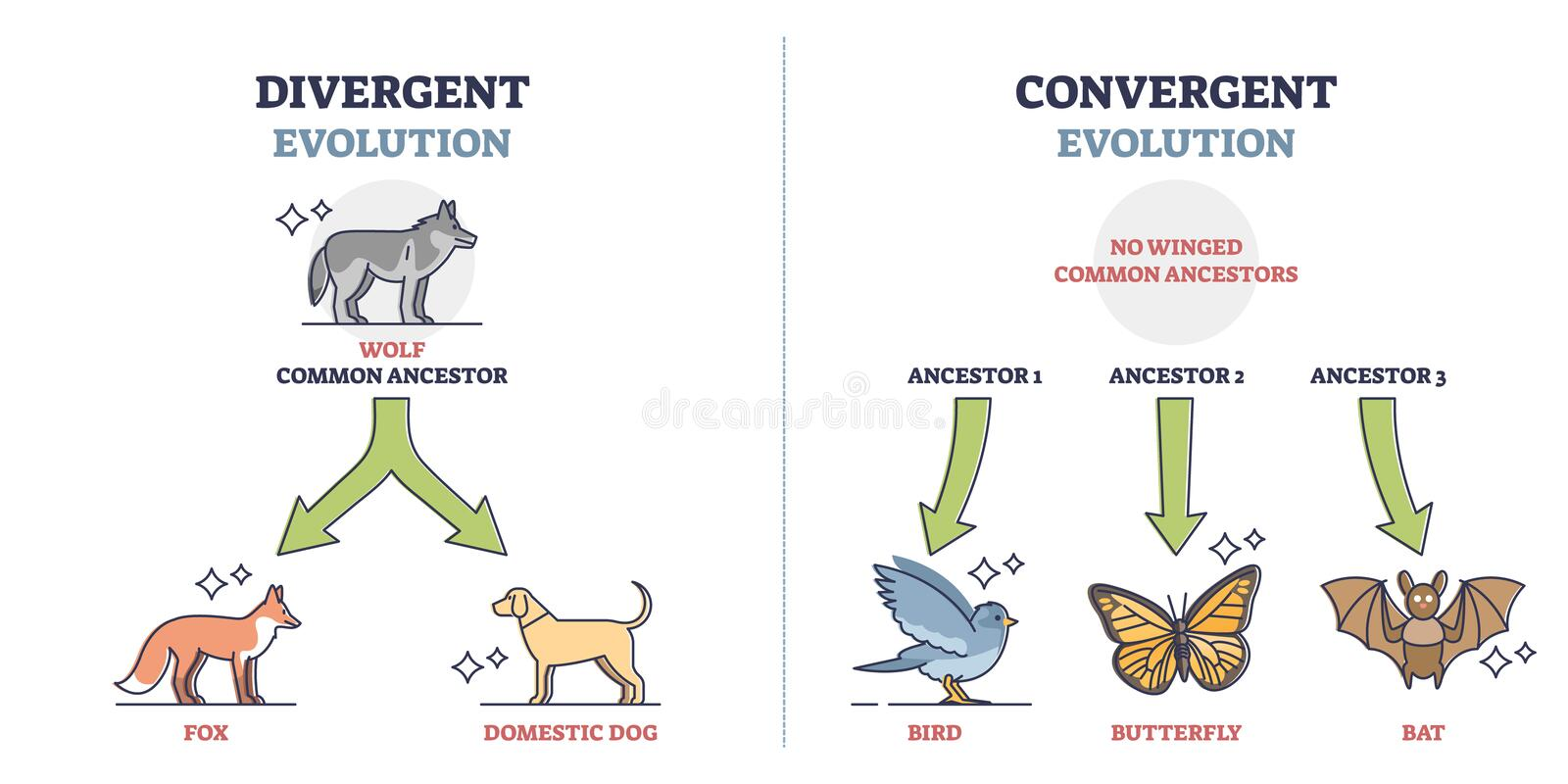
**Divergent Evolution** occurs when two or more related species become more different over time. This often happens when groups of organisms adapt to different environments. For example, consider the finches on the Galápagos Islands. These birds evolved from a common ancestor but adapted to various food sources. Some developed strong beaks for cracking nuts, while others evolved slender beaks for eating insects.
In contrast, **Convergent Evolution** happens when unrelated species develop similar traits because they adapt to similar environments or challenges. A classic example is the wings of bats and the wings of butterflies. Despite being from very different groups (mammals and insects), both have wings that allow them to fly, demonstrating how similar pressures can lead to similar adaptations.
Lastly, **Coevolution** refers to the process where two or more species influence each other’s evolution. A well-known example is the relationship between flowering plants and their pollinators, like bees. As flowers evolve to attract bees with vibrant colors and sweet nectar, bees, in turn, develop traits that help them access the nectar more efficiently.
In summary, while divergent evolution shows how species can become different from a common ancestor, convergent evolution highlights how unrelated species can develop similar features. Coevolution illustrates the dynamic interplay between species, shaping each other’s adaptations in response to their interactions. Understanding these concepts helps us appreciate the complexity of life on Earth.
What is the main characteristic of divergent evolution?
In the ocean surrounding Antarctica, there are fish that survive the cold water by using a molecule made of glycoproteins that circulates the blood and keeps it from freezing. Certain kinds of worms that live in the Arctic Ocean also make antifreeze proteins that help them live in icy water.
Ants are the correct size and weight needed to open the flowers for the peony plant. The peony plant provides food for the ant, and the ant fertilizes the peony’s flowers
A kit fox lives in the desert and has large ears with greater surface area that keep the fox from getting overheated. The red fox lives in the forest and has a red coat that keeps it camouflaged
Hummingbirds have a beak just the right length to reach the nectar in a cardinal flower and as they feed their foreheads bump into the pollen structure. Cardinal flowers are red which hummingbirds can see but bees can’t. Cardinal flower’s pollen structure is just the right length for the hummingbird to pick up pollen as it feeds.
The Galloti atlantica and Galloti galloti lizards evolved through natural selection from a common ancestor into a wide variety of different looking lizards.
Whales, sharks, and penguins all have streamlined bodies and fins/flippers for moving in water even though they belong in different classes of animals (mammals, fish, and birds)
The Galapagos tortoise shares a common ancestor but has necks of different lengths to best reach the food they need in their own environments.
This kind of evolution is proven by DNA analysis and results in organisms with different ancestors becoming more alike as they adapt to similar environments.
Bees don't see red, but do see yellow, blue, and ultraviolet light. Thus, bee-pollinated flowers are mostly yellow or blue with UV nectar guides (landing patterns) to guide the bee. They usually have a small, narrow floral tube to fit the tongue length of that species of bee.
Which of the following is an example of convergent evolution?
What does coevolution involve?