US.01 Explain how the Homestead Act and the Transcontinental Railroad impacted the settlement of the West.
Examine the following sources and then answer the exit ticket questions when you are finished.
Transcontinental Railroad Connected the United States from East to West
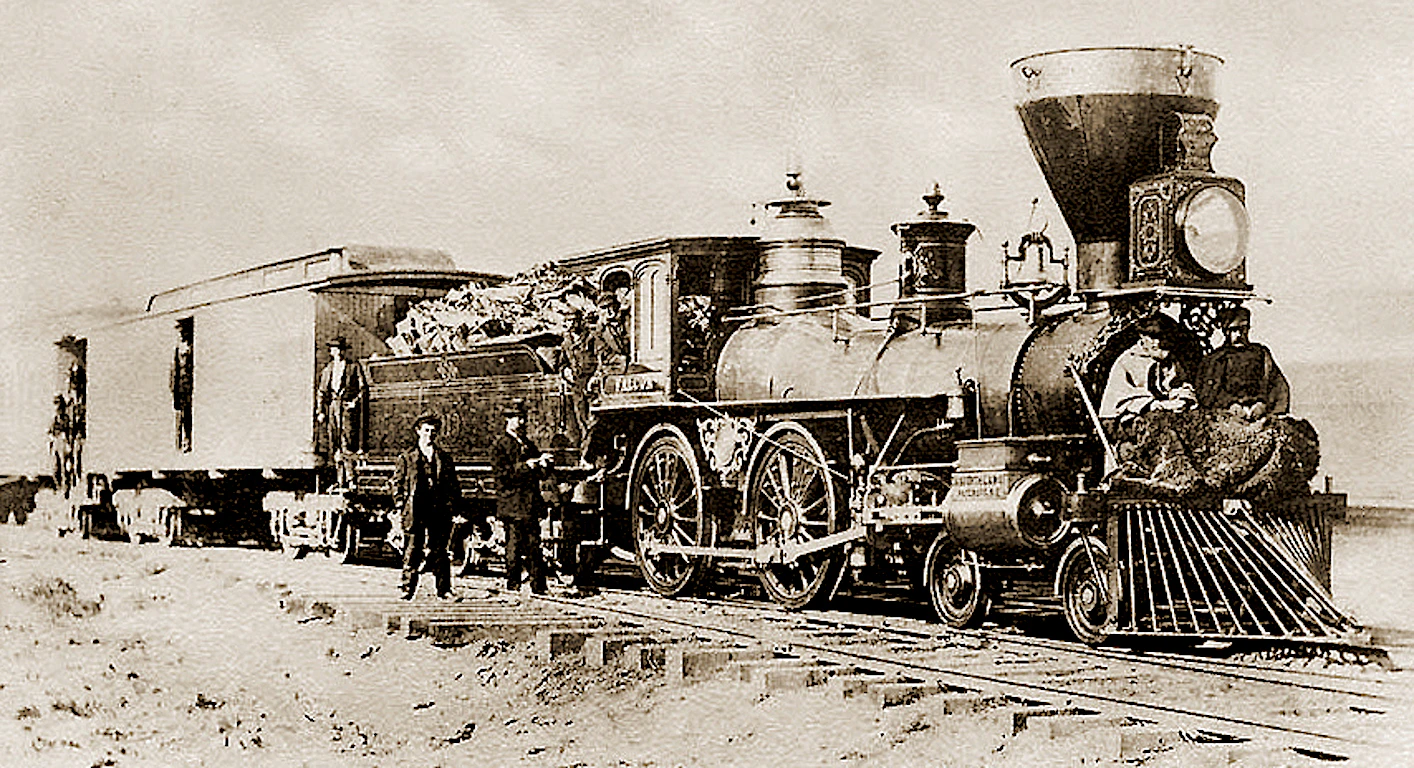
A Central Pacific Railroad train in Nevada in March 1869. The Central Pacific and Union Pacific Railroad linked together in Promontory Summit in Utah a few months later. Photo from Wikimedia
In 1862, the Pacific Railroad Act authorized the operation of the Central Pacific and the Union Pacific Railroad Companies. Both companies were tasked with building a
transcontinental railroad that would link the United States from east to west. The first American-built steam locomotive, named Tom Thumb, had made its debut in 1830. Despite losing a race to a horse-driven car, the locomotive demonstrated its potential. Over the next two decades, railroad tracks linked many cities on the East Coast.
By 1850, about 9,000 miles of track had been laid east of the Missouri River, and the first settlers had begun to move westward across the United States. This trend increased dramatically after the discovery of gold in California in 1849. However, the trip across mountains, plains, rivers and deserts was treacherous. The alternative required a six-month route around South America or the passage through Panama in Central America.
A young engineer named Theodore Judah decided to find a better solution. In 1860, he chose Donner Pass as the best path through California's Sierra Nevada mountains. The pass was famous for being particularly dangerous — in 1846, an expedition of settlers was blocked by snow, with only half of the group surviving.
Central Pacific Railroad Company is formed
By 1861, Judah had enlisted a group of investors in Sacramento: Charles Crocker, Leland Stanford, Collis Huntington and Mark Hopkins. Together they formed the Central Pacific Railroad Company. Judah headed to Washington, D.C., where he gained the support of members of Congress and President Abraham Lincoln, who signed the Pacific Railroad Act into law the following year.
The act said the Central Pacific Railroad Company would start building in Sacramento, California, and continue east across the Sierra Nevada. A second company, the Union Pacific Railroad, would build westward from the Missouri River, near the Iowa-Nebraska border.
Each company received land and, based on the location, $16,000 to $48,000 for every mile of track built. From the very start, the transcontinental railroad was set up as a competition between the two companies to build more miles than the other.
The Central Pacific started railroad construction in 1863, but Judah passed away soon after. His cause of death was yellow fever, a disease he caught while traveling near Panama on his way east.
Union Pacific Railroad Company launches
Meanwhile, in Omaha, Thomas Durant was the main authority in the Union Pacific Railroad Company. He also set up a company called Crédit Mobilier, which became notorious for corruption. Through this company, lawmakers and even the vice president were bribed into giving out extra government funding for construction. As a result, members of Union Pacific made large profits long before the railroad was operational. In 1863, the Union Pacific celebrated its launch, but little would be completed until the end of the Civil War in 1865. Army hero General Grenville Dodge, who had fought for the Union against the Southern Confederates, took charge of the Union Pacific Company after the Civil War. As the company moved westward in 1866, its workers suffered bloody attacks by Native Americans. Members of the Sioux, Arapaho and Cheyenne tribes saw their native lands under threat by the white man and his "iron horse." Still, the Union Pacific moved quickly across the plains. The Central Pacific Railroad Company's progress through the mountain ranges was much more difficult, and thus far slower.
Settlements generate wild behavior
Ramshackle settlements popped up wherever the railroad went. These settlements were full of drinking, gambling, prostitution and violence and produced the enduring mythology of the "Wild West."
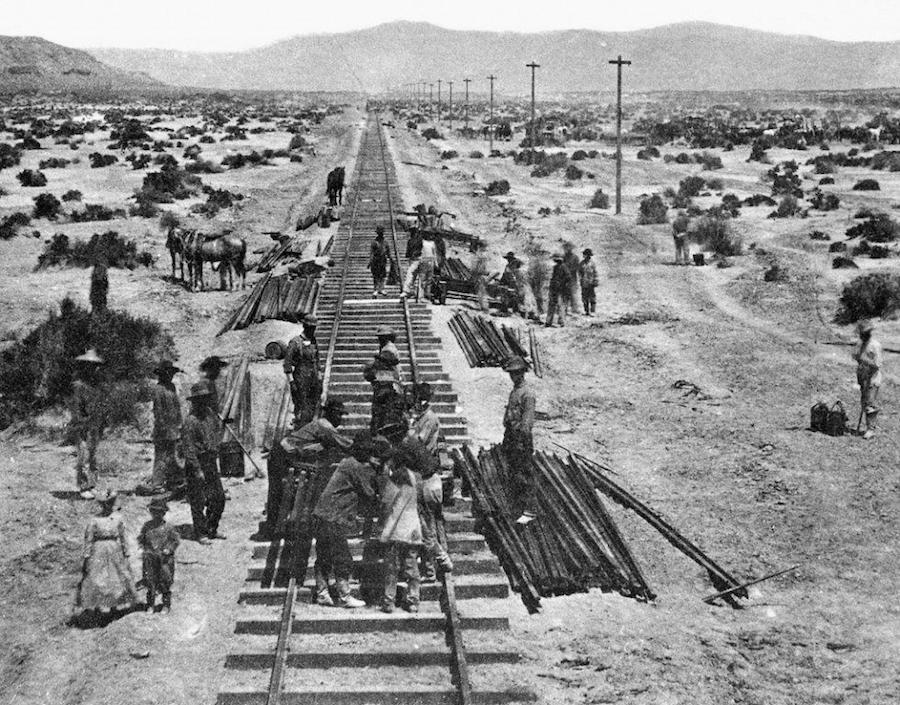
In 1865, the Central Pacific was struggling to keep workers from quitting due to the difficulty of the labor. Charles Crocker, therefore, began hiring Chinese laborers. Many Chinese immigrants had arrived to the West Coast during the Gold Rush. The choice of hiring them was controversial, as widespread racism fed the belief that the Chinese were inferior to whites. By contrast, the workforce of the Union Pacific was mainly Irish immigrants and Civil War veterans. Regardless, the Chinese laborers proved to be tireless workers. By early 1867, more than 10,000 were toiling under brutal working conditions in the Sierra Nevada mountains.
 Zoom in
Chinese workers lay tracks for the Central Pacific Railroad in Nevada. Photo from National Park Services. [click to enlarge]
By the summer of 1867, the Union Pacific was in Wyoming, covering far more ground than the Central Pacific. The Central Pacific broke through the mountains in late June, which meant the hard part was finally behind them. Both companies headed toward Salt Lake City, while cutting many corners in their race to get ahead. They built shoddy bridges or sections of track that had to be rebuilt later.
Final tracks are laid
By early 1869, the two companies were working only miles from each other, and the new president, Ulysses S. Grant, pressured them to choose a location at which to connect. The companies finally chose to join at Promontory Summit, north of the Great Salt Lake.
On May 10, after several delays, the final tracks were laid down to link the Central and Union Pacific railroads. The news immediately went out to President Grant and around the country that the transcontinental railroad had been completed.
Primary Sources: The Homestead Act of 1862
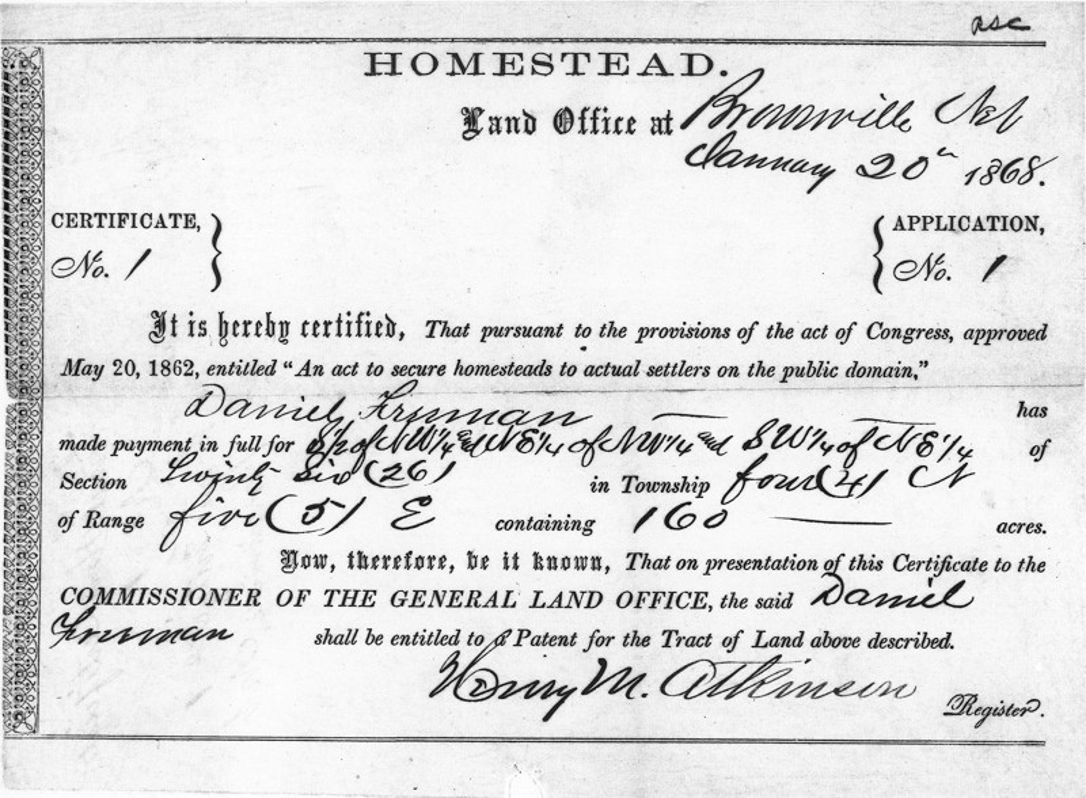
The Homestead Act was enacted during the Civil War in 1862 to encourage westward migration. It applied to any adult citizen, or intended citizen, who had never fought against the U.S. government. They could claim 160 acres of surveyed government land in the west. Claimants were required to "improve" the plot. They could do so by building a home and cultivating the land. After five years on the land, the original filer was entitled to the property, free and clear, except for a small registration fee of $18. The title could also be acquired after only a six-month residency and some small improvements. This was as long as the claimant paid the government $1.25 per acre. After the Civil War, Union soldiers who fought for the government could deduct the time they had served from the residency requirements.
This act was included in the Republican party platform of 1860. However, support for the idea began decades earlier. Even before 1787, under the Articles of Confederation, the distribution of government lands generated much interest and discussion. Two hundred and seventy million acres, or 10 percent of the area of the United States, was claimed and settled under this act.
The act was not a solution to poverty. Few laborers and farmers could afford to build a farm. The necessary tools, seed and livestock were expensive. In the end, most of those who purchased land came from areas quite close to their new homesteads. Many Iowans moved to Nebraska, Minnesotans to South Dakota, and so on. Unfortunately, the act was unclearly written so as to invite fraud. Early modifications by Congress only intensified the problem. Most of the land went to speculators , cattlemen, miners, lumbermen and railroads. Of some 500 million acres dispersed by the General Land Office between 1862 and 1904, only 80 million acres went to homesteaders. Indeed, small farmers acquired more land under the Homestead Act in the 20th century than in the 19th.
Homestead Act Of 1862: Section 1
Let the following be enacted by the Senate and House of Representatives of the United States of America in Congress. The law applies to any person who is the head of a family. It also applies to anyone who arrived at the age of 21 years and is a citizen of the United States, or who has filed his declaration of intention to become a citizen. Those who meet these requirements must have never fought against the United States government or given aid to its enemies. He shall from and after January 1, 1863, be entitled to enter one-quarter section or a less quantity of unused public lands. He may enter lands upon which said person may have filed a preemption claim. This is a claim to government land as personal property. Or, at the time the application is made, the land may be claimed at one dollar and 25 cents, or less, per acre, or 80 acres or less of such lands, at two dollars and 50 cents per acre. The land must be in conformity to the legal subdivisions of the public lands. Provided this, any person owning and residing on land may, under the provisions of this act, enter other land lying next to his or her said land. This shall not, with the land already owned and occupied, exceed 160 acres.
Section 2
The person applying for the benefit of this act must swear that he or she is the head of a family. Or they must be 21 years or more of age, or must have served in the Army or Navy of the United States. They must also swear that they have never fought against the government of the United States or helped its enemies. Applicants must swear that the application is made for his or her exclusive use and benefit. The application must be used to actually settle and grow on the land, not to benefit some other person or business. The applicant must file this affidavit, or written promise, with the register or receiver. They must also pay 10 dollars. Then, he or she shall thereupon be permitted to enter the quantity of land specified.
There are some exceptions. The land will be issued five years after the person applied. If after five years, the person making such entry, or if he has died, his widow, or if she has died, his heirs, will need to prove by two credible witnesses that he, she or they have resided upon or cultivated the same for the term of five years immediately after the time of the affidavit. Should this happen, that person will need to issue a written promise that no part of said land has been transferred to another person. If this happens, they will get the title to the land. It will be officially theirs. In case of the death of both father and mother, the right to the land and fee will belong to the infant or child they leave behind. The person in charge of the parents' estate may, at any time within two years after the death of the surviving parent, sell said land for the benefit of said children, but for no other purpose. At that point, the purchaser will get the title to the land.