Lesson 1.8 The Labor Movement
US.11 Explain the rise of the labor movement, union tactics (e.g., strikes), the role of leaders (e.g., Eugene Debs and Samuel Gompers), the unjust use of prison labor (e.g., Coal Creek labor saga), and the responses of management and government.
Examine the following sources and then answer the exit ticket questions at the end.
The Rise of Organized Labor in the United States
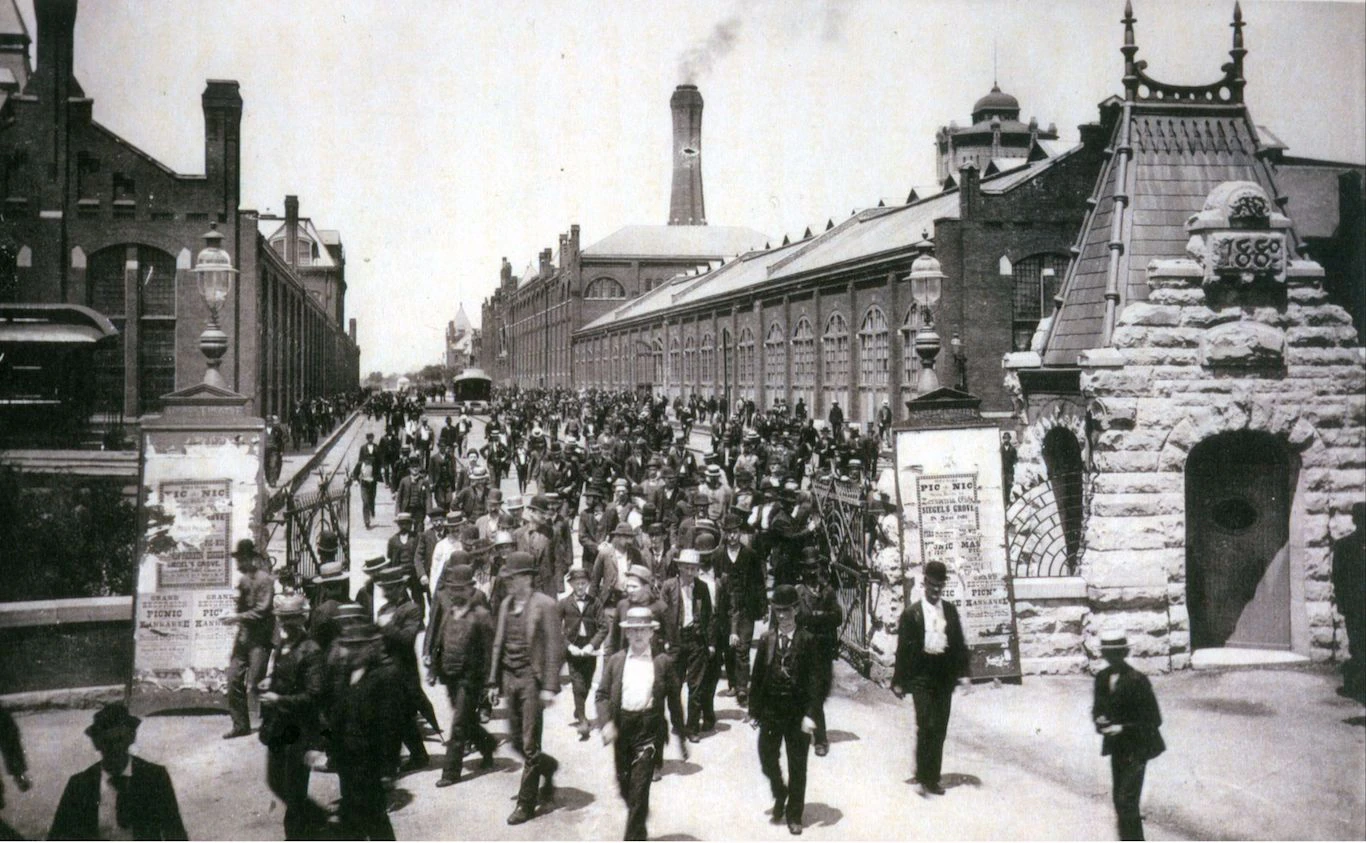
Workers leaving the Pullman Palace Car Works in 1893. The Pullman Strike was a nationwide railroad strike that started on May 11, 1894. Many of the Pullman factory workers joined the American Railway Union led by union leader Eugene V. Dubs. Photo from Wikimedia Commons
In the mid-19th century, the vast majority of American work was still done on the farm. By the turn of the 20th century, the United States economy revolved around the factory.
Most Americans living in the Gilded Age knew nothing of the millions of Rockefeller, Carnegie and Morgan. They worked 10-hour shifts, six days a week, for wages barely enough to survive. Children as young as 8 years old worked hours that kept them out of school. Men and women worked until their bodies could stand no more, only to be released from employment without retirement benefits. Medical coverage did not exist. Women who became pregnant were often fired. Compensation for being hurt while on the job was zero.
Come together
Soon laborers realized that they must unite to demand change. Even though they lacked money, education, or political power, they knew one critical thing. There were simply more workers than there were owners.
Unions did not emerge overnight. Despite their legal rights to exist, bosses often took extreme measures, including intimidation and violence, to prevent a union from taking hold. Workers, too, often chose the sword when peaceful measures failed.
Many Americans believed that a violent revolution would take place in America. How long would so many stand to be poor? Industrial titans, including John Rockefeller, arranged for mighty castles to be built as fortresses to stand against the upheaval they were sure was coming.
Slowly but surely unions did grow. Efforts to form nationwide organizations faced even greater difficulties. Federal troops were sometimes called to block their efforts. Judges almost always ruled in favor of the bosses.
The workers often could not agree on common goals. Some flirted with extreme ideas like Marxism. Others simply wanted a nickel more per hour. Fights erupted over whether or not to admit women or African-Americans. Immigrants were often viewed with hostile eyes. Most did agree on one major issue — the eight-hour day. But even that agreement was often not strong enough to hold the group together.
Organized labor has brought tremendous positive change to working Americans. Today, many workers enjoy higher wages, better hours, and safer working conditions. Employers often pay for medical coverage and several weeks vacation. Jobs and lives were lost in the epic struggle for a fair share. The fight sprouted during the Gilded Age, when labor took its first steps toward unity. It began with the Great Upheaval.
A spontaneous eruption
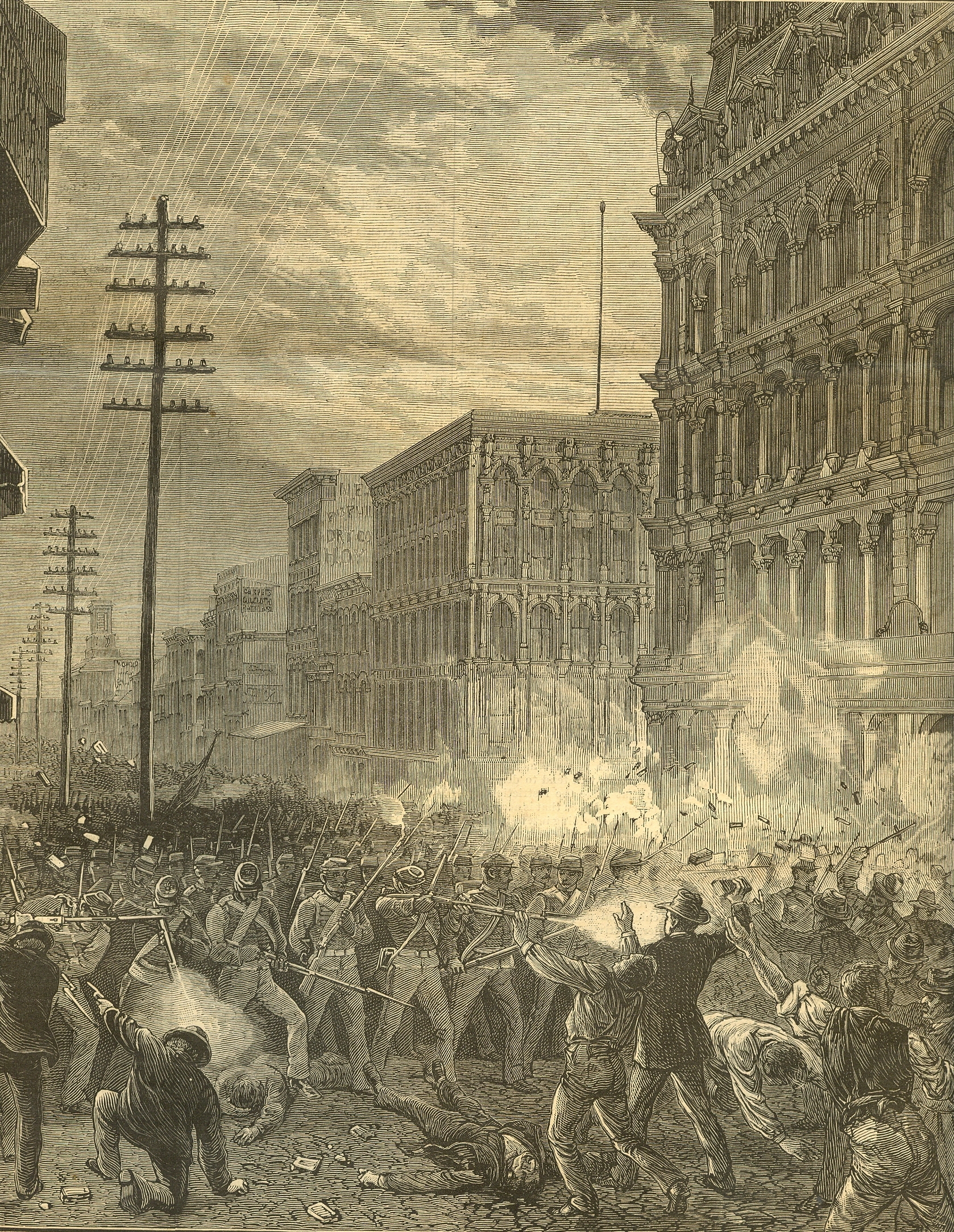
It started with a 10 percent pay cut. When leaders of the Baltimore and Ohio Railroad Company ordered this second reduction in less than eight months, railroad workers in Martinsburg, West Virginia, decided they had had enough. On July 16, 1877, workers in that town drove all the engines into the roundhouse and boldly declared that no train would leave until the owners restored their pay. The local townspeople gathered at the rail yard to show their support for the strikers. A great showdown was on.
 Zoom in
An engraving titled
The governor sent units of the National Guard to Martinsburg to accompany the trains out of town by force of arms. There was little support for the effort among the Guardsmen, however, because a majority of them were railroad workers themselves. After two people were killed in the standoff, the Guard simply laid down their weapons and began chatting with members of the crowd.
Only when federal troops sent by President Rutherford B. Hayes arrived did the trains leave the station. Even then they were sabotaged and harassed along their routes. Only one train reached its destination. The movement spread into Pennsylvania when workers on the Pennsylvania and Reading railroads joined their compatriots. Pittsburgh is the gateway to the Midwest, and so the strike widened to that region.
The police, the National Guard, and the United States Army clashed with angry mobs throughout America. Throughout the land, wealthy individuals feared that the worst had finally come. A violent revolution seemed to be sweeping the nation.
But then it stopped. In some cases the strikes were ended by force. In others, the strikers simply gave up. After all, most workers were not trying to overthrow the government or the social order. They simply wanted higher wages and more time to spend with their families.
When the strike ended in the first week in August, over 100 people were killed and a thousand more were imprisoned. Untold millions of dollars of damage was caused to rail lines, cars and roundhouses. The fight was over, but America had not seen the last of the mass strike.
Labor versus management
The battle lines were clearly drawn. People were either workers or bosses, and with that strong identity often came an equally strong dislike for those who were on the other side. As the number of self-employed Americans dwindled in the Gilded Age, workers began to feel the strength in their numbers and ask greater and greater demands of their bosses. When those demands were rejected, they plotted schemes to win their cases.
Those who managed factories developed strategies to counteract those of labor. At times the relationship between the camps was as intellectual and tense as a tough chess match. Other times it was as ugly as a schoolyard fight.
Strikes, boycotts and sabotage
The most frequently employed technique of workers was the strike. Withholding labor from management would, in theory, force the company to suffer great enough financial losses that they would agree to worker terms. Strikes have been known in America since the colonial age, but their numbers grew larger in the Gilded Age.
Most 19th-century strikes were not successful, so unions thought of other means. If the workers at a shoe factory could garner enough sympathy from the local townspeople, a boycott could achieve desirable results. The union would make its case to the town in the hope that no one would buy any shoes from the factory until the owners agreed to a pay raise. Boycotts could be successful in a small community where the factory was dependent upon the business of a group of people in close proximity
In desperate times, workers would also resort to illegal means if necessary. For example, sabotage of factory equipment was not unknown. Occasionally, the foreman or the owner might even be the victims of worker-sponsored violence.
Management strikes back
Owners had strategies of their own. If a company found itself with a high inventory, the boss might afford to enact a lockout, which is a reverse strike. In this case, the owner tells the employees not to bother showing up until they agree to a pay cut. Sometimes when a new worker was hired the employee was forced to sign a yellow-dog contract, or an ironclad oath swearing that the employee would never join a union.
Strikes could be countered in a variety of ways. The first measure was usually to hire strikebreakers, or scabs, to take the place of the regular labor force. Here things often turned violent. The crowded cities always seemed to have someone hopeless enough to "cross the picket line" during a strike. The striking workers often responded with fists, occasionally even leading to death.
Prior to the 20th century, the government never sided with the union in a labor dispute. Bosses persuaded the courts to issue injunctions to declare a strike illegal. If the strike continued, the participants would be thrown into prison. When all these efforts failed to break a strike, the government at all levels would be willing to send a militia to regulate as in the case of the Great Upheaval.
What was at stake? Each side felt they were fighting literally for survival. The owners felt if they could not keep costs down to beat the competition, they would be forced to close the factory altogether. They said they could not meet the workers' unreasonable demands.
What were the employees demanding? In the entire history of labor strife, most goals of labor can be reduced to two overarching issues: higher wages and better working conditions. In the beginning, management would have the upper hand. But the sheer numbers of the American workforce was gaining momentum as the century neared its conclusion.
Early national organizations
Divide and conquer. That simple strategy gave the owners the advantage over labor until the dawn of the 20th century. Laborers did not all have the same goals. By favoring one group over another, the bosses could create internal dissent in any union. Unions were spread from town to town. Unity among them might make a more effective boycott or strike, but bringing diverse groups together across a large area was extremely difficult.
Owners were smart enough to circulate blacklists. These lists contained the names of any workers active in the union. If anyone on the list would show up in another town trying to get hired (or to start another union), the employers would be wise. Still, the ratio of labor to management was so large that national organization was inevitable. The first group to clear the hurdles was the National Labor Union.
William Sylvis and the NLU
By 1866, there were about 200,000 workers in local unions across the United States. William Sylvis seized the opportunity presented by these numbers and established the first nationwide labor organization, named the National Labor Union. Sylvis had very ambitious goals. Not only did the NLU fight for higher wages and shorter hours, Sylvis took labor activity into the political arena. The NLU supported legislation banning prison labor, land reform laws to keep public holdings out of the hands of speculators, and national currency reform to raise farm prices.
It brought together skilled and unskilled workers, as well as farmers. The National Labor Union stopped short of admitting African-Americans. Racist tendencies of the times prevailed, despite the wisdom of bringing as many workers as possible into the fold. Unfortunately for the NLU, it tried to represent too many different groups. Farmers had their own agenda, and skilled workers often had different realities than the unskilled. When the Panic of 1873 hit America, the union was severely disabled. Soon after, the National Labor Union withered away.
The Knights of Labor
The Knights of Labor soon inherited the mantle of organized labor. Begun as a secret society in 1869, the Knights admitted all wage earners into their ranks, including women and African-Americans. The philosophy was simple: class was more important than race or gender. For such a group to influence the federal government, complete solidarity would be required.
The Knights supported the entire political agenda of the NLU and more. They advocated limits on immigration, restrictions on child labor, and government ownership of railroads, telegraphs and telephones. At the height of its membership in 1886, the Knights boasted 750,000 workers. But then disaster struck.
Tragedy in Haymarket Square
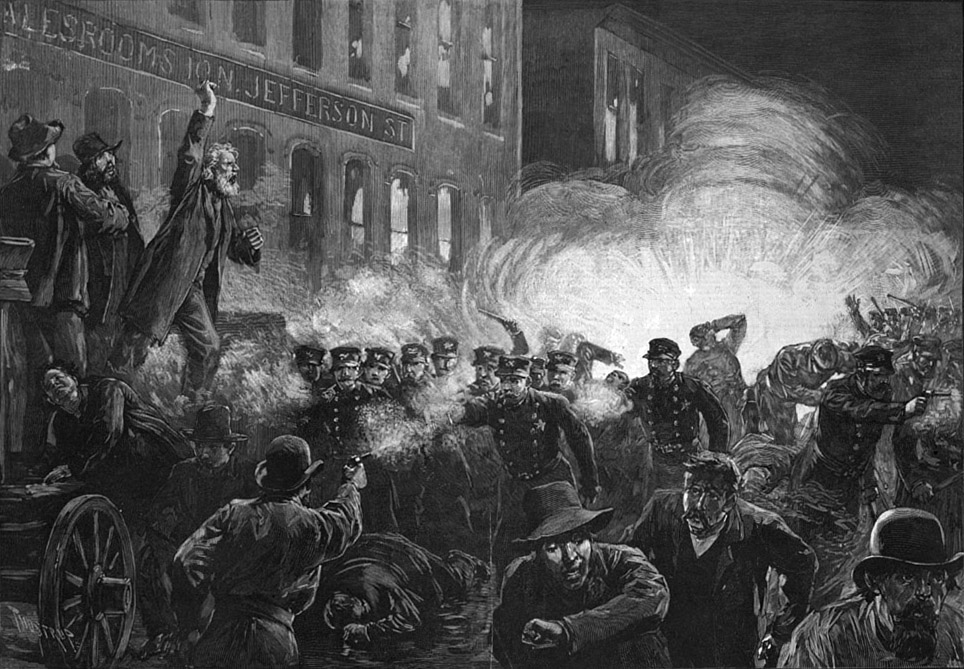
On May 1, 1886, International Workers Day, local chapters of the Knights went on strike demanding an eight-hour day for all laborers. At a rally in Haymarket Square in Chicago on May 4, someone threw a bomb into the crowd. One police officer died and several crowd members sustained injuries.
 Zoom in
On May 4, 1886, a labor protest in Chicago's Haymarket Square turned into a riot after someone threw a bomb at police. Photo from Wikimedia. [click to enlarge]
Who was responsible? No one was really sure, but the American press, government, and general public blamed the Knights of Labor. Leader Terence Powderly condemned the bombing to no avail. Americans associated labor activity with anarchists and mob violence. Membership began to fall. Soon the Knights were merely a shadow of their former size. But labor leaders had learned some valuable lessons. The next national organization of workers would endure.
American Federation of Labor
Keep it simple. That was the mantra of labor leader Samuel Gompers. He was a die-hard capitalist and saw no need for a radical restructuring of America. Gompers quickly learned that the issues that workers cared about most deeply were personal. They wanted higher wages and better working conditions. These "bread and butter" issues would always unite the labor class. By keeping it simple, unions could avoid the pitfalls that had drawn the life from the National Labor Union and the Knights of Labor.
Gompers was born in London in 1850 to a family of Jewish cigar makers. Coming to Manhattan at the height of the American Civil War, the Gompers family maintained that trade. An effective organizer and speaker, Gompers became the head of the local cigar makers' union at the age of only twenty-seven.
A union for the skilled
In December 1886, the same year the Knights of Labor was dealt its fatal blow at Haymarket Square, Gompers met with the leaders of other craft unions to form the American Federation of Labor. The AFL was a loose grouping of smaller craft unions, such as the masons' union, the hat makers' union or Gompers' own cigar makers' union. Every member of the AFL was, therefore, a skilled worker.
Gompers had no visions of uniting the entire working class. Tradespeople were in greater demand and already earned higher wages than their unskilled counterparts. Gompers knew that the AFL would have more political and economic power if unskilled workers were excluded. He served as president of the union every year except one until his death in 1924.
Although conservative in nature, Gompers was not afraid to call for a strike or a boycott. The larger AFL could be used to support these actions, as well as provide relief for members engaged in a work stoppage. By refusing to pursue a radical program for political change, Gompers maintained the support of the American government and public. By 1900, the ranks of the AFL swelled to over 500,000 tradespeople. Gompers was seen as the unofficial leader of the labor world in America.
Simplicity worked. Although the bosses still had the upper hand with the government, unions were growing in size and status. There were over 20,000 strikes in America in the last two decades of the 19th century. Workers lost about half, but in many cases their demands were completely or partially met. The AFL served as the preeminent national labor organization until the Great Depression when unskilled workers finally came together. Smart leadership, patience, and realistic goals made life better for the hundreds of thousands of working Americans it served.
Eugene V. Debs and American socialism
Despite the success of the American Federation of Labor, American radicalism was not dead. The number of those who felt the American capitalist system was fundamentally flawed was, in fact, growing fast.
American socialists based their beliefs on the writings of Karl Marx, the German philosopher. Many asked why so many working Americans should have so little while a few owners grew incredibly wealthy. No wealth could exist without the sweat and blood of its workforce. They suggested that the government should own all industries and divide the profits among those who actually created the products. While the current management class would stand to lose, many more people would gain. These radicals grew in number as industries spread. But their enemies were legion.
Eugene V. Debs was born in Terre Haute, Indiana, in 1855 to a family of French Alsatian immigrants. Making his way in the railroad industry, Debs formed the American Railway Union in 1892.
Two years later he found himself leading one of the largest strikes in American history — the great Pullman Strike. When its workers refused to accept a pay cut, the Pullman Car Company fired 5,000 employees. To show support, Debs called for the members of the American Railway Union to refrain from operating any trains that used Pullman cars. When the strike was declared illegal by a court injunction, chaos erupted. President Grover Cleveland ordered federal troops to quell the strikers and Debs was arrested. Soon the order was restored and the strike failed.
Debs was not originally a socialist, but his experience with the Pullman Strike and his subsequent six-month jail term led him to believe that drastic action was necessary. Debs chose to confine his activity to the political arena. In 1900, he ran for U.S. president as a socialist and garnered some 87,000 votes.
The following year, leading sympathizers joined with him to form the Socialist Party. At its height, the party numbered over 100,000 active members. Debs ran for president four more times. In the election of 1912, he received over 900,000 votes. After being arrested for anti-war activities during World War I, he ran for president from his jail cell and polled 919,000 votes. Debs died in 1926 having never won an election, but over 1,000 Socialist Party members were elected to state and city governments.
The Wobblies
Even more radical than the Socialists were the members of the Industrial Workers of the World. This union believed that compromise with owners was no solution. Founded in 1905 and led by William "Big Bill" Haywood, the "Wobblies," as they were called, encouraged their members to fight for justice directly against their employers. Although small in number, they led hundreds of strikes across America, calling for the overthrow of the capitalist system. The IWW won few battles, but their efforts sent a strong message across America that workers were being mistreated.
When the United States entered World War I, the Wobblies launched an active antiwar movement. Many were arrested or beaten. One unlucky member in Oregon was tied to the front end of an automobile with his knees touching the ground and driven until his flesh was torn to the bone. Membership declined after the war, but for two decades the IWW was the anchor of radical American activism.
 Which of the following people or groups would be least likely to agree with the ideas expressed in the above political cartoon?