Lesson1.2: American Indian Policy
US.02 Examine federal policies toward American Indians, including: the movement to reservations, assimilation, boarding schools, and the Dawes Act.
Examine the following sources and answer the exit ticket questions at the end.
Primary sources: Commissioner of Indian Affairs urges assimilation and a response from Hoopa Valley
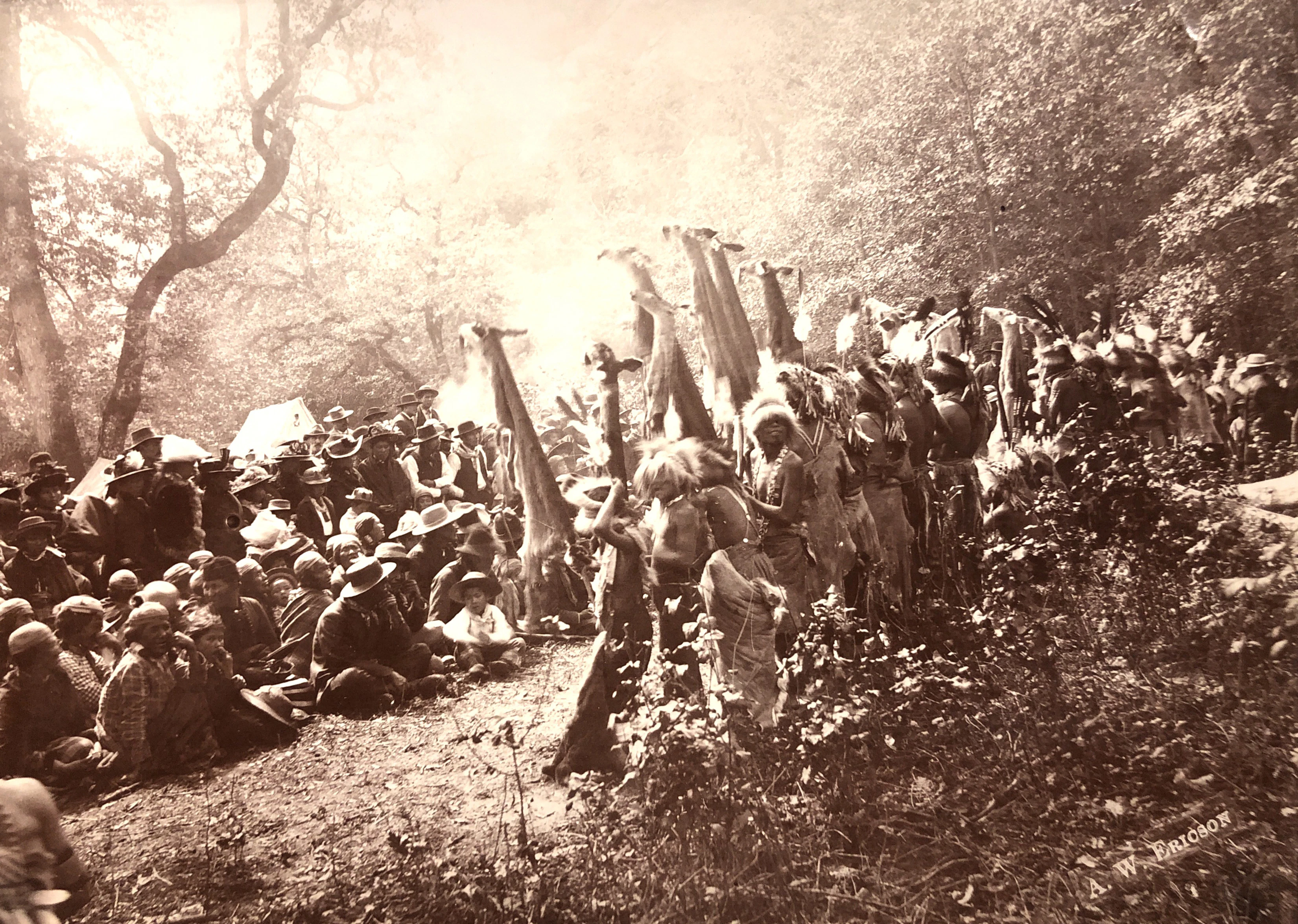
A traditional White Deerskin Dance performance by the Hupa tribe in California in 1896. The Hupa people signed a treaty with the U.S. government in 1864 establishing their land rights in the Hoopa Valley Indian Reservation. Photo: Augustus Ericson/Nextrecord Archives/Getty Images
The main idea of the article is to present two historical letters from 1902 that illustrate the U.S. government's attempts to change the behavior and customs of the Indigenous people living on the Hoopa Valley reservation in California, and a response from the reservation's superintendent requesting more leniency and understanding towards their cultural practices.
These suggestions have been generated by an AI model, but the ideas and underlying gist are original and generated by a human author.
Editor’s Note: The Bureau of Indian Affairs (BIA) is a government agency that was created in 1824. At first, it oversaw relations between the United States and the Indigenous American population. Eventually, many Indigenous groups were ordered to live on reservation land. The BIA oversaw the management of these reservations.
The Hupa are an Indigenous group from northwestern California who were forced to live on the Hoopa Valley reservation. Below are two letters from 1902 that give some idea of what life was like for them under BIA management. The first letter is from the Commissioner of Indian Affairs, William A. Jones. In it, he urges the superintendent at Hoopa Valley to change native people’s behavior on the reservation. The second letter is a response from the superintendent, Frank Kyselka, who describes reservation life and asks the government to be a little less strict. Some language used below is considered outdated and does not reflect the values of Newsela.
The “long hair letter” from the Commissioner of Indian Affairs about the way in which Indian people should dress and act, 1902.
To Superintendent,
Round Valley, California,
Sir: —
This Office wants to call your attention to a few Indian customs that, we believe, should be modified or ended.
First, male Indians should not have long hair. Wearing their hair this way goes against efforts to make them more civilized. Far too often, male students fall into the old custom of letting their hair grow long once they return from our schools and are back on their reservation. They also paint their faces and bodies and adopt all the old habits and customs our schools have tried to wipe out. The schools are not to blame for this. Rather, the problem lies with the conditions found on reservations. These conditions are often maintained simply because Superintendents are unwilling to enforce any strict new policies.
On many of the reservations Indians of both sexes paint themselves, claiming it keeps their skin warm in winter and cool in summer. Instead, the paint melts when a person sweats and runs down into their eyes. This leads to many diseases of the eyes and causes the majority of the blindness found among the Native population.
You are therefore directed to make your male Indians cut their hair, and to make both sexes stop painting themselves. With some of the Indians this will be an easy matter. With others, it will require considerable persistence. When it comes to your Indian employees, and to those Indians who receive rations and supplies, it should be an easy matter, as disobeying this order can be a reason for firing employees or for withholding ration and supplies. Many Indians will follow the order voluntarily, especially the students returning from boarding schools. Those returned students who do not obey should be dealt with very strictly. Employment and supplies should be withdrawn until they agree to follow the order. If they become rebellious, confine them in the guard-house. Force such rebels to perform hard labor while confined and cut their hair short. Certainly all the younger men should wear short hair and it is believed that by persistence, firmness and withdrawal of supplies the Agent can get everyone to follow this order.
The wearing of modern American clothing, instead of the Indian costume and blanket, should be encouraged. Indian dances and so-called Indian feasts should not be allowed to take place. In many cases these dances and feasts are simply excuses to perform immoral acts. You are therefore directed to suppress these evils as much as possible.
On or before June 30, 1902, you will report to this Office the progress you have made in carrying out these orders and instructions.
Very respectfully,
William A. Jones, Commissioner
A response to the “long hair” letter from the Hoopa Valley Indian Agency, 1902.
Hoopa Valley Agency and School
Hupa, California, July 21, 1902
Sir:
I am glad to report that your directions and suggestions have been kept in mind during the past few months. Currently, there are only two or three very old male Indians who wear long hair. I have not thought it best to take severe measures with them, as none of the others seem to want to follow their example. There is practically no painting of faces or bodies done by either males or females. All the Indians on the reservation wear modern American clothing. Indian dances have been discouraged and the Indians have not asked permission to hold any of them since last fall. If permission is requested to hold a harvest or brush dance, would it not be a good idea for me to grant it, so long as police were there to keep good order? I understand that some of the Indian dances formerly held here were not considered immoral in any way. Rather, they were ceremonies or simply innocent amusements. If my further personal observation convinces me this is true, it would be well to allow them, as innocent amusements are not very plentiful here. I sometimes think that the idea of a good time in the minds of some of the Indians here is like that of many white men in the west — a little gambling and plenty of whiskey. It is not very often that an Indian is found drunk on the reservation, and perhaps an occasional dance, say once a year, would let the Indians release some of their energy and emotions, and would prevent some of them from becoming drunk off the reservation. In time, as the minds of the Indians become filled with better things learned from employees and the missionaries, they will lose interest in their old-time dances and will give them up on their own.
Very respectfully,
Frank Kyselka
Superintendent of the Hoopa Valley Indian Agency
Primary Sources: Dawes Act
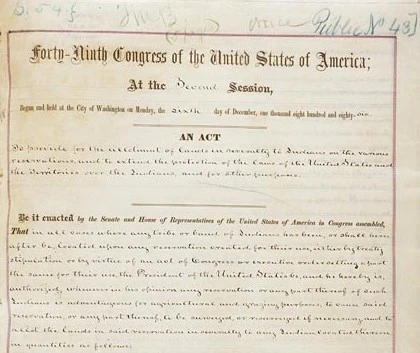
This image of the document for “An Act to Provide for the Allotment of Lands in Severalty to Indians on the Various Reservations” (General Allotment Act or Dawes Act) is from the National Archives. Photo: National Archives, Statutes at Large 24, 388-91, NADP Document A1887.
The article is about the passage of the Dawes Act, which emphasized severalty and provided for the allotment of lands in severalty to Indians on various reservations.
These suggestions have been generated by an AI model, but the ideas and underlying gist are original and generated by a human author.
Editor’s Note: Approved on February 8, 1887, "An Act to Provide for the Allotment of Lands in Severalty to Indians on the Various Reservations," known as the Dawes Act, emphasized severalty, meaning the treatment of Indigenous people as individuals rather than as members of tribes.
Please note that the MAX level is the original document without changes. Some of the original language is considered offensive to use today and does not reflect the values of Newsela. The leveled versions have been shortened and edited.
Forty-Ninth Congress of the United States of America;
At the Second Session,
Begun and held at the City of Washington on Monday, the sixth day of December, one thousand eight hundred and eight-six.
An Act to provide for the assignment of lands in severalty to Indians on various reservations.
The act extends the protection of the laws of the United States and the Territories over the Indians.
Be it passed by the Senate and House of Representatives of the United States of America in Congress. This act applies to cases where any tribe of Indians has been located upon any reservation created for their use. The President of the United States, whenever any reservation of such Indians is advantageous, can assign the lands. In said reservations, land will be assigned in severalty to any Indian located there. The quantities assigned shall be as follows.
To each head of a family, one-quarter of a section;
To each single person over eighteen years of age, one-eighth of a section;
To each orphan child under eighteen years of age, one-eighth of a section; and
To each other single person under eighteen years now living, or who may be born prior to the date of the order of the President directing an assignment of the lands, one-sixteenth of a section:
Provided, That in case there is not enough land in any of the reservations to assign land to each individual. The lands in that reservation shall be assigned to each individual based on the provisions of this act.
Where the treaty or act of Congress setting apart such reservation provides the assignment of land in severalty that is larger than those provided. Then, the U.S. President shall assign the lands to each Indian in the quantity set forth in this act. When lands assigned are only valuable for grazing, an additional assignment of lands, in the quantities provided above, shall be made to each individual.
Sec. 2. That all allotments set apart under the provisions of this act shall be selected by the Indians. The heads of families will select for their minor children. The agents shall select for any orphan child. Where a land assignment for two or more Indians have been made on the same land, a line may be run dividing said lands between them. The amount to which each shall receive is equal in the assignment of the remainder of the land.
Provided, if any one permitted to receive an assignment of land shall fail to make a selection within four years after the U.S. President directs allotments may be made on a reservation. Then, the Secretary of the Interior of the U.S. may direct the government agent representing such tribe. If there be no agent, then a special agent makes a selection for such Indian.
Sec. 3. That the allotments provided for in this act shall be made by special agents appointed by the President. The agents in charge of the reservations on which the allotments are to be made, under such rules and regulations as the Secretary of the Interior may make, shall be approved by such agents to the Commissioner of Indian Affairs. The approval document will be made with two copies. One copy will be retained in the Indian Office. The other will be transmitted to the Secretary of the Interior for his action. It will be deposited in the General Land Office.
Sec. 4. For any Indian not residing upon a reservation, or for whose tribe no reservation has been provided by treaty, act of Congress, or executive order. This Indian shall be allowed to settle upon any lands of the United States. He or she shall be able to receive, after applying to the local land-office for the land’s district, the same allotted to him or her, and to his or her children. The quantities of lands will be allotted as provided in this act.
Such settlement can be made upon unsurveyed lands. The land given to such Indians shall be adjusted. Legal documents shall be issued to them in the manner and with the restrictions as herein provided.
Sec. 5. Upon the approval of assignments in this act by the Secretary of the Interior. He shall cause legal documents to issue therefor in the name of the people assigned land. The legal documents shall declare that the United States does and will hold the land thus assigned. The land will be held in trust by the U.S. government for twenty-five years. It will be for the sole use and benefit of the Indian. The President of the United States may in any case in his judgment extend the period. At any time after lands have been allotted to all the Indians, it shall be lawful for the Secretary of the Interior to work with such Indian tribe for the purchase and release by said tribe.
Sec. 6. Upon the completion of said assignments. Every member of the tribes receiving an assignment shall have the benefit of and be subject to the laws of the State or Territory. No Territory shall pass any law denying any such Indian equal protection of the law. Every Indian born within the territorial limits of the United States who has a residence separate from any tribe of Indians, and has adopted the habits of civilized life, is hereby declared a citizen of the United States. The Indian will have the same rights as such citizens.
Sec. 7. In cases where water for irrigation is necessary to render the lands on an Indian reservation available for agricultural purposes. Then, the Secretary of the Interior is permitted to make rules. The rules secure a just and equal distribution among the Indians residing upon the reservation.
Sec. 8. That the provisions of this act shall not extend to the land occupied by the Cherokees, Creeks and Choctaws. Nor, extend to the land of the Chickasaws, Seminoles and Osage. Nor, extend to the land of the Miamies and Peorias. Nor, extend to the land of the Sacs and Foxes. Nor, extend to the reservations of the Seneca Nation of New York Indians. Nor, to the land in the State of Nebraska adjoining the Sioux Nation.
Sec. 9. That for the purpose of making the surveys and resurveys on land value in section two, there be appropriated out of money in the U.S. Treasury one hundred thousand dollars. The sum is to be repaid proportionately. The money will come from the sales of such land acquired from the Indians under this act.
Sec. 10. That nothing in this act shall be so interpreted to affect the power of U.S. Congress to grant the right of way through any lands granted to an Indian, or a tribe, upon making just payment. The use could be for railroads or other highways, or telegraph lines. The grants could be for the public use, or condemn such lands to public uses.
Sec. 11. That nothing in this act shall prevent the removal of the Southern Ute Indians from their present reservation in Southwestern Colorado to a new reservation. This removal can only happen with the consent of a majority of the tribe’s adult male members.
Approved, February, 8, 1887.