Observe the diagram below and complete the sentence.
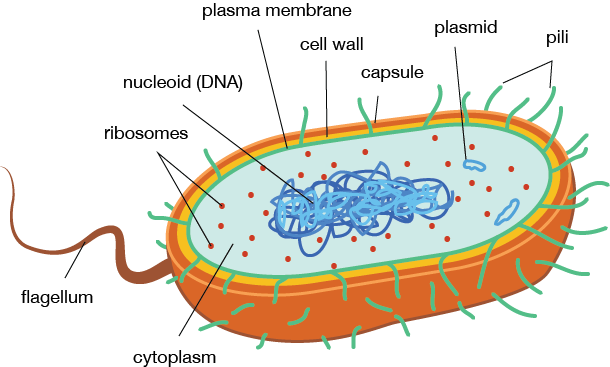
The cell above is an example of a . This is because the cell .
Decide whether each item below belongs to
Prokaryotes (1), Eukaryotes (2), or Both (4).
Prokaryotes Only | Eukaryotes Only | BOTH | |
|---|---|---|---|
Nucleus | |||
No Nucleus | |||
Ribosomes | |||
Cell Membrane | |||
DNA | |||
Cytoplasm | |||
Membrane Bound Organelles |
Observe the diagram below and complete the sentence.
The cell above is an example of a . This is because the cell .
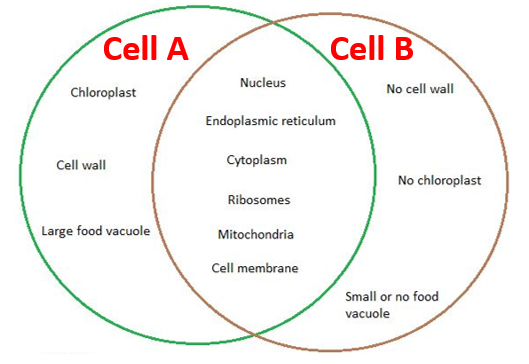
A student was taking notes during class on comparing cellular structures, however they forgot to put the cell labels on their Venn diagram! Can you help them figure out their missing cell labels?
From the information provided in the Venn diagram, Cell A should be labeled as a cell and Cell B should be labeled as a(n) cell.
Bacterial
Plant
Animal
Students created note cards comparing characteristics of eukaryotic and prokaryotic cells.
Which set of note cards most accurately compares these cells?
Which observation provides the strongest evidence for the endosymbiotic theory?
Scientists found that mitochondria and chloroplasts have their own DNA, reproduce like bacteria, and are similar in size to prokaryotes. These organelles may have formed when larger cells engulfed smaller prokaryotic cells.
Which statement best explains how these observations support the endosymbiotic theory?
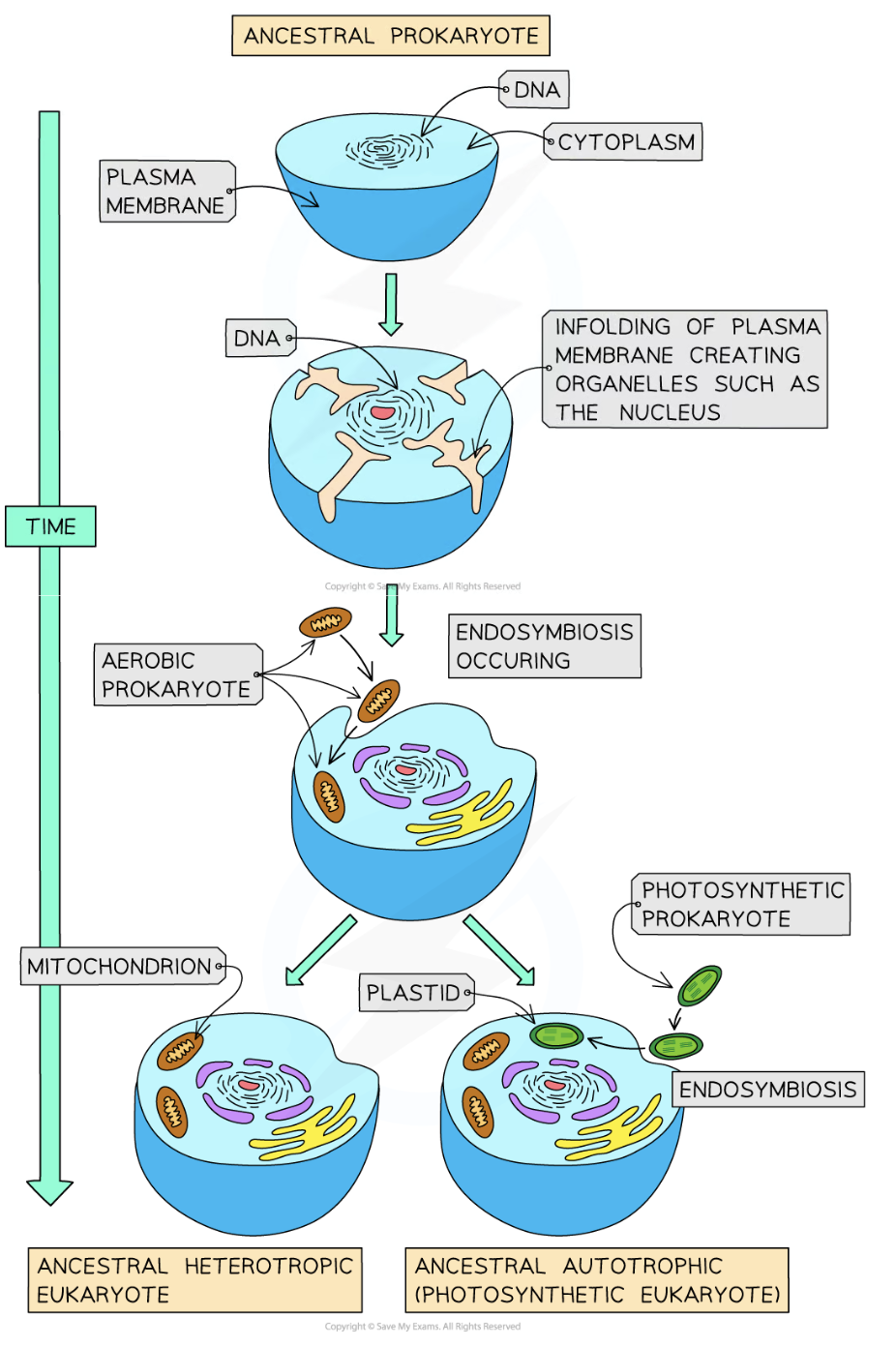
Based on the diagram, which organism evolved first?
Scientists hypothesize that early cells developed more complex internal structures when portions of the cell membrane folded inward. Over time, these folds formed membrane-bound structures such as the nucleus and endoplasmic reticulum.
Which theory best explains the development of these internal cell structures?
Scientists discovered that mitochondria contain their own DNA and can reproduce independently inside a cell. Which theory is best supported by this evidence?


Which statement is best supported by the diagram?