Biology Final Fall 2016 Master - 150 pts
star
star
star
star
star
Last updated about 7 years ago
70 Nsɛmmisa
1
1

3
1
1

1
4
20
1
1
1
1
1
5
3
2

1

1

1

1

1

1

1
1

1

1
1
1
1
1
20
1

1
1
1
1
Last Name First Name
Select your class period.
A "Who done it?" The first part of our lab final will test several items to determine who is the most likely culprit in this crime. Hyper Harry was found dead in his lab and an investigation is underway with five persons of interest: Bio Billy, ATP Allie, Polar Polly, Exo Earl, and Constant Connie, who all work in the same laboratory. To avoid biases while examing the evidence, they will be referred to as persons of interest (POI) #1, 2, 3, 4, and 5. You will keep track of matching evidence on your POI Data Sheet.
Evidence Sample A: a note was found on Hyper Harry's desk with the following sequence of numbers: 76 42 14 16 The chemist on the case thought these numbers might represent the Atomic Number of different elements. Look up the numbers on the Periodic Table and identify their chemical symbol.
Write the Chemical Symbol for each of these numbers. It will form a word.
POI 1, 2, and 3 had the same sequence of numbers on a piece of paper in their coat pocket when interviewed by the investigator. [Make note of this evidence on your POI Data Sheet. Your copy is in your Table Tub.]
Go to the south sideboard and look at the molecular representation for Sulfur. Give the number of electrons that Sulfur has in its third shell.
The nucleus is composed of 16 protons (positive charge) and 16 neutrons (no charge).
The word formed from the chemical symbols is the next clue. Look at the divided aquarium on Hyper Harry's desk. If the packing peanuts represent solutes and the divider represents a semi-permeable membrane, and both sides were originally filled to the same height with water, give the best explanation for why almost all the water is now on side B instead of equally divided between the two chambers.
All the POI had packing peanuts at their work station. [Mark your POI Data Sheet accordingly.]
It appears that Hyper Harry was experimenting with these packing peanuts to determine what was the best solvent to use on them. The class will now participate together in a group activity and share results as you model the experiments that Hyper Harry was doing. You will each do the 5 experiments and then share your data. (5 experiments: hot water, room temperature water, cold water, acid (vinegar), and shredded peanut)
Materials:
Ruler - measuring in cm
6 packing peanuts approximately all the same size
9 clear plastic cups, 2 styrofoam cups, and 1 glass beaker for measuring
plastic model guide for set-up of experiment
paper plate to put your wet peanuts on to measure
Timer to set for 10 minutes (use your chromebook)
Shared class data sheet (link in your Google Classroom to a Google Sheet)
Solvents: hot, cold, and room temperature water, acid (vinegar)
Procedure: 1) Use the glass beaker to measure 40 ml of room temperature water from the milk jug. Take 4 of the plastic cups and put 40 ml of room temperature water into each of them. Take 1 of the styrofoam cups and put 40 ml of room temperature water in it. These will be used as a “weight” to hold the packing peanut down in the testing cup so it will be totally submerged in the solution.
2) Use the glass beaker to smash 5 packing peanuts. After the peanut is smashed, measure the length and width of each of the packing peanuts in centimeters (cm) and put the measurements in the class shared data worksheet. Be sure to only put in the numbers (do not put in cm or words as it will block the equations from working). All measurements have to be in decimal format!
3) Class shared data Google Sheet - there is a separate page for each of the 5 experiments. Please be careful and put your data on the correct page. The 6th page will automatically total the data and fill the graph. You will need to go to this page to answer questions after the data is collected for your class.
4) Take one of the smashed packing peanuts and shred it up into small pieces. You can tear it with your fingers or use scissors to cut it up. Put all the pieces into one of the dry plastic cups. Be sure to not lose any of the pieces.
5) You want all of your tests to run at the same time so you only have to wait 10 minutes for all of them to be completed.
6) Use the glass beaker to measure 40 ml of each of the solutions for the 4 clear plastic testing cups (cold, room temperature, vinegar, and one more room temperature for the shredded peanut). Use the glass beaker last and measure 40 ml of hot water and place it in the styrofoam cup.
7)Take temperatures in Celisus of cold, hot, and room temperature waters and vinegar. Take pH reading of water (will be the same for all the waters) and vinegar. Enter information into your shared class table. Again, do not enter any alpha characters, only numbers.
8) Put one packing peanut into each of the 5 testing cups (4 whole ones & 1 shredded)
9) Start the timer for 10 minutes
10) Place your prepared “weights” in each of the cups so the packing peanut is completely submerged. No stirring.
11) While you are waiting, you can return to the Final and work ahead answering questions
12) At the end of the 10 minutes. Remove the weights and then the remains of the packing peanuts. Use the paper plate to put your pieces on so you won't have water all over your table. Measure their length and width and enter data into the class worksheet. For the shredded peanut, squish all the pieces together as much as you can and then measure it.
Clean-up:
Keep:
>empty dry plastic cup you originally put the shredded peanut in
>the glass beaker
Recycle the following:
> The water used in the cups for weights is clean - you can carefully pour the water back into the milk jug and dry the cups with the rag - put dry cups back into your table tub
> The cups with peanuts & liquid - pour contents into one tub and then put all the empty cups into the other container marked for used cups on the back counter
Trash Can: the remains of the peanuts and paper plates and any paper toweling used for clean-up
Although we didn't start with a hypothesis, write one now for this experiment. Remember that it must follow the "If...then" format. The "If" portion is the independent variable, and the "then portion is the dependent variable, i.e., whatever was measured or recorded for the results.
Nothing is required from you in this space. However, if you feel that something didn't go correctly in your experiments and you are concerned that it will affect your grade, you may comment here.
Performance skills on experiment, score submitted by Mrs. Egbert.
Before Answering the next questions about the 5 experiments, you must wait for at least 10 individuals from your class to have completed the experiments. You don't have to wait for everyone to complete their experiments. There also must be data from all 5 experiments for the graph to display correctly on page 6, Comparison Totals. Question 8 is the only question that you have to wait on the results. You can work ahead and come back to #8 if you were more speedy than peers in completing your 5 experiments.
Go to the 6th page of the Google Sheet named "Comparison Totals". Use the information on this page to answer the following questions.
Which solvent situation worked the best dissolving the packing peanut?
What was the control in this experiment? or was there a control?
Look at the Title on the Graph (page 6 Comparison Totals). Identify the Independent Variable.
Select the best answer for why we collected a minimum of 10 sets of data in the experiment.
Since the packing peanut dissolved some in all the solvent conditions, the packing peanut must be
You are now going to use the dry plastic cup you were to keep from the 5 experiments.
A sandy substance was found in HH’s shoes. The POI also had some sandy looking substances in their shoes. You are going to test and see if any of them are the same. Use your dry clear plastic cup to catch any sand you might spill while you are looking at the sand samples.
1) Go to the front tables and locate the sand samples
2) Open each and touch and feel the sand
3) Mark your POI Data Sheet if anyone’s sand matches that of HH.
4) Clean-up - if you have some sand in your clear plastic cup, dump it out into the trash can and put it back in your table tub - you are going to use it soon.
Did any of the POI have sand that matched HHs?
A solution was found at Hyper Harry's lab station. It was marked as starch (a large carbon molecule). Each of the POI lab stations also had beakers of a solution, but there's weren't marked. You will now test the POI solutions to see if any of them are the same solution as Hyper Harry (HH). Starch will react with iodine. Iodine is a lightly yellow colored liquid and can stain your clothing. (Be careful.) When Iodine reacts with starch it will turn a dark blue/black color.
1) Use the marked plate with wells. Go to the front table with your marked plate.
2) You will put 3-5 drops of the solutions into each of the appropriate wells marked 1, 2, 3, 4, 5 (for the POI) and HH (the victim).
3) Now place 3-5 drops of iodine in each of the test wells filled with the solutions from the POI and HH.
4) Return to your table and enter your results in your POI Data Sheet. Any POI with the same solution as HH should be marked on your POI Data Sheet.
5) Take your plate to the back counter and leave it in the appropriate tub for cleaning.
Write a hypothesis for this experiment to identify the solutions that have starch in them.
You may do this next experiment with a peer sitting close to you so that one of you can hold the thermometer while the other is pouring in the water.
There was a white substance that was spilt over HHs lab station, however, no white substances were found at any of the POI's lab stations. The investigators want to be thorough so you will need to test the white substance.
1) Use the dry clear plastic cup that you have left over from the previous experiments
2) Go to the front and get one small scoop of the white substance in your cup
3) Use the glass beaker to measure out 40 ml of room temperature water from the milk jug
4) Place the thermometer in the cup with the white substance and get a beginning temperature in Celisus
5) Pour in the water
6) Start the timer
7) Wait until the reaction stabilizes and then record your ending temperature in Celisus
Clean-up - leave the cup and contents in the appropriate tub on the back counter marked for cup w/white substance

Enter the beginning temperature in Celisus
All cells have these three things:

This is the Golgi Apparatus and it helps with distribution of proteins.
Look at the figure above of a cell membrane. It's complex structure is described by the Fluid Mosiac Model. One element of that description explains that the different proteins and lipids that make up the membrane are fluid and move around.
Look at the figure above of a cell membrane. The distinction between passive and active transport is
Look at the figure above about tonicity in plant and animal cells. The main distinction between plant and animal cells is that
Look at the picture above of red blood cells in three different types of solutions. Select the picture of the cell that is shown in a stable isotonic solution.
Refresh your memory about the carbon transfer lab by looking at the picture above. One of the experiments placed a snail in a test tube solution that was exposed to the day and night treatments. The solutions both turned from green to yellow at the end of the cycle indicating that carbon dioxide concentrations had increased (High level). This is because all organisms do cellular respiration 24-7 and the waste gas from cellular respiration is carbon dioxide.
Refresh your memory about the carbon transfer lab by looking at the picture above. In this experiment a leaf was put inside the test tube and exposed to a day and night cycle. The test tube solution for the leaf exposed to the day cycle turned from green to blue, indicating that the carbon dioxide in the solution was used up by the leaf in photosynthesis. The test tube solution for the leaf in the night cycle remained the same color green becaues it, like all organisms, does cellular respiration 24-7. The leaf wasn't a good choice to prove cellular respiration in organisms because there would need to be equipment to sort out the exchange of gases for photosynthesis minus the gases released from cellular respiration.
Plants release oxygen during photosynthesis as a waste product which is extremely important for all aerobic organisms. (organisms that require oxygen to live, like us)
Use the figure above to help you. Select the incorrect statement about cellular respiration.
Use the figure above to help you. Select the incorrect statement about photosynthesis.
After the investigators searched the POI lab stations, they found the previous test questions #22-27 at POI #1; questions #28-31 at POI #5; and questions #32-36 at POI #3. Mark your POI data sheet accordingly.
The last item on HH's lab desk was a box of slides that were obviously being studied and examined. You will need to look at the slides and complete HH's work. Open the link below to take you to a virtual lab where you will identify the cells on the slides. Virtual Lab: Cell Reproduction: How can cancer cells be recognized?
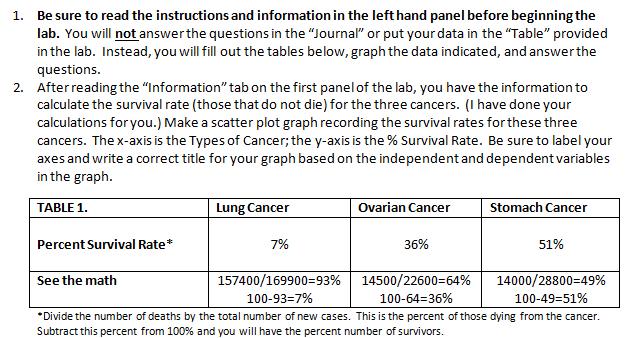
Write an appropriate title using the format "The Effect of (Independent Variable) on the (Dependent Variable)"
According to the calculations in Table 1, which type of cancer has the least chance of survival? k���8
Eating smoked, dried, salted or pickled foods can increase the chance of
For females, the older you are the more at risk you are for
Being male increases your risk for
If you need to tally the phases on a separate sheet of paper, you can use the bottom of your POI's data sheet. You may also submit your work on that sheet instead of filling the table out here. If you select to use the paper for submission of the Table, you still have to complete the graph using the information from the Table that follows.
Complete the scatter plot graph comparing the percent of cells at rest (interphase) vs the percent of cells dividing for all three cancers. The x-axis is the type of cells and the y axis is percent. Be sure to label axes appropriately. Give the graph a proper title based on independent and dependent variables. Don't worry about the Key since we are filling in the information a different way.
Based on your data and observations, describe some of the differences between normal and cancer cells. Find the incorrect (false) statement.
Study the graphic which has more recent statistics about survival rates of cancer compared to what you entered into Table 1, 1995, in the virtual lab.
While prostate and breast cancers are the most common cancers in men and women, their survival rates are very high, 98% and 89%, respectively.
Your data found ovarian cancer to be the most agressive cancer of the three, however, it appears that great strides have been made in treating ovarian cancer because survival rates have increased from 30% to 45%.
Your data found stomach cancer to be the least agressive cancer of the three, however, survival rates have decreased from about 50% to 24%.
Back to our "Who Done It". If your data collected on the POI's was truly valid and indicative of whether they killed HH, rank the POI's from most likely to least likely.
You are going to fill out only one of the diagrams based on whether the reaction was endothermic or exothermic. Tell me which one it is.
Enter the ending temperature in Celisus.
Enter the length of time it took for the reaction to go from start to finish. Put your answer in minutes/seconds.
Enter the beginning temperature in Celisus
Enter the ending temperature in Celisus.
Enter the length of time it took for the reaction to go from start to finish. Put your answer in minutes/seconds.
Identify this structure
Identify this structure and its function
This is smooth ER and it helps with detoxifying alcohol and drugs.
Something that the mitochondrion has in common with the Gogli Apparatus and the rough ER is that it has lots of folded membranes that increases the surface area for chemical reactions to occur.
Write the label for the y-axis
Write the label for the x-axis
The scale for the y axis begins at 0 and each tick mark is in increments of 5. You do not have to answer anything here. There are no points attached to this question.
This mark is for the first number in Table 1, 7% . Tell me the label for 7%.
This mark is the next value, 36%. Tell me its label.
This mark is the next value, 51%. Tell me its label.
Give an appropriate title based on the format "The Effect of IV on DV"
Give the label for the y axis. The y axis starts at 0 and each tick mark is an increment of 5 up to 100.
Give the label for the x axis
This is the dividing cells for normal lungs. Don't include % after the number, just give the number.
This is the resting cells for normal lungs. Don't include % after the number, just give the number.
This is the dividing cells for cancerous lungs. Don't include % after the number, just give the number.
This is the resting cells for cancerous lungs. Don't include % after the number, just give the number.
This is the dividing cells for normal ovary. Don't include % after the number, just give the number.
This is the resting cells for normal ovary. Don't include % after the number, just give the number.
This is the dividing cells for cancerous ovary. Don't include % after the number, just give the number.
This is the resting cells for cancerous ovary. Don't include % after the number, just give the number.
This is the dividing cells for normal stomach. Don't include % after the number, just give the number.
This is the resting cells for normal stomach. Don't include % after the number, just give the number.
This is the dividing cells for cancerous stomach. Don't include % after the number, just give the number.
This is the resting cells for cancerous stomach. Don't include % after the number, just give the number.