DBQ: Congress and Special Interests
star
star
star
star
star
Last updated over 8 years ago
11 Nsɛmmisa
Hyɛ no nsow a efi ɔkyerɛwfo no hɔ:
DBQ: Should the United States authorize drilling for oil in Alaska.
1
1
1
1
1
1
1
1
1
1
1
DBQ: Should the United States authorize drilling for oil in Alaska.
Write this as an argument to persuade a member of Congress who has to make a decision.
Avoid writing with I, Me, My, You, We, Us.
Focus ENTIRELY on FACTS. NO OPINIONS by themselves.
This should be viewed as a educational paper where facts are presented to prove your point
You can pick either side to act as a Special Interest Lobbyist. What you are trying to argue is:
Should the United States drill for oil in Alaska’s wilderness?
DBQ Instructions:
Remember:
1. No 1st person (I, me, my) writing style. I should not see a sentence that says "I think that the Constitution" or "What I mean is..." Just say "The Constitution" or "The American people"
2. Write for Grandma - explain what you mean. This requires more sentences and clarity
3. Listen to the voices in your head - the thoughts going through your mind that provide clarity to you should be used in the DBQ
4. Details are your friends but Mr. Parry DOESNT KNOW THEM, so be sure to include them.
5. Documents don't talk so DO NOT SAY "the document says".
6. VOCABULARY MATTERS - Write clearly using the English language. Don't abreviate words, and work on learning how to use vocabulary words so that you can use 1 word that has a meaning behind it instead of having to explain yourself in a long sentence. Ex. I want you to be cognizant of writing expectations. I use that word instead of saying I want you to be aware of or have knowledge regarding writing expectations.
7. DO NOT write about what the documents have in them. Documents have facts that you look at and then use as examples to prove your point. This is NOT a DBQ about what the documents have in each of them. Writing this way equals an automatic ZERO. Be COGNIZANT so you don't waste your time and effort.
8. CITE all of your work. You are not an expert, you don't even have an educational degree. You are getting information to support your belief FROM a document someone else has provided who is an expert. You MUST cite the document as (Doc A) or (Doc B) or (Doc C) or (Doc D) at the END of the sentence. Failure to do so is stealing that work and is plagiarism and results in a automatic ZERO. Changing a word or two is still plagiarism so be sure to use your own words. Be COGNIZANT so you don't waste your time and effort.
Example: The American government under Federalism has a complex process of powers assigned to each branch. These additional powers form what is classified as "checks and balances", enabling each branch to exercise power over the other two branches to thwart their attempts at acting in a tyrannical manner (Doc C). For example, the executive branch has the power to Veto bills passed by Congress and prevent them from becoming a law that could endanger the rights of the American public (Doc C).
DBQ Structure:
1. Intro Paragraph - Background information and Thesis
2.Support Paragragh #1
A. Topic Sentence
B. Argument and supporting Detail for the topic sentence
C. Examples
3.Support Paragragh #2
A. Topic Sentence
B. Argument and supporting Detail for the topic sentence
C. Examples
4.Support Paragragh #3
A. Topic Sentence
B. Argument and supporting Detail for the topic sentence
C. Examples
Conclusion Paragraph
A. Restate your thesis / argument
B. So What? This is where you need to summarize your main points.
Background Reading. Read the following and answer the questions at the end. These questions will help develop your introduction paragraph.
The conservation of our natural resources and their proper use underlies almost every other problem in our national life. - Theodore Roosevelt, June 10, 1907
During the first 200 years of its settlement, America seemed a country with no
limits. When Thomas Jefferson finalized the Louisiana Purchase, he believed it would provide
the nation with endless resources. In the next 64 years America would add Florida, California
and the Mexican Cession, Oregon Country, and then Alaska. With all this land, America’s
natural riches would surely last forever.
But forever is a long time, especially when so many settlers saw the wilderness as a big candy store.
Fortunately, there were some farsighted people who realized that the candy store should not be open all the time. In fact, there were some aisles in the store that should be
closed down. In 1872 Congress set aside a piece of land in Wyoming, establishing Yellowstone as the
country’s first national park. This was followed by the first forest reserve in 1891 and the first wildlife
reserve in 1903. By the time Congress and President Woodrow Wilson established the
National Park Service in 1916, there were 40 national parks and monuments to place
under its care.
Flash forward to 1980. Events in the Middle East were making Americans aware of
How fragile the oil supply lines were. The United States was importing more than a
third of its oil. If oil from the Middle East were cut off, how would America keep its
economy running?
One answer to the crisis was to use less oil. Some Americans did switch to smaller
cars. Another answer was to drill for more oil here at home. Indeed, the largest oil
field in North America had recently been discovered in Prudhoe Bay on the north
coast of Alaska. Prudhoe Bay would soon account for 20% of all domestic US
oil production.
Given the concerns about oil in 1980, it is surprising that, in that same year,
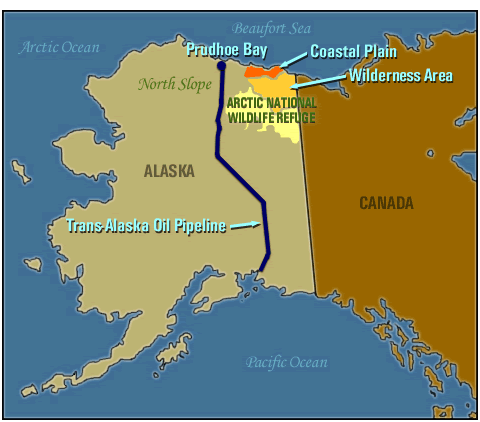
Congress created a wildlife reserve just east of Prudhoe Bay. The Arctic National
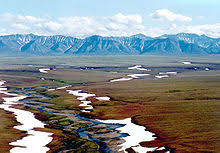
Wildlife Refuge (ANWR) was established to protect native plants and animals from
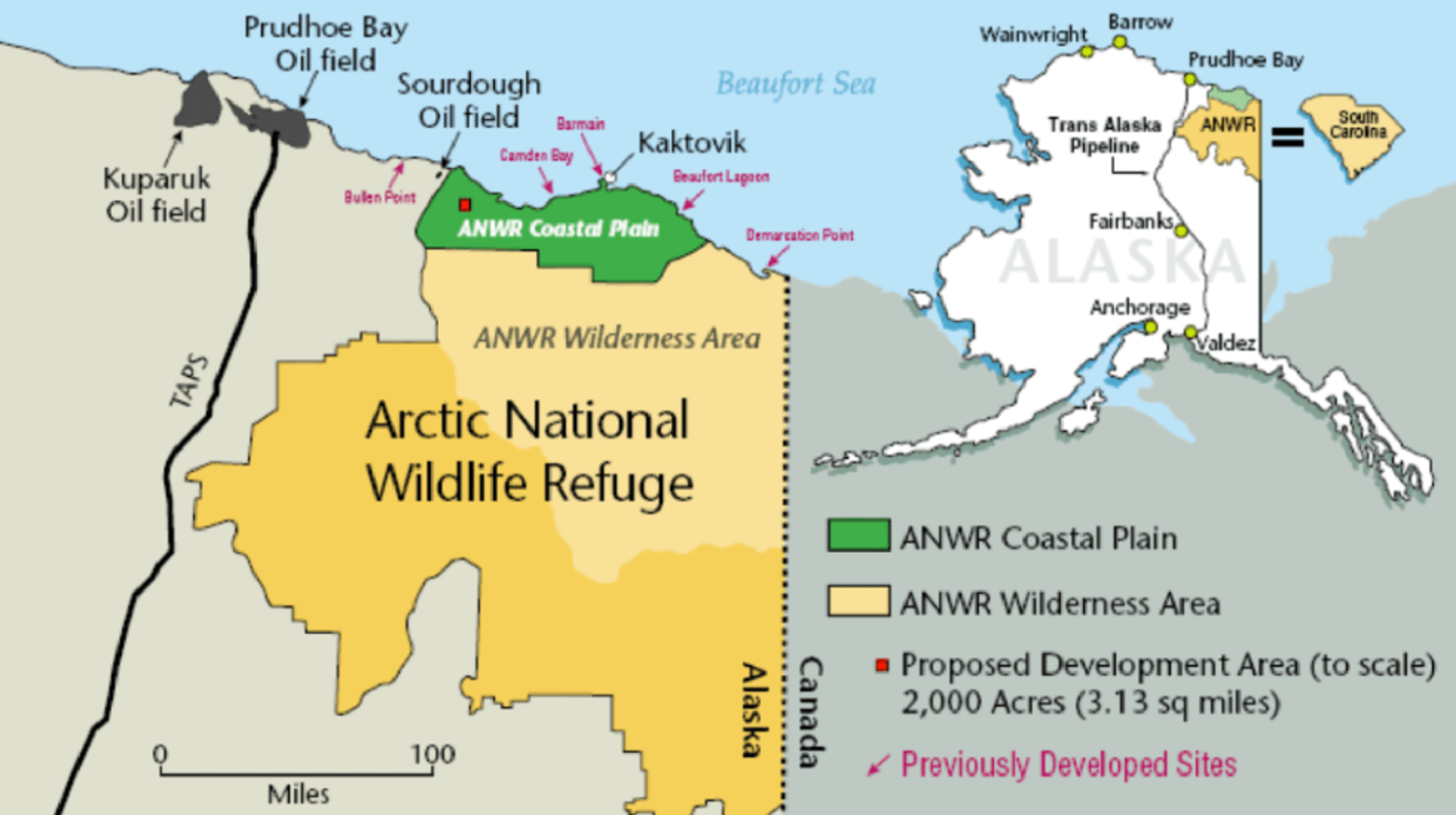
human interference. The refuge would cover 19 millions acres, an area about the size of
South Carolina.
To protect the ecosystem, most of ANWR was declared closed to oil exploration.
However, the act did give Congress future power to allow drilling in a 1.5 million acre stretch
along the shore where oil reserves are believed to be. Since then, Special Interests
have battled in Washington about opening up the refuge to drilling.
In recent years, advances in drilling technology have made it easier to access oil
reserves in the US. Hydraulic fracturing (“fracking”) is a process in which water,
sand, and chemicals are forced into underground rock, releasing deposits of oil and natural gas. Many say that fracking is dangerous to both the land
and human health, while others argue that it has reduced US dependence on
foreign oil.
In early 2015, with the oil crisis at bay, President Barack Obama proposed
legislation that would forever ban drilling in ANWR. However, it is likely that
Congress will resist any such bill, so the debate continues.
1. Why weren’t many colonial Americans concerned about protecting natural resources?
2. In what year was the National Park Service established?
3. In what two basic ways did Americans deal with the gas shortage of 1980?
4. Did the ANWR legislation of 1980 permit any oil drilling? Explain.
5. What change regarding ANWR did Barack Obama propose in 2015?
Document A Questions:
1. What is the name of the human settlement on the north coast of the Refuge?
2.Look at the areas along the coast, what would allowing the continued drilling of Previously Developed sites impact the integrity (safety) of the land in the Arctic National Wildlife Refuge?
3. If this land in the Arctic National Wildlife Refuge has been left in its natural state, how will building roads through the part be a problem?
4. The area in Yellow on the map could fit the state of South Carolina inside it. Would drilling in an area (RED DOT) that is as small as Washington County pose a problem to the entire Arctic National Wildlife Refuge? Explain.
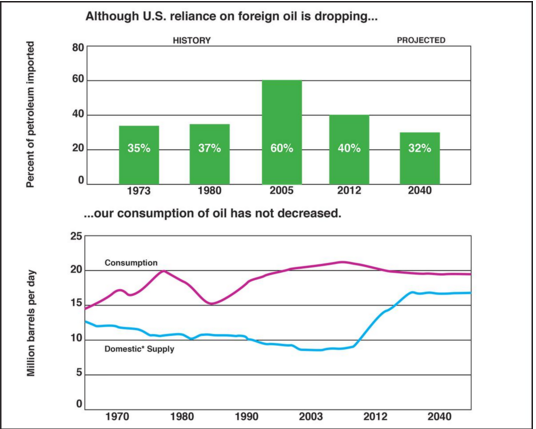
5. What does the chart show about American reliance upon Oil?
6. What does the chart show regarding consumption rates over the 70 year period of time?
7. Should the United States drill for oil in Alaska’s wilderness if it impacts local communities?
Document B Questions:
1. Why do you think the Alaska state legislature supports Arctic Power Oil and Electric Company desire to drill for more oil?
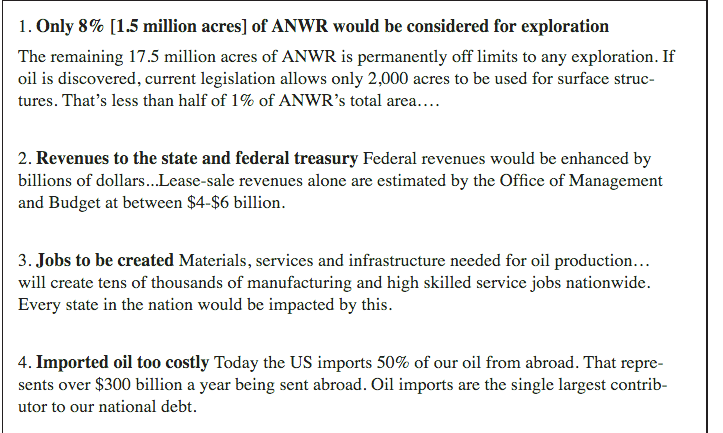
2. According to Arctic Power, what are three benefits to Americans from drilling in ANWR?
3. No oil is guaranteed to be found in ANWR, so should Arctic Power be allowed to do exploration drilling in the area on the map that is the red dot? Explain.
4. How much money would ANWR oil bring in to the US Treasury?
5. Should the United States drill for oil in Alaska’s wilderness if in the end it is more of a financial benefit to the nation?
Document C Questions:
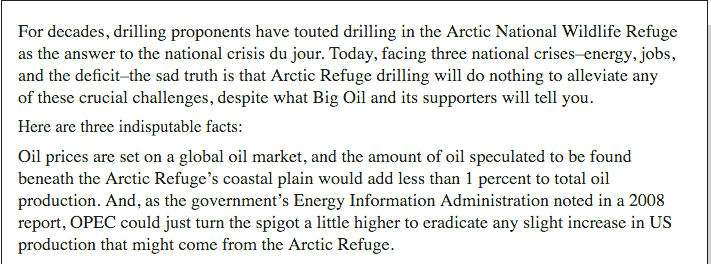
1. According to the document, what are three crises this country faces?
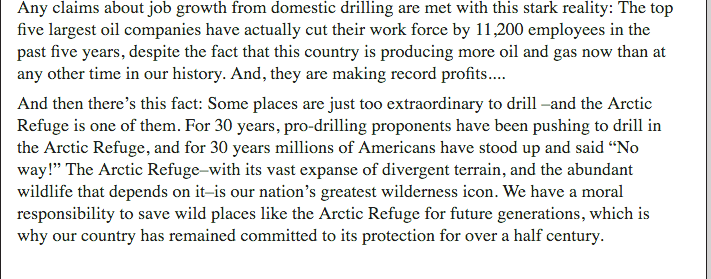
2. Would domestic drilling create job growth? Why or why not?
3. What does the author mean when she says that “some places are just too extraordinary to drill?”
4. What do you think is the best counter-argument against this editorial essay?
5. Should the United States drill for oil in Alaska’s wilderness if it's impact will ultimatley be a small impact on the larger oil drilling / supply process?
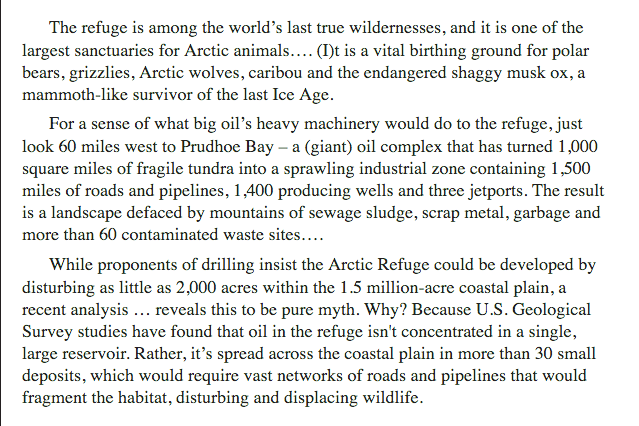
Document D Questions:
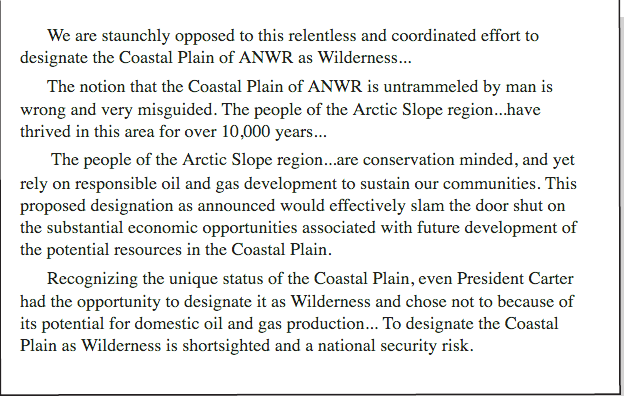
1. According to the release, why do the Inupiat support oil drilling in ANWR?
2. What do you think is the best argument against the press release’s position?
3.Should the Inupiats’ point of view be given special consideration by Congress?
Explain.
4.Part II, the document calls the Wildlife Refuge a “sanctuary” and a “birthing ground.”
What is the meaning of both terms?
5. According to the document, what are four ways that drilling can hurt the
environment?
6. Why does the document say that drilling on only 2,000 acres in ANWR is a myth?
7. Given this perspective, should the United States drill for oil in Alaska’s wilderness?
Create a thesis around this question: Should the United States drill for oil in Alaska’s wilderness?
Intro Paragraph Background Info. That these facts, expand upon them, and turn it into a flowing paragraph. Review the questions to the background essay, take those and tie them into a 4-5 sentence paragraph
BODY 1 Paragraph: How does this impact the environment?
First, create your topic sentence based on this concept: Should the USA drill for Oil in Alaska's Wilderness (BUT focus on Environmental Impacts)
Next, make an argument for or against depending upon your viewpoints BUT keep it specific to Environmental Impacts.
Third, give examples
Fourth, explain why this is supports drilling or not drilling in Alaska.
BODY 2 Paragraph: Does drilling make a positive impact on the Economy?
First, create your topic sentence based on this concept: Should the USA drill for Oil in Alaska's Wilderness BUT focus on the impact to the economy
Next, make an argument for or against depending upon your viewpoints BUT keep it specific to its impact the economy.
Third, give examples.
Fourth, explain why this is supports drilling or not drilling in Alaska.
BODY 3 Paragraph: Does drilling make a positive impact on the Native Communities?
First, create your topic sentence based on this concept: Should the USA drill for Oil in Alaska's Wilderness BUT (focus on the impact to the native populations - will this benefit them or not)
Next, make an argument for or against depending upon your viewpoints BUT keep it specific to its impact the native communities.
Third, give examples.
Fourth, explain why this is supports drilling or not drilling in Alaska.
Conclusion Paragraph:
Restate your thesis
Summarize your main points