1
1
1
1
1
1
1
1
1
2
2
2
2
2
2
density practical
Directions:
1. Go to phet.colorado.edu/sims/density-and-buoyancy/density_en.html
2. Use the simulation to answer the questions on this handout.
What is the volume of the water now? (don't forget the units)
By how much did the volume of water change? (don't forget the units)
Is this the volume of the block of wood? Why or why not?
Use the green triangle to make the mass of the wood block around 5 kg. Does the wood still float?
What happens to the volume of the wood as you make the mass smaller?
What happens to the volume of the wood as you make the mass bigger?
What happens to the density of the wood as you make the mass bigger or smaller?
What is the density of Brick? (don't forget the units)
If aluminium has a mass of 8.56kg, what will its volume be? (don't forget the units)
Click on “Reset All” in the bottom right hand corner. Click on the circle for “Same Mass.” on the top right side of the screen.
All blocks now have a mass of 5 kg.
Which colour blocks float?
What density value will determine whether the block floats ?
-Click on “Mystery” in the upper right hand corner.
-You will see 5 blocks labeled A, B, C, D, and E.
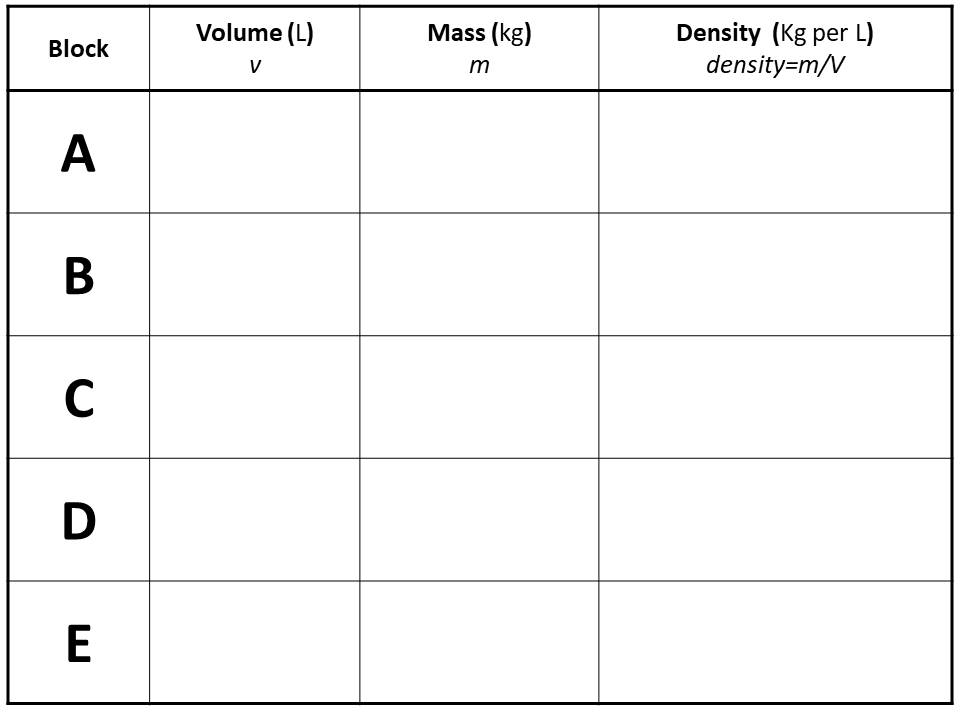
-One at a time, take a block, lower it into the liquid, and record its volume. If it floats, you will need to
hold it under the water to record its volume.
-Use the scale to determine each block’s mass.
-Then Calculate each block’s density. *Remember density = mass ÷ volume.
Record your results in the table below. (Round off to 2 decimal places)
A:
B:
C:
D:
E: