Photosynthesis Overview - Chapter 4.2 - 30 pts
star
star
star
star
star
Last updated about 7 years ago
26 Nsɛmmisa
1
3
2
1
1
1
1
1
1
1
1
1
1
1
1
1
1
1
1
1
1
1
1
1
1
2
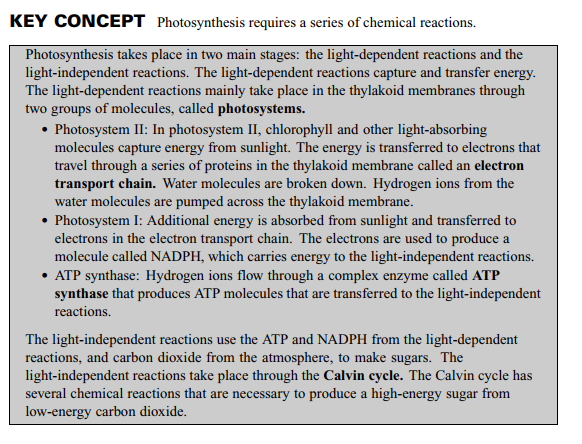
Watch Animated Biology at Classzone.com, Unit 2, Chapter 4, Photosynthesis
Go to classzone.com, Interactive Review, Chapter 4.2, Concept Map. Complete and then take a screenshot of your success and place it here.
Go to classzone.com, Interactive Review, Assessments, Chapter 4.2 and take the practice quiz. There are 5 multiple choice questions. After you submit and get your score, take a screenshot and place it here.
Vocabulary. Use each term in the word bank below once for the following 6 vocab questions:
Calvin Cycle electron transport chain photosystem
chlorophyll light-dependent reaction thylakoid
1. (Vocab) Coin-shaped compartment that contains light-absorbing molecules. You must type the term correctly to receive credit.
2. (Vocab) A series of chemical reactions that produces sugars from carbon dioxide. You must type the term correctly to receive credit.
3. (Vocab) A series of proteins in the thylakoid membrane that transfer high-energy electrons. You must type the term correctly to receive credit.
4. (Vocab) Two groups of molecules in the thylakoid membrane that capture and transfer energy. You must type the term correctly to receive credit.
5. (Vocab) Reaction that captures energy from sunlight and transfers energy to the light-independent reactions. You must type the term correctly to receive credit.
6. (Vocab) Light-absorbing molecule in thylakoid membrane. You must type the term correctly to receive credit.
The prefix "photo-" means
When talking about photosynthesis, the word "synthesis" means to bring together molecules to make glucose.
The prefix "chloro-" means
The suffix "-phyll" means
The Calvin Cycle is also called
Light independent means that light is required to complete the reaction.
Light dependent means that light is not required to complete the reaction.
Stomata are openings on plants that allow for gas exchange.
Photoinhibition is when the rate of photosynthesis is decreased or even stopped due to excessive light exposure resulting in the reduction of plant growth.
The distinction between C3, C4, and CAM plants is the intermediate substance that is made prior to the Calvin Cycle. These modifications allow C3 plants to grow in cooler regions, C4 plants to grow in hot climates, and CAM plants to grow in very dry environments.
Corn is an example of a C4 plant which can tolerate hot weather conditions.
Pineapple is an example of a CAM plant. The malic acid stored in the fruit can cause canker sores in your mouth when you eat too much fresh pineapple.
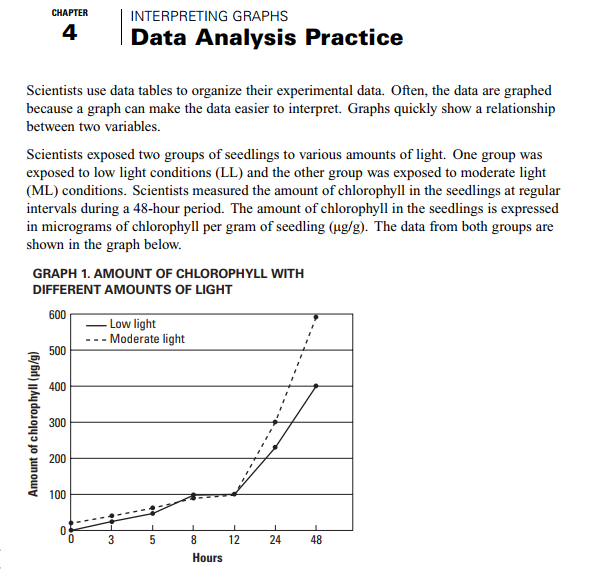
Approximately how much chlorophyll was present in the low-light plants after 24 hours?
Approximately how much chlorophyll was present in the moderate-light plants after 24 hours?
One similarity about the chlorophyll content between the low and moderate light seedlings is:
One of the differences in the seedling groups is
To which of the two lighting conditions would you expose seedlings if you wanted to maximize the rate of photosynthesis in the plants as well as minimizing your costs for electricity to light the plants in the greenhouse?