Log in
Sign up for FREE
arrow_back
Library

Particulate nature of matter

star
star
star
star
star
Last updated over 7 years ago
15 questions
Note from the author:
Introduction to the particulate nature of matter. After introducing the concepts through videos and a ChemThink interactive, students must apply what they've learned to answer a couple of questions.
1
1
1
1
1
1
1
1
1
1
1
1
1
1
1
Question 1
1.

What is matter made of?

Question 2
2.

Which two particles make up the nucleus of an atom?

Question 3
3.

What is the role of an electron in an atom?

Question 4
4.

Which of the following determines the type of element that an atom makes?

Question 5
5.

What is in between the nucleus and the electrons in an atom?

As you proceed through the interactive below, think about how the different particles that make up an atom behave. https://www.pbslearningmedia.org/resource/lsps07.sci.phys.matter.theatom/the-atom/#.Wyetm6dKjIU
Question 6
6.

The picture below shows a solid. In the blank box below it draw how particles are arranged in solids

Question 7
7.

The picture below shows a liquid. In the blank box below it draw how particles are arranged in liquids

Question 8
8.

The picture below shows a gas. In the blank box below it draw how particles are arranged in gases.

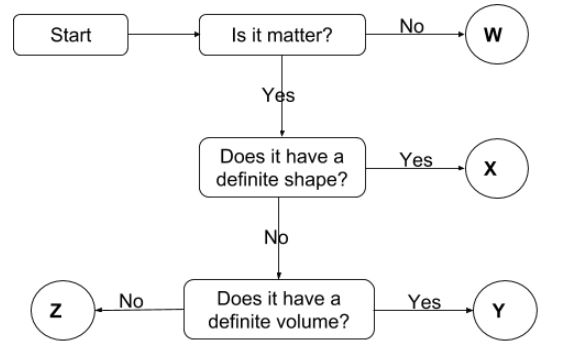
The flowchart below describes four different substances. Study the flowchart and answer the questions that follow.
Question 9
9.

Which of the substances X, Y or Z are made up of tiny particles?

Question 10
10.

Refering back to the flowchart, which letter can be used to represent water?

Question 11
11.

Refering back to the flowchart, which letter can be used to represent sound?

Question 12
12.

Refering back to the flowchart, which letter can be used to represent glass?

Question 13
13.

Is Z a solid, a liquid or a gas?

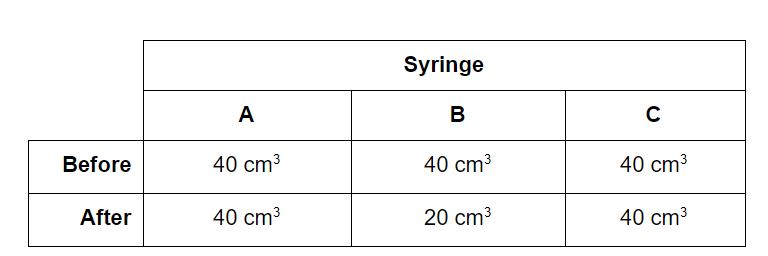
Laura filled three syringes, A, B and C, with 40 cm3 of matter each. She then tried to push the plungers in. She recorded the markings the plungers were at before and after the experiment. The table below shows her findings.
Based on her findings, Laura drew two conclusions:
Conclusion 1: Syringes A and C must contain solids.
Conclusion 2: Syringe B must contain a gas.
Question 14
14.

Which of her conclusions are correct/incorrect?
Think about which states of matter have a definite volume.

Question 15
15.

Explain your answer to the previous question.