Discovery of the Genetic Material - 10 pts

Last updated over 6 years ago
14 questions
Note from the author:
Video clips and written text about how scientists figured out that the genetic material was DNA instead of proteins.
1

Last Name, First Name

1

Class Period:

0

Date

It may be hard to believe today, but there was a time in history when mankind did not know what the genetic material was that was passed down from generation to generation. Listen to the following video to begin your "history" lesson. (abt 18 mins)
Here is a summary of the same experiments shown in the video. This information comes from your textbook "Reinforcements".

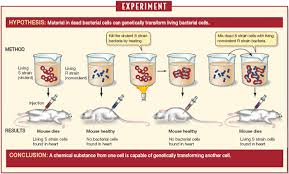
A series of experiments helped scientists recognize that DNA is the genetic material. One of the earliest was done by Frederick Griffith who was studying two forms of the bacterium that causes pneumonia. The "S" form was surrounded by a coating that made them look smooth. The "R" form did not have a coating, and the colonies looked rough. Griffith injected these bacteria into mice and found that only the "S" type killed the mice. When the "S" bacteria were killed, they did not cause the mice to die. However, when killed "S "bacteria were mixed with live "R" bacteria, the mice died and Griffith found live "S" bacteria in their blood. This led Griffith to conclude that there was a transforming principle that could change "R" bacteria into "S" bacteria.

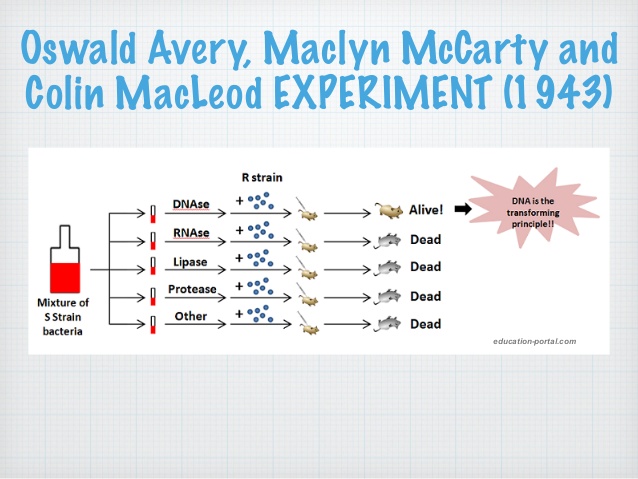
Oswald Avery, another scientist, developed a way to purify this transforming principle. He then conducted a series of chemical tests to find out what it was. Many scientists thought that DNA was too simple of a molecule to be the genetic material and that proteins, being more complex, were a better candidate. However, Avery made three key discoveries about his samples of transforming principle that showed otherwise:

• DNA was present, not protein.
• The chemical composition matched that of DNA, not protein.
• The addition of enzymes that break down DNA made the transforming principle inactive. The addition of enzymes that break down proteins or RNA had no effect.

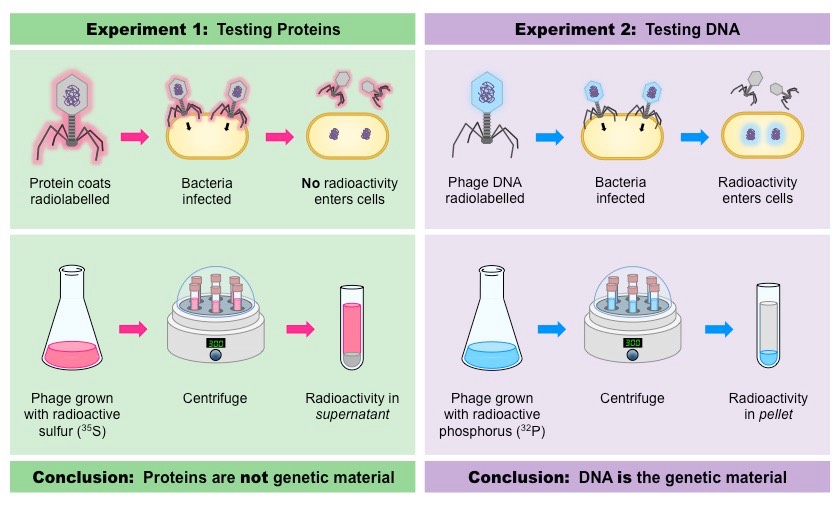
Alfred Hershey and Martha Chase carried out the final, conclusive experiments in 1952. Bacteriophages are viruses that infect bacteria and take over bacteria’s genetic machinery to make more viruses. They consist of a protein coat surrounding DNA. Hershey and Chase grew these viruses in cultures containing radioactively labeled sulfur, a component of proteins, or phosphorus, a component of DNA. Bacteria were then infected with viruses that either had radioactively labeled sulfur or phosphorous. Hershey and Chase next separated the viruses from the bacteria with a blender. The bacteria had radioactive phosphorus but no radioactive sulfur. Hershey and Chase concluded that the viruses’ DNA, but not the protein coat, had entered the bacteria.
1

Explain why scientists preferred proteins as the source of genetic material over DNA.

1

Review Hypothesis: Using the figure above of Griffith's experiment, the hypothesis rewritten to follow proper formatting could be: If genetic material in a dead bacterial cell can be transformed, then another living bacterial cell will inherit the material and express its traits.

1

Review Scientific Method: Griffith's conclusion was that a chemical substance from one cell is capable of genetically tranforming another cell.

1

Which type of bacteria caused a disease, the S form or the R form?

1

Although Griffith did not have the knowledge about DNA that we have today, what was "transformed" in Griffith's experiment? (one word answer - spell correctly to receive credit)

1

One of the key discoveries Avery's work contributed to the discovery of the genetic material was that enzymes that break down DNA made the tranforming principle inactive. Enzymes that break down proteins or RNA had no effect on the transforming material.

1

Bacteriophages are bacteria that infect other bacteria and take over their genetic machinery to make more of themselves.

1

Hershey and Chase were able to see whether the backteriophage moved genetic material because they used _____________ labels to attach to sulfur and phosphorus. (one word - spell correctly for credit)

1

Sulfur was part of (proteins or DNA).

1

Which molecule entered the bacterium in their experiments?

1

Which molecule is a major component of DNA?

As stated at the end of the video when DNA was identified as the genetic material, many questions remained and one of them was what was DNA's structure. A new race among scientists began as they each tried to understand the chemical makeup of DNA and how it was arranged (to create a model of its structure). Watch the next video "The DNA Double Helix Discovery" to learn about the scientists involved in the next step to understanding genetics. (abt 17 mins) These scientists won a Nobel Prize for identifying the structure of DNA and how it stored information and copied information into new cells.