Vocabulary quiz 04/26/2019 cloned 5/23/2019
star
star
star
star
star
Last updated almost 4 years ago
21 Nsɛmmisa
1
1
1
1
1
1
1
1
1
1
1
1
1
1
1
1
1
1
1
1
1
Offspring that are the result of sexual reproduction are:
Which of the following organisms reproduce sexually?
Which of the following is an example of asexual reproduction?
Which of the following statements is TRUE?
Process by which organisms make exact copies of themselves without the union of gametes (sperm and egg cells).
A change in the DNA of a gene that can lead to a different trait.
An offspring produced by asexual reproduction, either naturally or through artificial processes.
An individual’s pair of alleles for a specific gene or group of genes that determine a trait.
An organism’s observable traits.
An organism that has two identical alleles for a specific trait.
An organism that has two different alleles for a specific trait.
A genetic trait is represented by the letter “a.” Which of the following would most likely be used to represent the recessive condition?
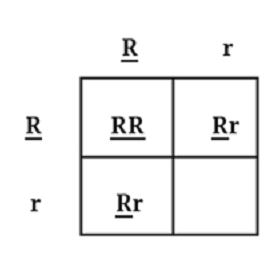
In the table shown above, the empty square should be filled in as:
In the table shown above, among the offspring, what is the ratio of dominant to recessive for this trait?
In the table shown above, the dominant condition of this characteristic is represented by:
In the table shown above, the probability of traits in offspring is a result of:
One of the first people to study patterns of heredity scientifically was:
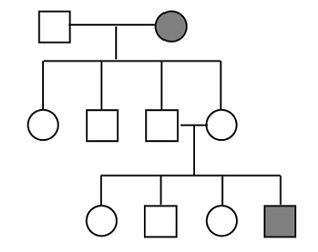
Look at the shaded inividuals. They have a certain trait. The white circles and boxes have a different trait. By studying the diagram, you can conclude that the trait is:
Most human cells have ____ copies of each chromosome.
Which genotype is homozygous recessive
Which genotype is homozygous dominant