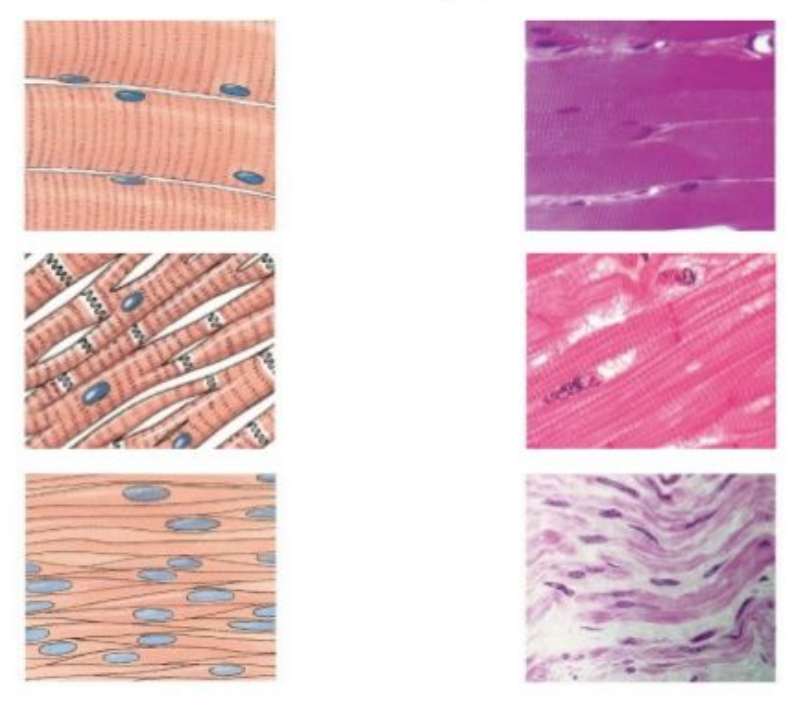
1
Which type of muscle tissue is this?
Which type of muscle tissue is this?
1
What type of muscle tissue is this?
What type of muscle tissue is this?
1
What type of muscle tissue is this?
What type of muscle tissue is this?
Which type of muscle tissue is this?
What type of muscle tissue is this?
What type of muscle tissue is this?
You kick a soccer ball which type of muscle is involved?
Which of the following would be involved in peristalsis?
_________________ has branching fibers, one nucleus per cell, striations, and intercalated disks. Its contraction is not under voluntary control.
Which substances are needed for muscle contraction?

If the original length of a muscle strand is 42mm long and the final length is 37mm long, what is the percent contraction?
What is your answer from question #8? (Round to nearest whole percent)
When the muscle fibers shorten, the striations are getting closer together.
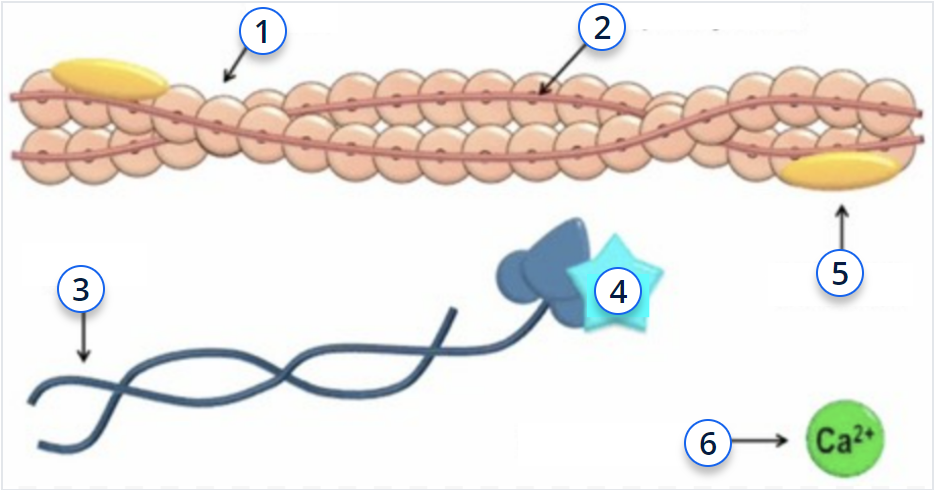
What is this structure?
What is this structure?
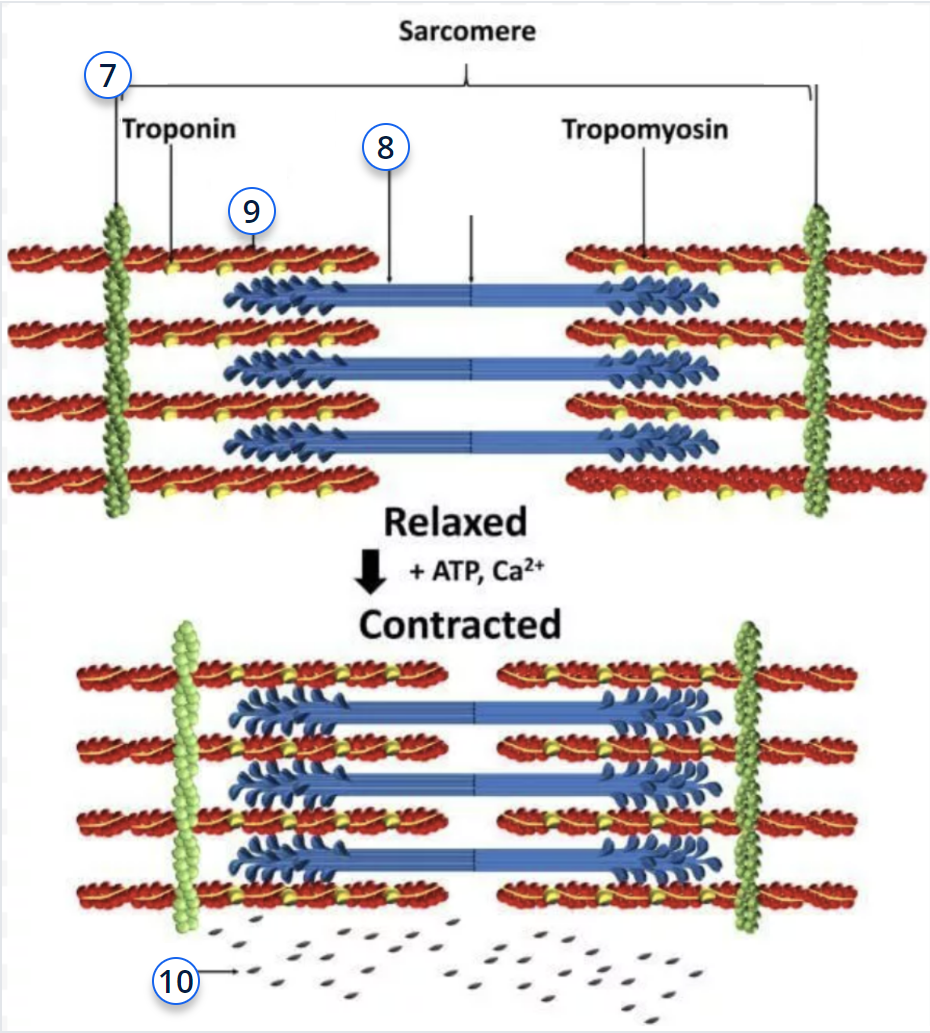
The green area here represents the
This structure is called (blue area)
This structure is called (red area)
These molecules that assist with sarcomere contraction are
The explanation of how thick and thin filaments slide relative to one another during striated muscle contraction to decrease sarcomere length is referred to as the (3 words)
Order the steps below in the correct sequence of muscle contraction.
Calcium is released from the sarcoplasmic reticulum.
After the cross-bridge forms, the myosin head rotates towards the center of the sarcomere. As it rotates, the myosin releases its ADP and phosphate.
Calcium binds to troponin on the actin filaments of muscle fibers. This signals tropomyosin to move out of the myosin binding sites on actin.
Acetylcholine then diffuses across the synaptic cleft and attaches to acetylcholine receptors on the sarcolemma at the neuromuscular junction.
This action slides the thin actin past the thick filament, creating the power stroke.
After the power stroke, the actin-myosin cross-bridge remains intact until an ATP molecule binds to the myosin head. After ATP attaches to myosin, the myosin detaches from actin.
Energized myosin heads, with an attached ADP molecule and phosphate group, bind to the open myosin binding sites on actin. This forms the actin-myosin cross-bridge.
As a nerve impulse reaches the ends of an axon terminal, it stimulates the release of acetylcholine from synaptic vesicles.
An action potential is generated and travels along the sarcolemma
Muscle cramps can be due to low levels of _____ . If these are deficient, the muscle cannot relax.
ATP is required for muscle contractions to relax.
If you exercise on an empty stomach and drink only water, you should have enough stored glucose to produce ATP.
What is this structure?
This energy molecule is required for muscle contraction
What is this structure?