Space #3: "Life Cycle" of Stars/Formation of Our Solar System
star
star
star
star
star
Last updated over 8 years ago
6 Nsɛmmisa
Hyɛ no nsow a efi ɔkyerɛwfo no hɔ:
SHMS
1
1
1
1
1
1
SHMS
This Formative assignment will be completed in sections as classwork and homework over about a week. Any unfinished classwork automatically becomes homework.
Points: 50 assignment points
SECTION #1: WHAT ARE STARS?
Stars are extremely hot, round masses of mostly hydrogen gas. Stars are held together by their own gravity and produce light and heat from the nuclear reactions that occur within them.
Before you continue studying what stars are, what they do, and how they begin and end, click on http://stars.chromeexperiments.com/ to take "A Tour of the Stellar Neighborhood," and look at some of the stars close to our solar system within the Milky Way Galaxy. Once you open the link, click on "Take a Tour" in the upper left corner and watch the simulated tour. Once it finishes, you may zoom in and out, rotate your view, and learn more about individual stars in our very large "neighborhood" in space.
After completing the tour, write 5 things you learned. Use complete sentences.
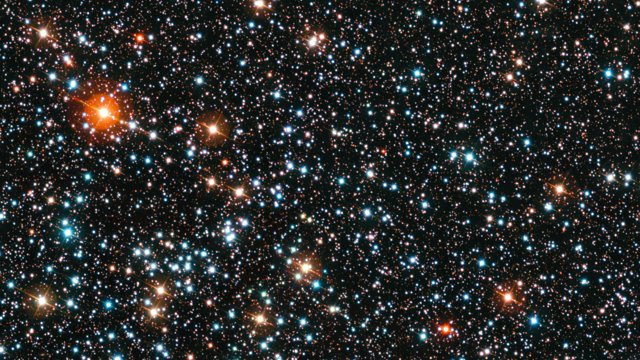
From Earth, we see the closest star to us, the Sun, every day. At night, you can see several more distant stars in the sky but they are a teeny-tiny fraction of how many stars exist in the universe. Believe it or not, there are five to ten times more stars in the universe than there are grains of sand on every single beach on Earth. The current rough estimate is that there are 10 sextillion (that's 22 zeros!) stars in the universe. There are 200 billion to 400 billion stars just in the Milky Way Galaxy alone.
Stars vary by mass, temperature, and luminosity, or brightness and can be put into categories based on these characteristsics. Most stars are smaller low-to-medium mass stars such as the Sun, which is a yellow dwarf star. The most common type of star in the universe are red dwarf stars which are cooler and smaller than other types of stars. The color of the star indicates its temperature. The hottest and largest stars are blue, medium-temperature stars are white or yellow, and cooler, smaller stars are red or brown.
High mass, or large stars, are called red or blue giants. Even bigger stars are called supergiants. The biggest of all are called hypergiants. The largest known star is a red hypergiant called VY Canis Majoris, which is 2,600 times wider than the Sun.
All stars are more massive than planets, which means stars have more gravity. If you consider all the matter (atoms) in our solar system, 99.8% of them are part of the Sun. The 0.2% of remaining matter is what makes up everything else--all the planets, moons, asteroids, comets, dust, and ice. This is why stars are always at the center of a solar system. Their strong gravitational pull is what holds planets in their orbits within the solar system they belong to.
The Sun is a ______________________ star.
Why are stars always the center of a solar system?
SECTION #2: THE LIFE CYCLE OF STARS
Even though stars are not living things, we think of them as having a "life cycle." All stars form, or are "born," and when they run out of the hydrogen fuel needed to do nuclear fusion, they "die." Just what happens to a star throughout its life cycle depends on its mass. Low mass stars like the Sun die differently than larger, high mass stars.
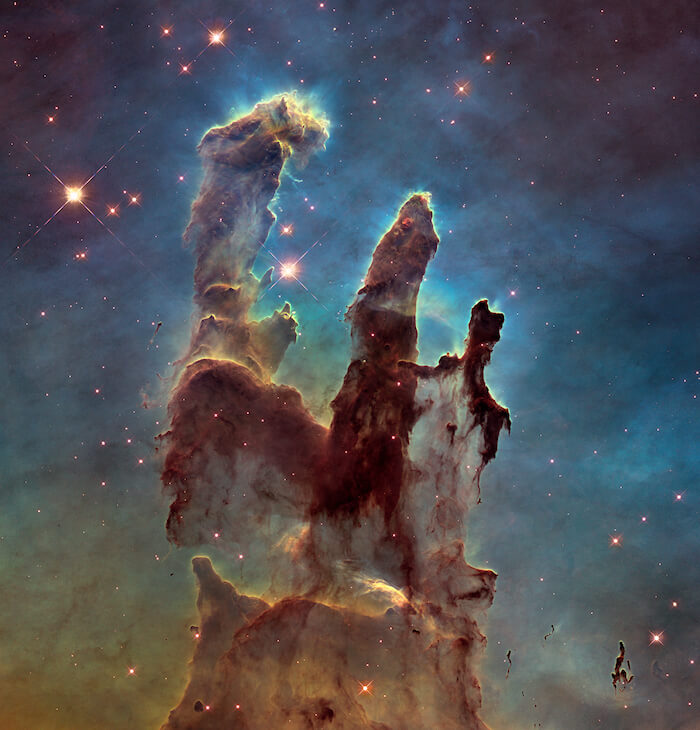
The picture above shows the "Pillars of Creation," a part of the Eagle Nebula. Brand new stars form and are "born" when hydrogen and helium gases clump up into a ball and become hot enough to begin shining.
A STAR IS BORN
Large or small, all stars form in gigantic clouds of gases and dust called nebulae. These clouds are much larger than solar systems and are found inside galaxies. One of these clouds by itself is called a nebula. Nebulae are beautiful and come in many different shapes. The telescope pictures we have of nebulae are colorful and complex. These images are made by viewing the nebula's different electromagnetic waves using special telescopes that take in different waves of light. This includes the visible light humans can see, as well as ultraviolet, microwave, x-ray, and infrared waves humans can't see. We can only see the entire nebula when we put all these images together.
The part of a nebula where new stars form is called a "stellar nursery." The word "stellar" means "star." Other parts of a nebula can form new planets that eventually become part of new solar systems. New stars are born when gravity clumps hydrogen and helium gas into a ball. As it gets bigger and bigger, pressure increases and it gets hotter and hotter. This round ball of gas is called a protostar and it does not shine yet. It is only when it becomes hot enough to begin a process called nuclear fusion that it starts shining and officially becomes a new star.
What element are stars mostly made of?
A ball of gases forms inside a nebula. It is getting hotter and hotter but it has not started shining yet. What is this called?
What does that ball of gases need to start doing in order to become a star?
MAIN SEQUENCE STARS
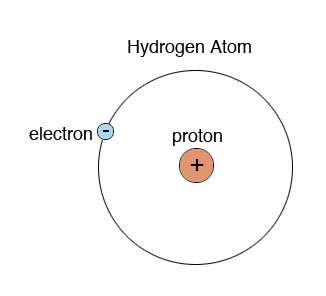
All stars shine and produce heat and light by a process called nuclear fusion. Just after the Big Bang, the first atoms formed. Almost all of these atoms were hydrogen, the simplest atoms there are because they are made up of only one proton and one electron. In fact, most of the regular matter in the universe is hydrogen and that is what stars are mostly made of.
Nuclear Fusion
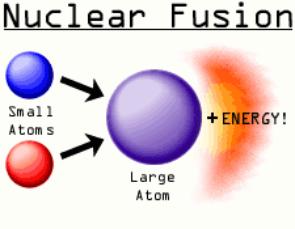
When a protostar becomes extremely hot and under enough pressure to become a new star, it starts smashing hydrogen atoms together. It forces them to crash together with so much force that two hydrogen atoms that each have one proton become one helium atom with two protons in its nucleus. When the nuclei of two small atoms are fused, or stuck togther, into one larger atom by a star it is called nuclear fusion. This process releases A LOT of energy in the form of light and heat. This is how stars shine.
As long as stars continue the process of nuclear fusion, they are called main sequence stars. This is what stars spend most of their existence doing. They smash smaller hydrogen atoms together to make larger helium atoms, and by doing so, they release huge amounts of energy. This energy includes heat, visible light, gamma rays, x-rays, infrared, microwave, and radio waves. 99% of the energy we have on Earth originally comes from the Sun doing nuclear fusion.
Stars will continue on in main sequence for a very, very long time. Smaller, low mass stars use up their hydrogen slowly and shine for billions of years. High mass stars use up their hydrogen quickly, making them hotter and brighter. However, large stars do not last as long, existing as main sequence stars for only millions of years.
Stars are so massive that they want to collapse in on themselves by the force of their own gravity. However, the huge amount of energy produced by nuclear fusion also makes them want to explode at the same time. As long as a star is in main sequence and doing nuclear fusion, the forces are balanced and the star will not collapse or expand. It will remain quite stable for a very long time.
It is when stars run out of hydrogen that they can no longer do nuclear fusion and begin to "die." When nuclear fusion can no longer occur, the forces are no longer balanced and that is when things get interesting.
Our Sun is average in every way. It is medium-sized, medium temperature, medium brightness, and about halfway through its lifetime. It formed in a nebula that provided the material for our solar system about 4.6 billion years ago. It has been an "adult" main sequence star for billions of years and it will continue on that way for billions more. Eventally, in about 5 billion years, the Sun will run out of hydrogen atoms and won't be able to continue nuclear fusion anymore.
When any star gets to this point, the crushing force of gravity and the explosive pressure of nuclear fusion are no longer in balance. The star begins to cool off. Gravity causes the core, the inner most part of the star, to shrink. The core becomes hot enough and under enough pressure to start nuclear fusion again. However, instead of fusing hydrogen atoms into helium atoms like it did before, it fuses helium atoms into even larger oxygen and carbon atoms. In the meantime, the outer layers of the star expand dramatically into space. This makes the star 10 times larger than it was before. When this happens to low-to-medium mass stars like the Sun, it becomes a red giant star. When the Sun becomes a red giant, it will expand just about to where Mars is, burning the surfaces of Mercury, Venus, and Earth as it does so. It will remain a red giant for about a billion years. Remember that this won't happen for 5,000,000,000 years. By that time, humans will have moved on to live on other planets or will have gone extinct.
The same thing happens to large, high mass stars when they run out of hydrogen. Gravity and pressure are no longer in balance and the core of the star shrinks. The core gets hot enough to start nuclear fusion again. Their second round of nuclear fusion produces elements up to iron. The outer layers of the star expand making it much, much bigger than it started out--some become 1,000 times larger than the sun. Due to their large size, high mass stars are called red supergiants when this all happens.