Log in
Sign up for FREE
arrow_back
Library
CRMS The Constitution Test
By Milissa Wechter
star
star
star
star
star
Share
share
Last updated almost 8 years ago
20 questions
Add this activity
4
4
4
4
4
4
4
4
4
4
4
4
4
4
4
4
7
7
7
15
Question 1
1.
Why is the U.S. Constitution called a “living document”?
A It has changed with time
B It is rewritten by each president.
C It has remained the same over the years
D It is signed each year by members of Congress
Question 2
2.
Why did the delegates start the Preamble to the Constitution with the words “We, the people”?
A to record that all the citizens wrote the Constitution
B to state that government power comes from the people
C to declare that the people were separating from Great Britain
D to provide an introduction that would interest readers
Question 3
3.
What is the primary work of Congress?
A to make laws for the country
B to debate whether laws are constitutional
C to determine who will be the candidate for president
D to be the chief executives of the states they represent
Question 4
4.
What is the final step before a national bill becomes a law?
A It is signed by the president.
B It is voted on by the citizens.
C It is passed by the Supreme Court.
D It is approved by the state legislators
Question 5
5.
Why does each state have two senators?
A to balance the rights of large and small states
B so the Senate does not become overcrowded
C to assure there are enough people to pass the laws
D so that one can take over if the other is unavailable
Question 6
6.
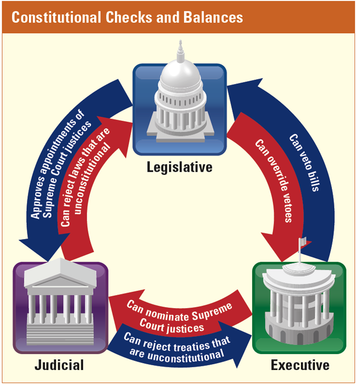
What is the purpose of the system of checks and balances?
A to list the responsibilities of elected officials
B to make it difficult to amend the Constitution
C to prevent any one branch from becoming too powerful
D to share power between state and national governments
Question 7
7.
All of these are duties of the executive branch except
A negotiating treaties.
B carrying out the laws.
C proposing new taxes.
D nominating federal judges.
Question 8
8.
Why does the Constitution establish the principle of majority rule?
A so decisions are based on what the president wants
B so decisions represent what most of the people want
C so decisions are made only when more than half of the people vote
D so decisions are made when most of the members of Congress are present
Question 9
9.
Which of these describes the responsibility of the judicial branch?
A to put laws into effect
B to resolve disputes under the law
C to veto decisions of the Supreme Court
D to propose bills needed to achieve justice
Question 10
10.
What name is given to the Supreme Court’s power to declare a law unconstitutional?
A federalism
B veto power
C impeachment
D judicial review
Question 11
11.
The U.S. population can directly participate in government in all of these ways except through
A passing laws.
B joining interest groups.
C participating in elections.
D belonging to political parties.
Question 12
12.
Which of these powers is shared by state and national governments?
A raising taxes
B declaring war
C printing money
D negotiating treaties
Question 13
13.
Which of these refers to the sharing of power between national and state governments?
A bicameral
B federalism
C commerce
D nationalism
Question 14
14.
An amendment to the Constitution can be ratified by three-fourths of the
A Senate
B citizens.
C state legislatures
D Supreme Court justices.
Question 15
15.
Which of these can propose an amendment to the Constitution?
A Congress
B governors
C presidents
D Supreme Court
Question 16
16.
All of these are advantages to having states share a common market except that
A it creates a single national economy.
B trade outside of the country is prohibited.
C a large business can be located in several states.
D goods and resources can move more easily across the country
Question 17
17.
How does the president balance the power of Congress?
Question 18
18.
How does the Supreme Court prevent the president and Congress from abusing their power?
Question 19
19.
How does Congress check the power of the president?
Question 20
20.
When you have finished the online part of the test, get the last question from Mrs. Wechter. Mark this answer "true"
True
False