waves final
star
star
star
star
star
Last updated almost 4 years ago
24 Nsɛmmisa
1
1
1
1
1
1
1
1
1
1
1
1
1
1
1
1
1
1
1
1
1
1
1
1
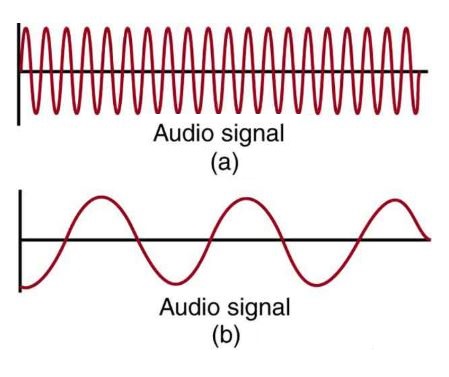
Which wave was played first?
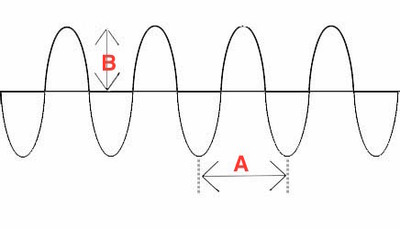
What property of this wave is represented by the letter "A"
Which wave was played second?
What property of the wave is represented by the letter "B"?
If a 60-dB sound increases to an intensity of 70 dB, about how much louder is the sound to you (not the intensity)?
The number of wavelengths that pass a point each per second is:
The lowest point on a wave is the:
The highest point on a wave is:
When the frequency of a wave increases, what happens to the wavelength?
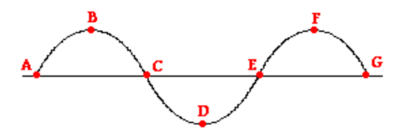
Which vocabulary term is used to identify the distance between points C & G?
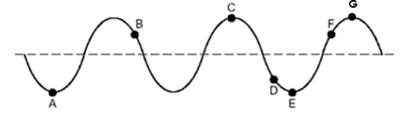
Which letter(s) represent the crest of the wave?
Which letter(s) represent the trough of the wave?
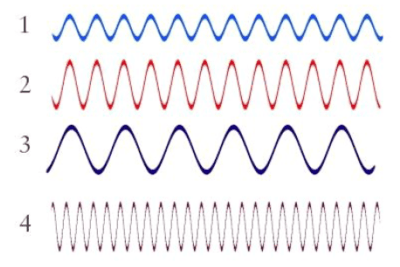
Which wave in the diagram has the greatest frequency?
Which wave in the diagram has the greatest wavelength?
Which of the following can sound travel through?
What is measured crest to crest or trough to trough
What are regular disturbances that carry energy through matter or space?
The amplitude of a wave is the
Frequency is
Which statement is NOT true?
One wave completes 4 cycles in 2 sec, and another wave completes 6 cycles in 1 sec. Which one has the higher frequency? Explain your response.
Describe one similarity and one difference between a longitudinal wave and a transverse wave.
If the frequency of a sound increases, what happens to its wavelength?
Explain noise-induced hearing loss, and provide three ways a person can prevent it.