The Oak Processionary moth
star
star
star
star
star
Last updated over 6 years ago
15 questions
Note from the author:
Listening and reading comprehension about the oak processionary moth. Originally created for an ESL class for foresters.
1 point
1
Question 1
1.
Which complaints can the oak processionary moth's caterpillar cause in humans (multiple answers)?
1 point
1
Question 2
2.
How can you help the forestry commision reduce this problem (name 2 things)?
1 point
1
Question 3
3.
Why are they called oak procession moths?
Oak processionary moth (OPM) – Time to learn to live with it!
The oak processionary moth, which defoliates oak trees and sheds toxic hairs, is well established in northern
Europe, including London. The current Defra/Forestry Commission Programme slows down the spread,
but cannot forever prevent it. The financial and environmental costs of the twice-yearly spraying are out of
proportion to the effects of the pest. Patrick Mannix, who has owned, managed and worked Sandhurst Copse
and Sheepwalk since acquiring the woodland in 2000, prepares to live with the OPM in ancient woodland in
the Surrey Hills AONB.
1 point
1
Question 4
4.
Why can't they simply spray to prevent the spread of this moth.
THE OPM is a native species of central and southern Europe. Its range has been expanding northwards
through Europe and it is now well established in Germany, northern France, Belgium and the Netherlands. In 2006 colonies of larvae were discovered in parts of London.
The larvae (caterpillars) of OPM feed on the foliage of many species of oaks. As well as being a defoliator of oak
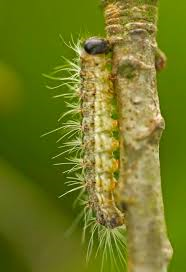
trees, OPM can also pose a risk to human and animal health. The larvae are covered in hairs that contain a toxin.
Contact with this toxin can result in irritation of the skin and respiratory tract. Where OPM is found on urban trees,
along forest edges and in amenity woodlands, there is a risk of public exposure.
1 point
1
Question 5
5.
Which of the following is true?
Efforts to control OPM in the UK began after its discovery in 2006. Between 2006 and 2011, UK
government policy was to eradicate all OPM outbreaks. In 2011, the policy objective for south-west London was
changed from eradication to containment.
Defra/Forestry Commission have published their OPM Operational Programme for 2017/18. The map
shows a core zone in which the pest is established and and no control of the pest is being carried out, except
by individual land owners. The surrounding area is designated as the Control Zone, in which the objective is
to slow the rate of spread of OPM and reduce the impact, the costs paid for by Defra. Within the control zone there
are a large number of distributed infected sites to the east of the core zone and dense clusters to the south and south
west, in particular to the north of Croydon and Bromley and to the north of Guildford. The latter are designated as
protected zones in which there is more vigorous action, to avoid the establishment of such epicentres for spread of the
pest, paid for by Defra.
1 point
1
Question 6
6.
Who pays for the eredication of the OPM? (multiple anwers possible)

I own and work Sandhurst Copse and Sheepwalk, partly ancient, mixed broadleaf, woodland in the Surrey Hills
AONB. The woodland is about five miles from Ockham, which is in the infected cluster to the north of Guildford,
in the protected zone. With open country and many oak trees between the two, without control the OPM could
arrive within two years.
The current aim is to attempt eradication in the protected zones. However, the scale of infestation, the
limited windows for effective action by spraying (mid April to mid May) and nest removal (mid June to mid
August) caused by the life cycle of the moth, and practical problems on site mean that it is not possible to achieve
eradication. Practical problems include access to sites, the significant variation in budburst dates between individual
oaks, which affects the spraying window, and difficulty in finding some of the nests. The Defra programme has been
successful in greatly restricting the spread of the OPM; the question is whether it is sustainable, and are the costs
and the environmental damage commensurate with the damage that might otherwise be caused by the OPM?
1 point
1
Question 7
7.
It is quite easy to eradictate the OPM.
OPM has been well established since the 1980s in northern France, Germany, Belgium and the Netherlands. In the UK the inexorable expansion of the infected area around the original location in south-west London suggests that there is a high probability of infection reaching Sandhurst Copse and Sheepwalk. I believe that the appropriate strategy is to prepare to live with the moth.The first step is to improve understanding of the actual risks, which may turn out not to be as great as feared.
1 point
1
Question 8
8.
What does the word inenxorable mean in Dutch?
The OPM caterpillars defoliate oak trees in the spring; but so do other species. About ten years ago I
reported complete defoliation of oak by winter moth caterpillars; but failed to raise any interest from the
Forestry Commission Research at Alice Holt. Oaks have a second growth spurt to compensate for such attacks.
Repeated annual defoliation may weaken a tree, making it more susceptible to attack by other pests, pathogens or
diseases; but OPM on its own typically does not kill trees. Physical nest removal can be undertaken to protect an
important vulnerable tree where the costs are justified.
1 point
1
Question 9
9.
The OPM can itself cause the death of an oak tree.
OPM caterpillars, after their third stage, bear very small hairs, setae, which are toxic and can cause skin irritation
to people and animals. These are not the same as the easily visible hairs. If under threat it is reported that the
caterpillar can eject these setae.There is a May 2015 report from Public Health England, ‘Health effects of exposure to setae of Oak Processionary Moth larvae – Systematic review,’ which reviews peer-reviewed papers for references to OPM impact on health in Europe where the moth has been established for some time. This concludes that only about 5%
of people are sensitive to these hairs. There are no confirmed reports of hospitalisation, anaphylaxia or death from OPM.
1 point
1
Question 10
10.
Which is true?
Which is true?
In discussion with parties involved in the current operations, I have concluded that if OPM does arrive
in Sandhurst Copse and Sheepwalk the only effective programme to eradicate the pest in relatively dense natural
mixed broadleaf woodland would be aerial spraying. However, this would kill all caterpillars on all vegetation
at the time of spraying, with significant consequences for other dependent species. The disruption and pollution
of ancient woodland would not be acceptable and out of proportion to the actual risks and harm from the pest.
Walkers are permitted in the woodland on specified footpaths. They apply for and are given written permission.
I refer to this as ‘managed access’. There is a mailing list for walkers to receive an annual newsletter and information/
advice on topics such as OPM. There are also regular school visits, currently in particular with severely autistic
children. If OPM is detected in the vicinity then we must assume it will move into the woodland. All parties would
be advised.
1 point
1
Question 11
11.
Why does the author not agree in spraying to eradicate the OPM in this area?
We need good factual information and advice distributed to landowners, schools, GP surgeries, medical centres, etc,
and calm advice disseminated through local media. Individual caterpillars and nests can fall from trees. The
risk when they are on the ground is particularly for young children or dogs who might be tempted to investigate.
The caterpillars are active only from April to July. Children should be advised ‘Do not touch hairy caterpillars’; dogs
should be on a lead when in the vicinity of oaks during this period. Caterpillars seen on paths would be reported
by walkers for removal. The rule regarding hairy caterpillars was standard practice when I was growing up in Lancashire
in the 1940s, although not the same species! For removal of individual caterpillars I would suggest using latex gloves
on both hands, then turn the one holding the collected caterpillars inside out to contain them in a bag, for disposal
in accordance with Defra guidelines regarding such affected material.
1 point
1
Question 12
12.
Which rule should chilren be taught regarding OPM?
If the occurrences of fallen caterpillars are frequent, consideration would be given to re-routing paths, as
necessary, away from oak tree canopies. Vigorous bramble growth as the result of milder winters, previously regarded
as a potential problem, becomes an ally by providing a barrier between young children, and dogs, and oak trees
away from footpaths.
1 point
1
Question 13
13.
Explain in your own words how something that was previously regarded as a complication is now seen as something helpful with regard to the OPM?
Toxic setae of OPM are known to exist in the environment for at least a year.If an old nest is damaged,
the hairs can be blown by wind. There is already in place advice that walking in Sandhurst Copse and Sheepwalk
should not take place when winds are forecast at 20mph or higher, which may result in gusts, which in turn can
dislodge hanging boughs.
People who are sensitive to the hairs should also avoid walking on windy days near oak trees, or at least wear long sleeves, trousers and a hood.Setae in an old nest, undisturbed in a protected space, eg. a timber stack, have been shown to remain toxic for some years. Anyone working in the wood in an area in which old nests may be encountered should wear appropriate protective clothing and the area should be taped off to avoid walkers coming into the area or
downwind of the same.
1 point
1
Question 14
14.
Why should you take measures when in an area where the OPM was active in previous years?
We must get used to living with natural events, and not assume we have to respond with an arrogant assumption
that we can control nature, in particular where the impact of such control is out of proportion to the impact of the
event. In the absence of spraying, it is possible that some of our native predators, such as tits, may develop a taste for
the caterpillars in the stages before they develop the toxic hairs. Nature continually evolves over time and does so
without our clumsy interjections.
1 point
1
Question 15
15.
What advice does the author give on how to deal with the OPM?