
1
1
1
1
1
1
1
1
1
1
1
1
1
1

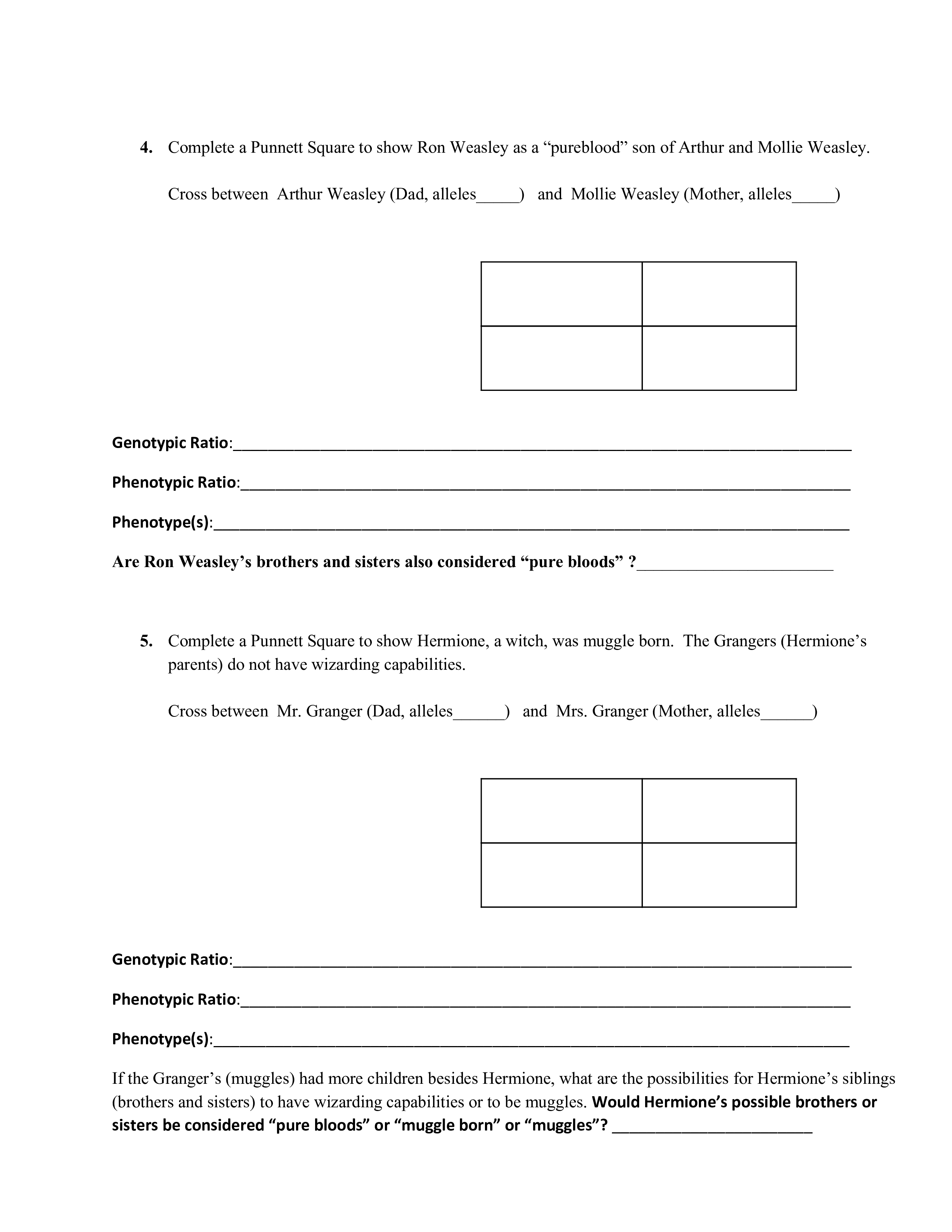
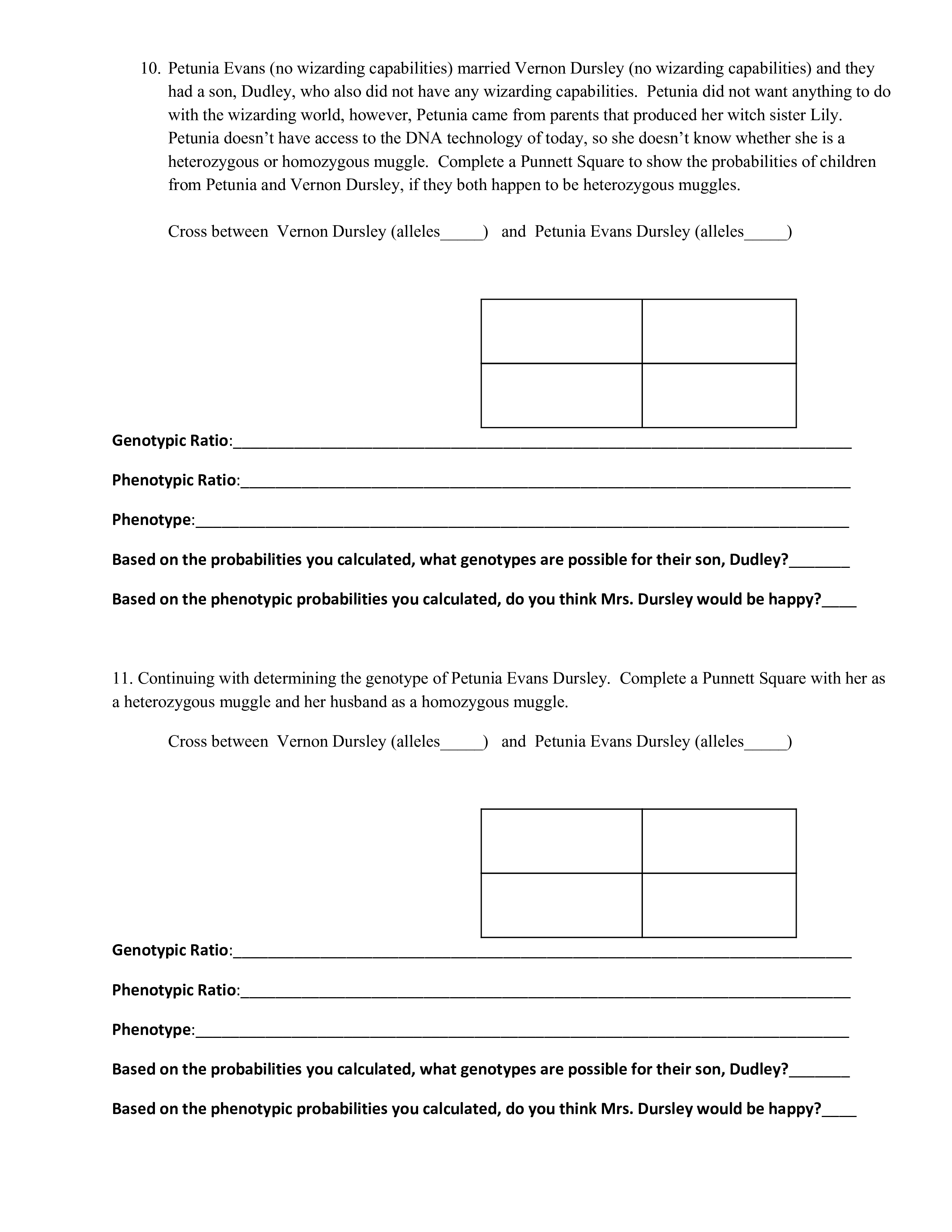
From the #11 cross you just completed, is there a chance that she, Mrs. Dursley, could someday have a grandchild or greatgrandchild that had wizarding capabilities
Since everyone in this cross has wizarding capabilities and the allele has to be recessive homozygous for the individual to have these capabilities, all of the answers 1 through 10 have to be the alleles, m m.
Complete the punnett square by putting in the appropriate recessive alleles in all of the locations. Lily's alleles are mm
The alleles are the same as #7
The alleles are the same as #7 and #8
The alleles are the same as #7, 8, and 9.
Genotypic Ratio:
Phenotypic Ratio:
Phenotype(s):
Would Harry's possible brothers and sisters be considerd "pure bloods" or "muggle born"?
Since everyone in this cross has wizarding capabilities, the alleles have to be recessive homozygous for the individual to have these capabilities, and it is known that they are all pure bloods, all of the answers 15 through 24 have to be the alleles, mm.
Fill in all of the punnett square with the homozygous recessive alleles.
The alleles are the same as #21.
The alleles are the same as #21 and 22.
The alleles are the same as #21, 22 and 23.
Genotypic Ratio:
Pnenotypic Ratio:
Phenotype(s):
Mr. Riddle's alleles:
Mrs. Riddle's alleles:
This is the same alleles as Question #34 above.
The alleles for this square are the same as those in Question #36 above.
Genotypic Ratio:
Phenotypic Ratio:
Phenotype(s)
Since everyone in this cross has wizarding capabilities and the alleles have to be recessive homozygous for the individual to have these capabilities, all of the answers 41 through 50 have to be the alleles, mm.
Type in the correct homozygous recessive alleles for wizarding for the Punnett Square.
The alleles are the same as #47.
The alleles are the same as #47 and #48.
The alleles are the same as #47, 48 and 49.
Genotypic Ratio:
Phenotypic Ratio:
Phenotype(s):
Are Ron Weasley's brothers and sisters also considered "pure bloods"?
Mr. Granger's alleles:
Mrs. Granger's alleles:
Genotypic Ratio:
Phenotypic Ratio:
Phenotype(s):
If the Granger's (muggles) had more children besides Hermione, what are the possibilities for Hermione's siblings (Brothers and sisters) to have wizarding capabilities or to be muggles? Would Hermione's possible brothers or sisters be considered "pure bloods" or "muggle born" or "muggles"?
Since everyone in this cross has wizarding capabilities and the alleles have to be recessive homozygous for the individual to have these capabilities, all of the answers 69 through 78 have to be the alleles, mm.
Complete the punnett square with the recessive wizarding alleles.
The alleles are the same as #75.
The alleles are the same as #75 and #76.
The alleles are the same as #75, 76 and 77.
Genotypic Ratio:
Phenotypic Ratio:
Phenotype(s):
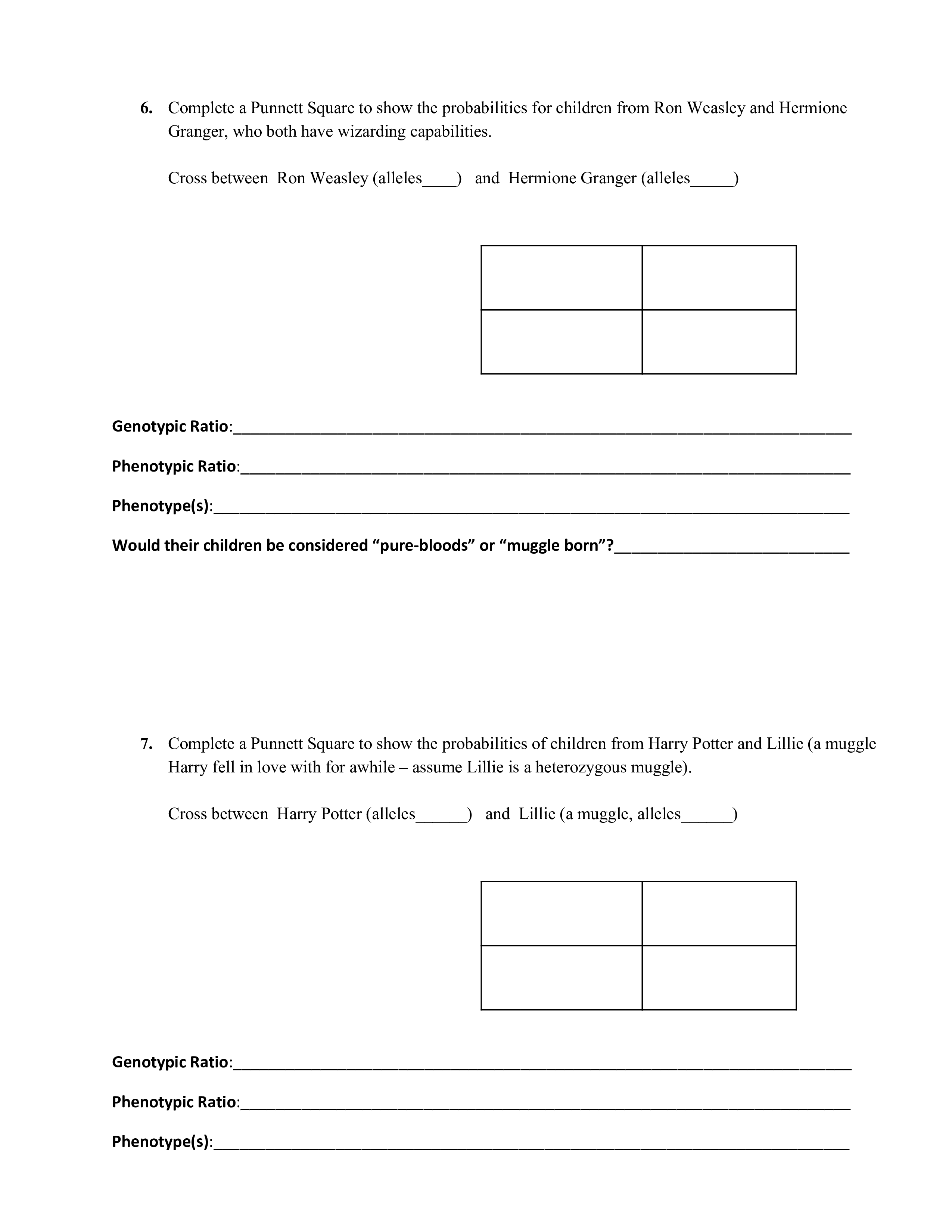
Would their children be considered "pure bloods" or "muggle born"?
Harry Potter's alleles:
Lillie's alleles:
Genotypic Ratio:
Phenotypic Ratio:
Phenotype(s):
Since everyone in this cross has wizarding capabilities and the alleles have to be recessive homozygous for the individual to have these capabilities, all of the answers 96 through 105 have to be the alleles, mm.
Complete the punnett square with the appropriate recessive wizarding alleles.
The allele is m.
The allele is m.
The allele is M.
The allele is M.
The alleles are mm.
The alleles are MM.
The alleles are Mm.
The alleles are mm like all the other probabilities for children (#102, 103 and 104).
Genotypic Ratio:
Phenotypic Ratio:
Phenotype(s):
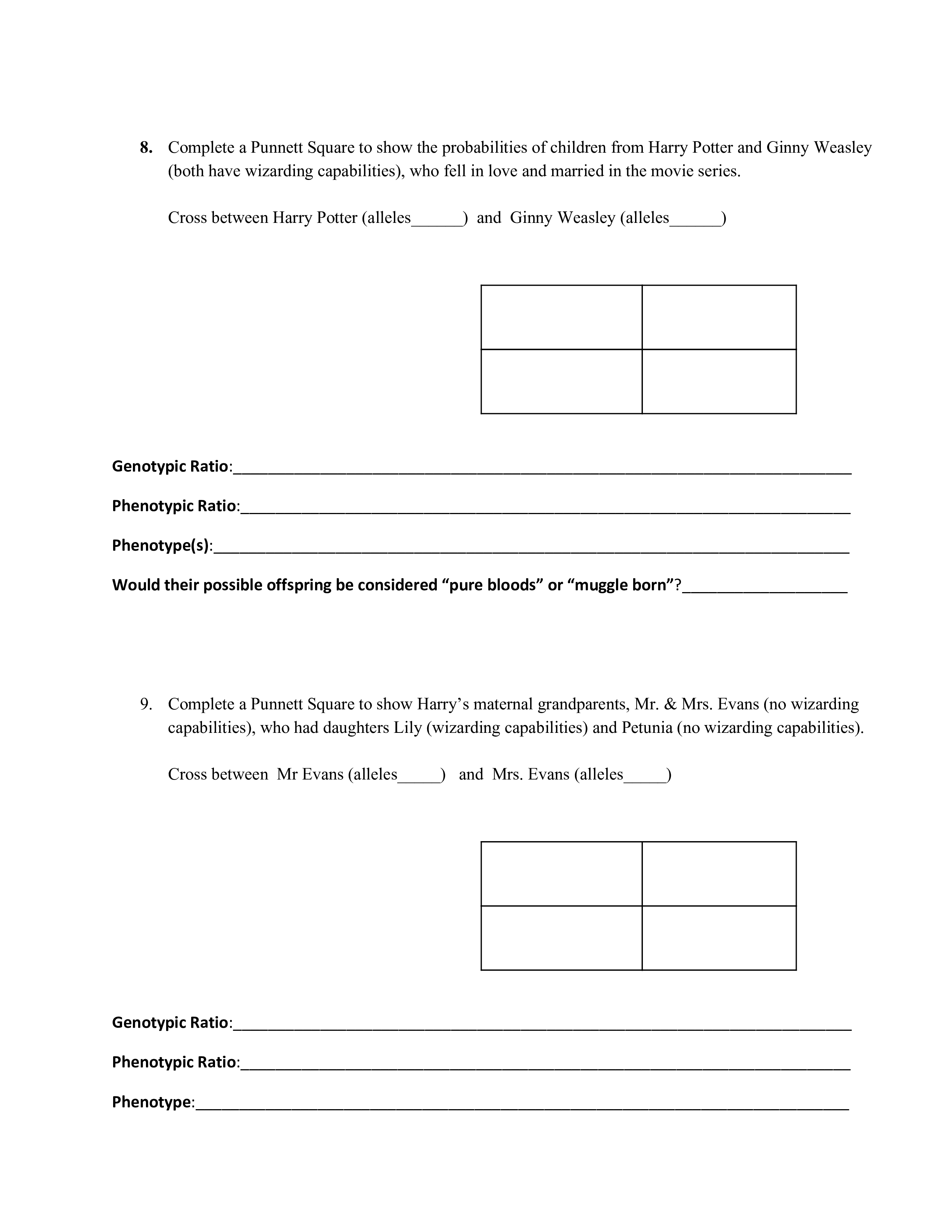
Would their possible offspring be considered "pure bloods" or "Muggle born"?
Mr. Evans' alleles:
Mrs. Evans' alleles:
Genotypic Ratio:
Phenotypic Ratio:
Phenotype(s):
Vernon Dursley's possible alleles:
Petunia Evans Dursley's possible alleles:
Geotypic Ratio:
Phenotypic Ratio:
Phenotype(s):
Based on the probabilities you calculated, what genotype(s) are possible for their son, Dudley?
Based on the phenotypic probabilities you calculated, do you think Mrs. Dursley would be happy?
Vernon Dursley's possible alleles:
Petunia Evans Dursley's possible alleles:
Genotypic Ratio:
Phenotypic Ratio:
Phenotype(s):
Based on the probablilities you calculated, what genotype(s) are possible for their son, Dudley?
Based on the phenotypic probabilities you calculated, do you think Mrs. Dursley would be happy?
Since everyone in this cross is homozygous muggles, all of the answers 154 through 163 have to be the dominant alleles, MM.
Enter the correct dominant alleles to complete the punnett squares.
Allele M.
Allele M.
Allele m.
Allele m.
Alleles MM
Alleles Mm
Alleles Mm
Alleles mm
Genotypic Ratio:
Phenotypic Ratio:
Phenotype:
Based on the probabilities you calculated, what genotypes are possible for their son, Dudley?
Based on the phenotypic probabilities you calculated, do you think Mrs. Dursley would be happy?