Log in
Sign up for FREE
arrow_back
Library
Seasons Quiz
By Sarah Gleason
star
star
star
star
star
Share
share
Last updated over 7 years ago
10 questions
Add this activity
1
2
zoom_in
1
1
Question 1
1.
Which of these locations on Earth experiences the least change in the number of hours of daylight per year?
A -
Equator
B -
North Pole
C -
Tropic of Capricorn
D -
Tropic of Cancer
Question 2
2.
Earth would not have seasons if it –
A - was no longer tilted on its axis
B - stopped rotating on its axis
C - took an additional month to orbit the sun
D - revolved around the sun in the opposite direction
3
4
5
zoom_in
1
1
1
6
7
8
zoom_in
1
1
1
9
10
zoom_in
1
1
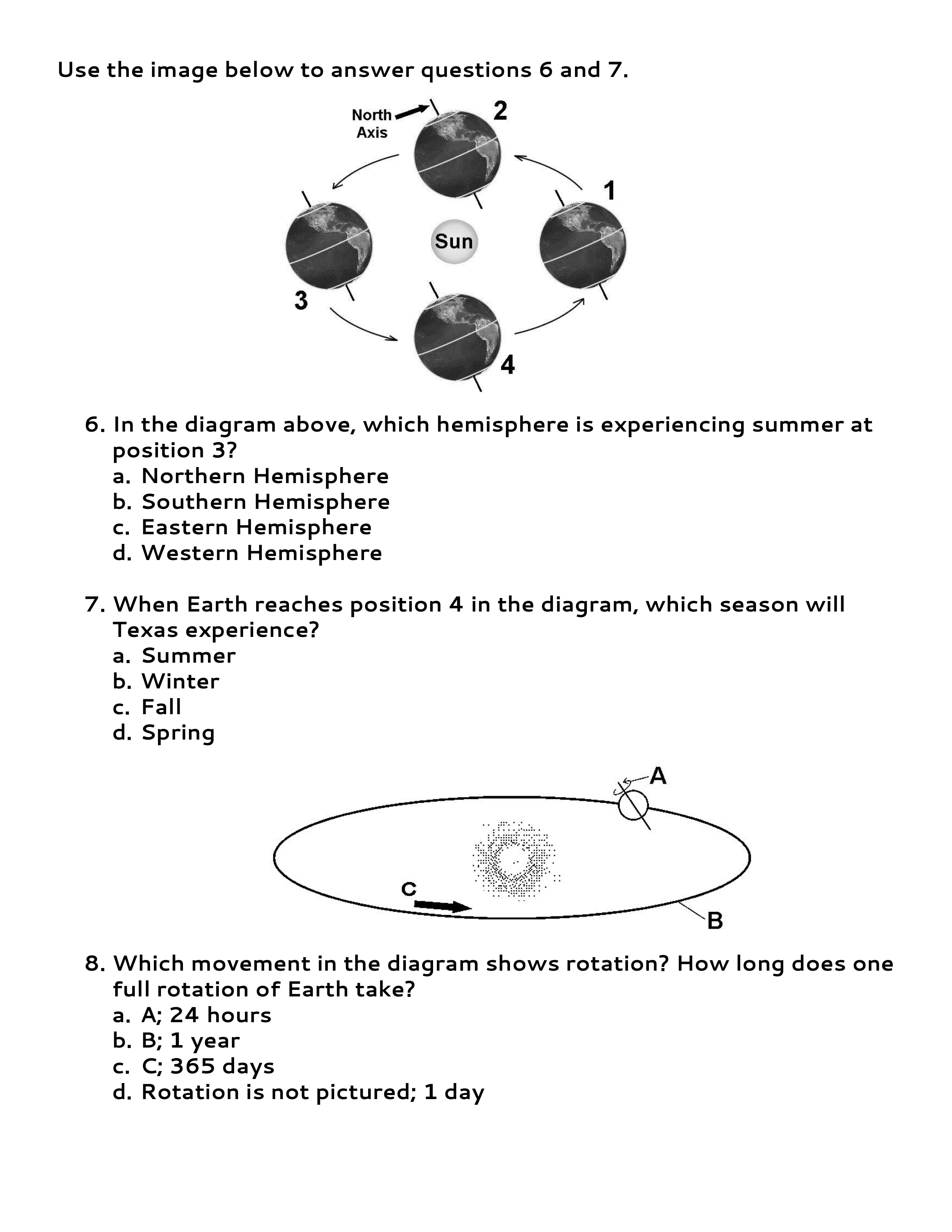
Question 3
3.
At which position will the Northern Hemisphere be experiencing the coldest weather?
A
B
C
D
Question 4
4.
A student is using a globe to model the seasons. If the Northern Hemisphere is tilted toward the Sun, what season is occurring in Texas?
A - Summer
B - Winter
C - Fall
D - Spring
Question 5
5.
Which example below models an object rotating?
A - a member of an audience sitting in a chair
B - an actor walking onto the stage
C - a tuba player marching arounf a chair while facing the conductor
D - a ballerina spinning around on her toe
Question 6
6.
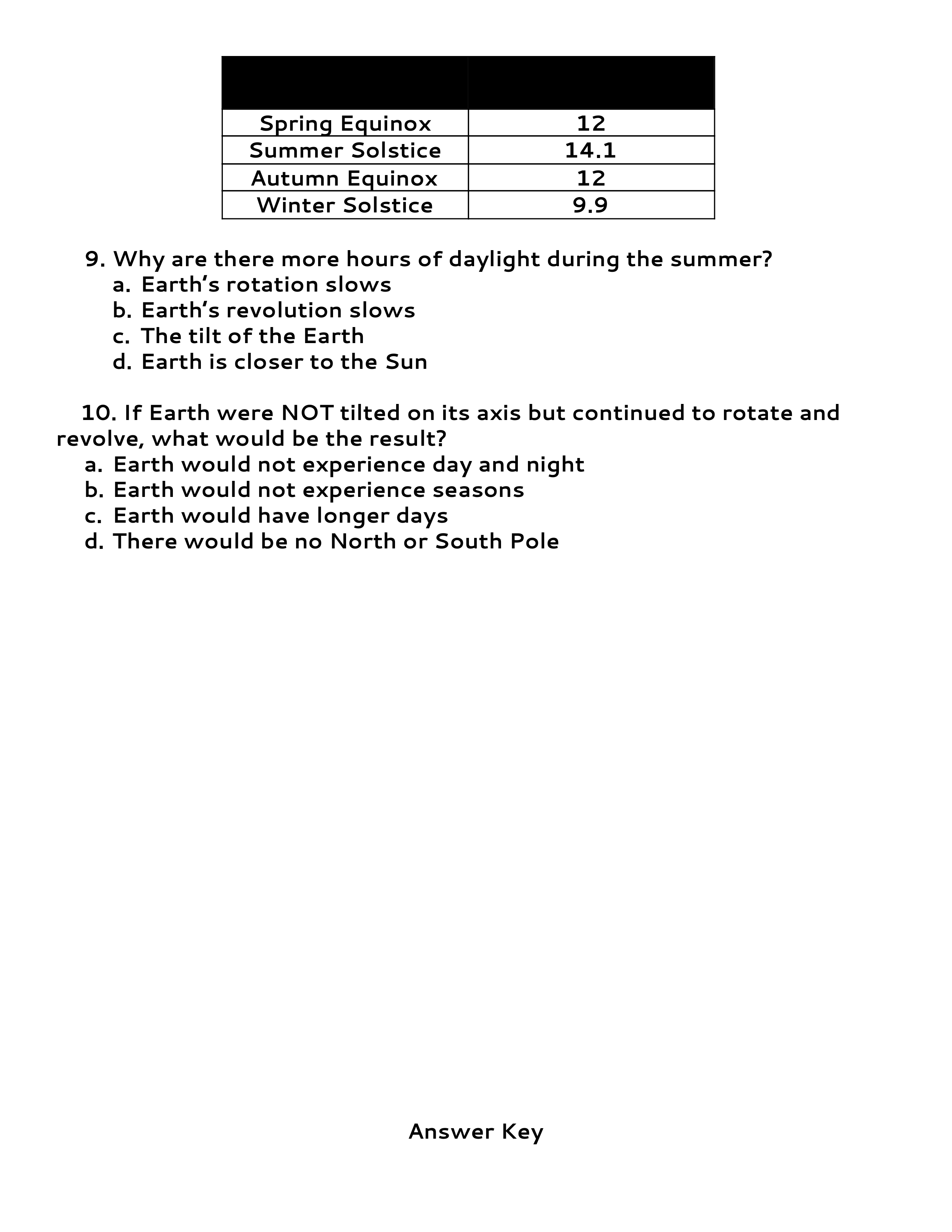
In the diagram above, which hemisphere is experiencing summer at position 3?
A - Northern Hemisphere
B - Southern Hemisphere
C - Eastern Hemisphere
D - Western Hemispherer
Question 7
7.
When Earth reaches position 4 in the diagram, which season will Texas experience?
A - Summer
B - Winter
C - Fall
D - Spring
Question 8
8.
Which movement in the diagram shows rotation? How long does one full rotation of Earth take?
A - 24 hours
B - 1 year
C - 365 days
D - rotation is not pictured
Question 9
9.
Why are there more hours of daylight during the summer?
A- Earth's rotation slows
B - Earth's revolution slows
C - The tilt of the Earth
D - The Earth is closer to the Sun
Question 10
10.
If Earth were NOT tilted on its axis but continued to rotate and revolve, what would be the result?
A - Earth would not experience day and night
B - Earth would not experience seasons
C - Earth would have longer days
D - There would be no North or South Poles