Summative open note Gas laws, stoichiometry, and Kinetic Molecular theory quiz
5 points
5
Question 1
1.
Use the kinetic molecular theory to explain the following scenario:
You are planning a surprise for Ms. Baker. You plan to leave helium balloons in
her room up high where she can not reach them to remove them (it is fun being
short). To test your surprise you leave a helium filled Mylar balloon to float
over night in Ms. Baker's classroom. When you left the balloon was floating
approximately 6 ft above the floor. The next morning after clearing your
windshield of frost you drive to school early to check on your surprise and you
find that the balloon is sadly floating only 2 ft from the floor. Explain what
has happened to your balloon assuming ideal behavior.
KMT
2 points
2
Question 2
2.
In the fermentation process, yeast converts glucose to ethanol and carbon
dioxide. What volume of carbon dioxide, measured at 745 torr and 25.0°C, can be
produced by the fermentation of 10.0 g of glucose?
C6H12O6(aq) ® 2C2H5OH(aq) + 2CO2(g)
2 points
2
Question 3
3.
Dry air is approximately 78% nitrogen, 21% oxygen and 1% argon, by number of
molecules. What is the partial pressure of oxygen in a sample of dry air, if
atmospheric pressure is 751 torr?
2 points
2
Question 4
4.
A 3.60-L gas sample is at a pressure of 95.5 kPa and a temperature of 25.0°C.
a. Calculate the volume occupied by the gas at STP, assuming it behaves ideally.
b. If the gas sample weighs 6.10 g, calculate the molar mass of the gas.
1 point
1
Question 5
5.
At very high pressures (~ 1000 atm), the measured pressure exerted by real gases
is greater than that predicted by the ideal gas equation. This is mainly because
1 point
1
Question 6
6.
At moderate pressures (~ 200 atm), the measured pressure exerted by CO2 gas is
less than that predicted by the ideal gas equation. This is mainly because
1 point
1
Question 7
7.
The ideal gas law tends to become inaccurate when
1 point
1
Question 8
8.
two flasks with equal volumes each contain argon gas. Four students are
discussing whether the density of the gas inside the flasks could be different
1 point
1
Question 9
9.
On a very hot and humid day, Alphonse takes an empty jar off the shelf. He puts
a lid on the jar tightly and places it in the refrigerator. One hour later
Alphonse discovers that many tiny water drops have formed on the inside of the
sealed jar.
Choose the best statement
1 point
1
Question 10
10.
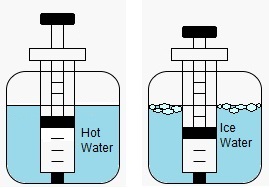
Jane and Allen are experimenting in the lab with a sealed syringe of air. The
syringe of air begins in a hot water bath and then they move it to an ice water
bath. The plunger is free to move and it moves in when the syringe is placed in
the ice water.
[
]
What happens to the pressure of the air trapped in the syringe? Compare the
pressure of the air in the syringe in hot water to the air pressure in the ice
water well after the plunger has stopped moving.
2 points
2
Question 11
11.
Solid Calcium carbonate decomposes at high temperature to form carbon dioxide
gas and calcium oxide solid. How many grams of calcium carbonate are required to
form 5.2 L of Carbon dioxide at 1.03 atm and 150 degrees C?
2 points
2
Question 12
12.
How many liters of water are formed when 3.5 Liters of ethylene (C2H4) react
with 2.5 Liters of Oxygen gas at 1.3 atm and 75 degrees C?
remember that the products of a combustion reaction are carbon dioxide and water
vapor
1 point
1
Question 13
13.
Ima Chemist found the density of Freon-11 (CFCl3) to be 5.58 g/L under her
experimental conditions. Her measurements showed that the density of an unknown
gas was 4.38 g/L under the same conditions. What is the molar mass of the
unknown?
1 point
1
Question 14
14.
If 0.750 L of argon at 1.50 atm and 177C and 0.235 L of sulfur dioxide at 95.0
kPa and 63.0C are added to a 1.00-L flask and the flask's temperature is
adjusted to 25.0C, what is the resulting pressure in the flask?
1 point
1
Question 15
15.
A gas consists of 85.7 % carbon and 14.3% hydrogen, by weight. A sample of this
gas weighing 0.673 g occupies 729 mL at a pressure of 720.0 mmHg and a
temperature of 77C. Calculate its empirical and molecular formulas.
Combination of empirical formulas and gas laws, Oh my! -- Remember that you need
the molecular formulas molar mass to find its molecular formula. Can you find
the molar mass of a gas?
1 point
1
Question 16
16.
Hydrochloric acid is prepared by bubbling hydrogen chloride gas through water.
What is the concentration of a solution prepared by dissolving 225 L of HCl(g)
at 37°C and 89.6 kPa in 5.25 L of water?
Molarity and Gases! Remember that molarity is Moles per Liter. Can you determine
the number of moles of a gas?
1 point
1
Question 17
17.
Calculate the pressure of a helium sample at -207.3°C and 768 mL if it exerts a
pressure of 175 kPa at 25.0°C and 925 mL.
10 points
10
Question 18
18.
A carbon dioxide sample weighing 44.0 g occupies 32.68 L at 65C and 645 torr.
What is its volume at STP?
10 points
10
Question 19
19.
A sample of oxygen gas has its absolute temperature halved while the pressure of
the gas remained constant. If the initial volume is 400 mL, what is the final
volume?
10 points
10
Question 20
20.
A weather balloon was initially at a pressure of 0.950 atm, and its volume was
35.0 L. The pressure decreased to 0.750 atm, without loss of gas or change in
temperature. What was the change in the volume?