Unit 4 Membrane/Transport/Water Quest
star
star
star
star
star
Last updated about 7 years ago
25 Nsɛmmisa
1
1

1
1
1
1
1
1
1
1
1
1
1
1
1
1
1
1
1
1
1

1
5
8
5
Because the phospholipid molecules are free to move and the membrane is made of many different parts, the plasma membrane is said to be:
Which of the following is a function of the cell membrane?
In the diagramme above, structure B represents:
What cell membrane structure is NOT shown in the illustration above?
Diffusion is the movement of molecules from:
The movement of water across a selectively permeable membrane is called:
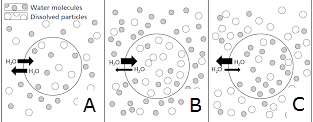
In the diagramme above, which of the following represents a cell in equilibrium with the surrounding solution?
What process requires energy for particles to pass through the cell membrane?
One of the functions of proteins in a cell membrane could be:
The unique properties of water enable life to exist on Earth. Which of these is a property of pure water?
Most of the molecules in cell membranes are:
The leaves at the tops of trees receive water because of:
Due to the uneven distribution (spread) of charges, water is considered to be:
Water strider beetles can walk on water due to:
Fish can survive after a pond has frozen in the winter because of which property of water?
The phospholipid bilayer describes a structure with:
If all materials were allowed to cross the cell membrane, then a cell’s contents would be the same as its surroundings. This does NOT happen because the cell membrane is:
Water may dissolve many compounds because of its:
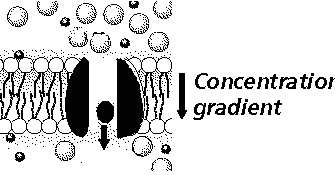
The molecule shown in the illustration above is passing through the transport protein from an area of high concentration to an area of low concentration. This process is called:
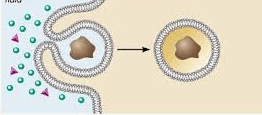
The unicellular organism pictured above is taking IN a large food particles by which process?
If hypotonic cells are placed in a highly concentrated sugar solution, water will:You may use the whiteboard space below this question to draw it out.
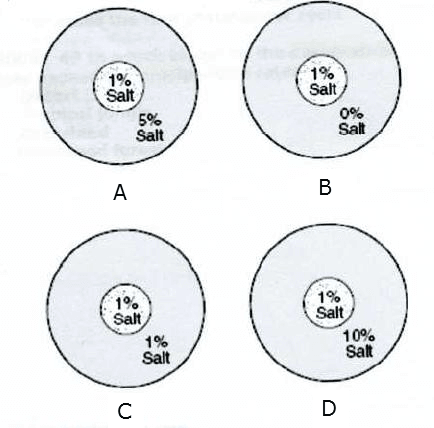
Which conditions shown in the illustration above might cause a cell to burst?
Draw a single phospholipid molecule and label the following: (1) head, (2) tail, (3) hydrophobic end, and (4) hydrophilic ends.
Label the cell membrane below using the following terms: (1) phospholipid, (2) transport protein, (3) cholesterol, (4) hydrophobic region, (5) hydrophilic region, (6) head, (7) tail, (8) polar, (9) non-polar Be VERY specific - circle items if necessary to make it very clear what you are labeling!
Draw and label TWO water molecules showing the partial charges, bonds (hydrogen and covalent), and label the atoms/elements.