Preskoči na glavni sadržaj
Prijava
Sign up for FREE
arrow_back
Biblioteka

Biology Final Spring 2016

star
star
star
star
star
Posljednje ažuriranje about 7 years ago
55
1
1
1
1
1
1
2
1
1
1
1
1
2
3
1
4
2
1
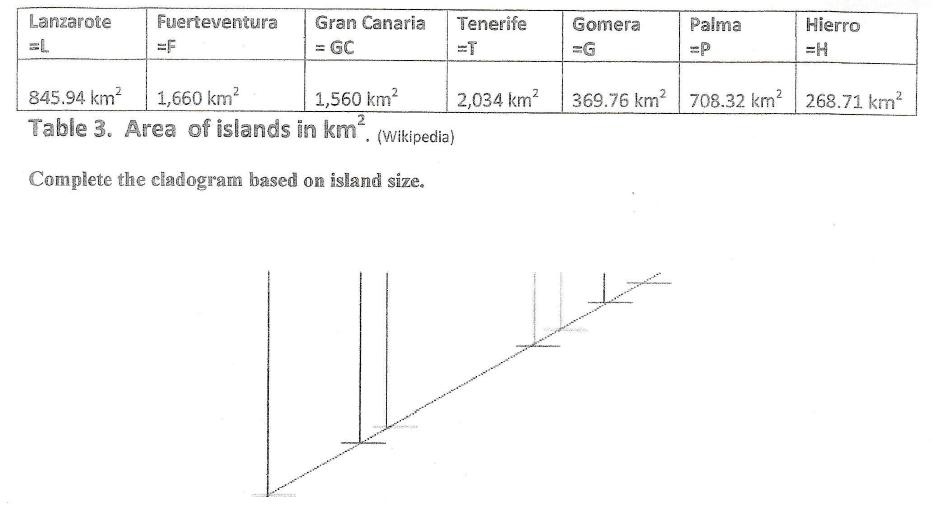
  • Look at the size of each of the islands
  • Make a cladogram based on the size of the islands. The largest island would be in the “ancestral” location and the smallest island would be in the “most recent” location on the cladogram.
    • Hash marks (nodes) will be the island's area (you will only enter the number and not the units)
1
1
2
1
1
5
1
1
1
1
Pitanje 1
1.

You have been working in the Research Division, Egbert Bio Labs, this past year. Your skills have improved so much that you are in line for a promotion in August to the Prather-Dean Facilities at OHS. However, before you can leave your present position you need to wrap up some projects. Your Research Division has been assigned some projects regarding the maintenance and production of organisms for Pet Stores.

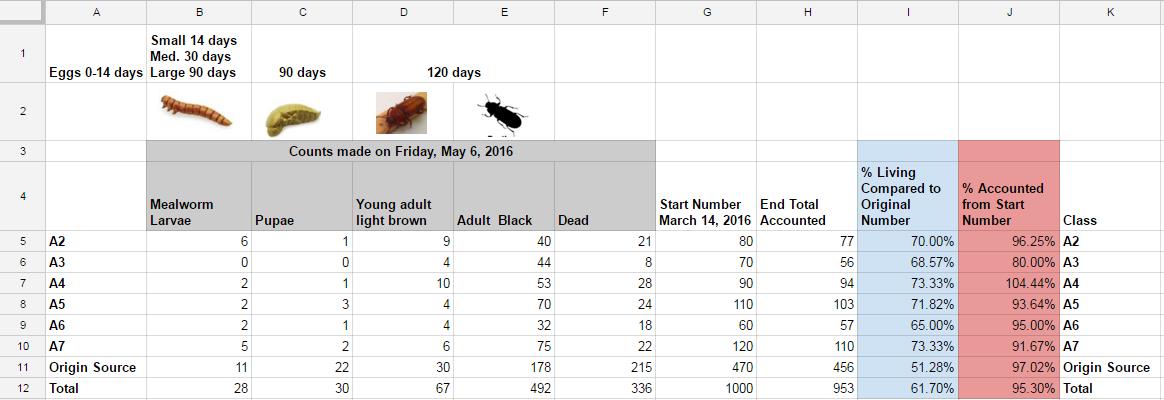
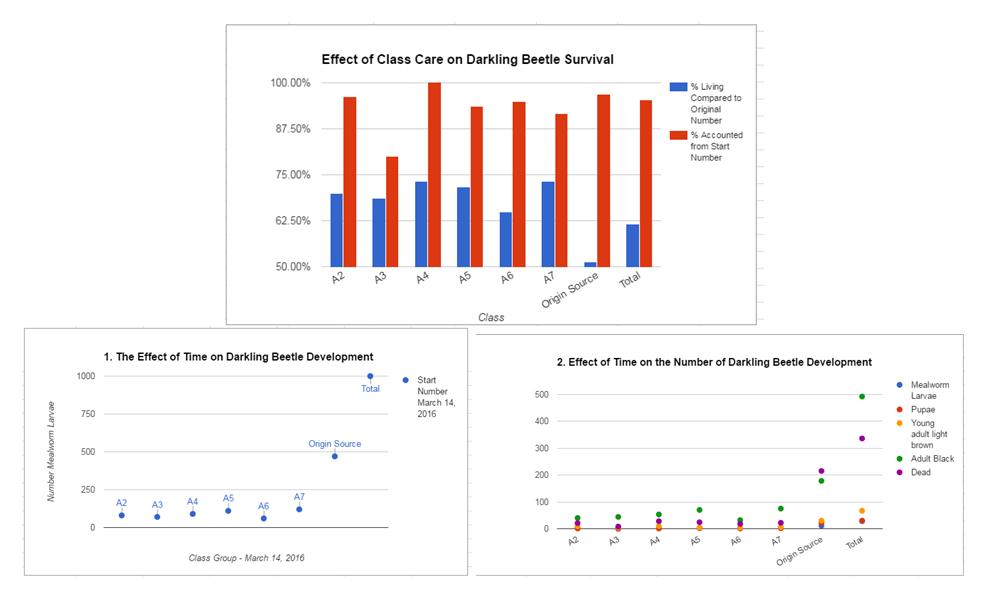
1. Wrap up mealworm production information to give to retailers. Friday, May 6th you took a last count of your mealworms from their micro-habitats you created mid-March. Either use the images from the Google Sheet below or open up the Google Sheet attached to your Google Classroom Assignment Final 2nd Semester. It will look like the images below.

Hint: If you open the Google Sheet, it might be helpful to split your screen so you can look at the Google Sheet and the formative questions at the same time. Pull down the tab and resize to fill half of the screen. Resize the remaining tab.
Pitanje 2
2.

Pitanje 3
3.

Pitanje 4
4.

Pitanje 5
5.

Pitanje 6
6.

Pitanje 7
7.

Pitanje 8
8.

Pitanje 9
9.

Pitanje 10
10.

Pitanje 11
11.

Pitanje 12
12.

Pitanje 13
13.

A Pet Store owner needs to know how to breed dogs he has so the puppies will have certain traits. Different traits are more marketable than others. Since the gestation period for dogs is between 58-62 days, the Pet Store owner needs to guarantee the traits of the puppies to maximize profits. Go to the following link and use the game to produce the dog traits your customer wants.There are 3 single traits and 3 multiple traits in the game. You need to only do the ones to give the preferred traits below.

http://pbskids.org/dragonflytv/games/game_dogbreeding.html

Your customer is interested in puppies:

1) with black coat, long hair, and straight ears (3 traits- Level 5) because they can be sold for $200 more than other puppy traits.
2) with medium floppy ears (single trait- Level 3) puppies because they can be sold for $50 more than the other puppy traits.

Pitanje 14
14.

Pitanje 15
15.

Purebred means having both alleles for the same trait.
Pitanje 16
16.

Pitanje 17
17.

Incomplete dominance is when heterozygotes express a blending of the dominant and recessive trait
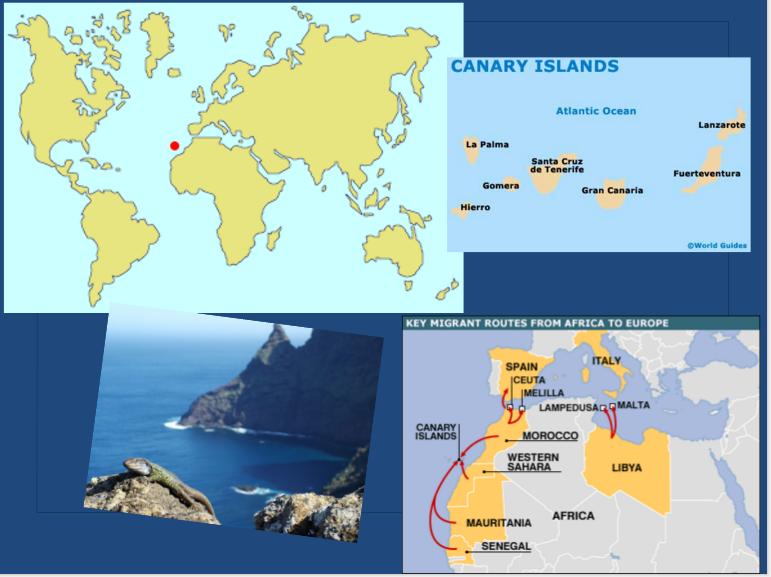
The Pet Store owner can sell the lizards he has for more money if he can also document ancestry of the lizard. These are a special group of lizards that come from the Canary Islands off the coast of Africa.

Background:

The Canary Islands form an archipelago of seven volcanic islands just west of the African continent. The island chain starts about 85 km (50 miles) west of the continent following a fault line of the Atlas Mountains in northern Africa. Geologist theorize that a geological hot spot of upwelling magma has been drifting westward for the past 20 million years, gradually forming the islands as it moves. Thus the most eastern island, Lanzarote, is oldest, while the smaller western island, Hierro, is the youngest, about 0.8 million years old. Volcanic islands are particularly good laboratories for evolution science because they can be dated accurately using radioactive isotope decay and because they start out as lifeless masses of rock emerging from the sea.

The development of ecosystems on volcanic islands is somewhat unpredictable. However, ecological succession does occur first with pioneer species that gradually alter the environment until a stable climax community is established. What is unpredictable is what plant and animal species will colonize these new environments. Much of this is left to climate, proximity to other land masses, and of course, chance. We are concerned about three species of lizards of the genus Gallotia, and within one of these species, Gallotia galloti, and four separate island populations. The arrival of the Fallotia lizards was probably by rafting. Rafts of natural vegetation are often washed out to sea when high river levels cause river banks to collapse, carrying away both plants and clinging animals. Oceanic currents in this region vary with the seasons. Colonization by airborne organisms, such as insects and birds, usually occurs during storms.
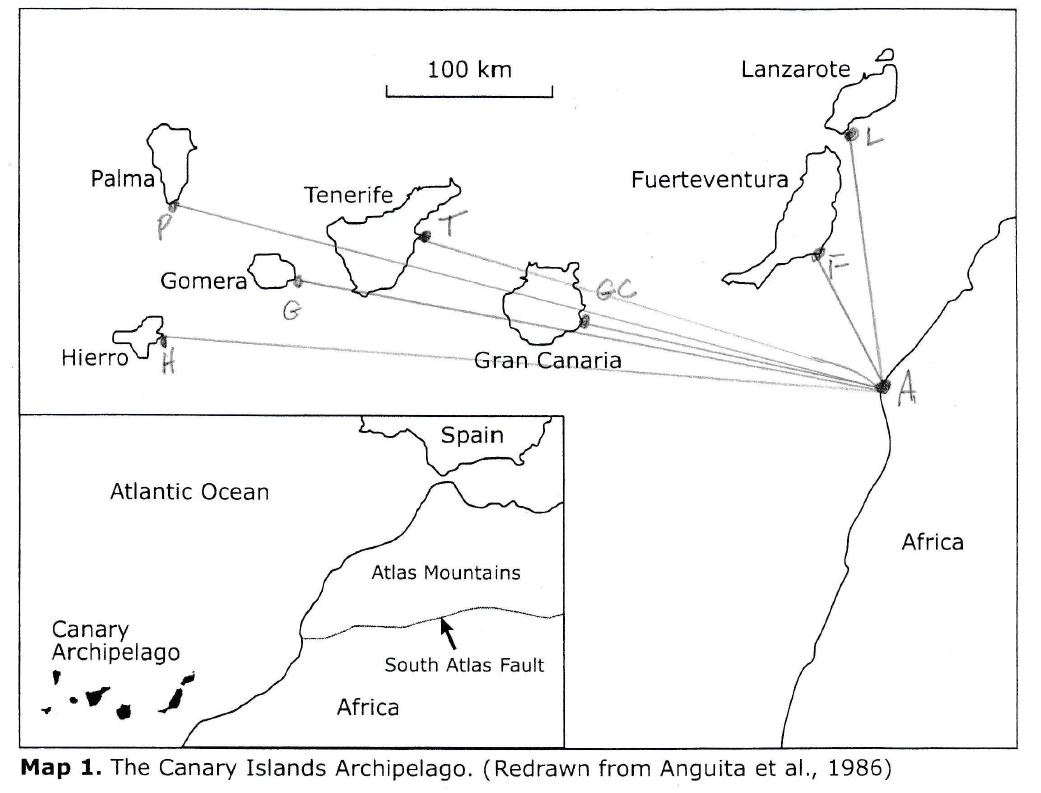
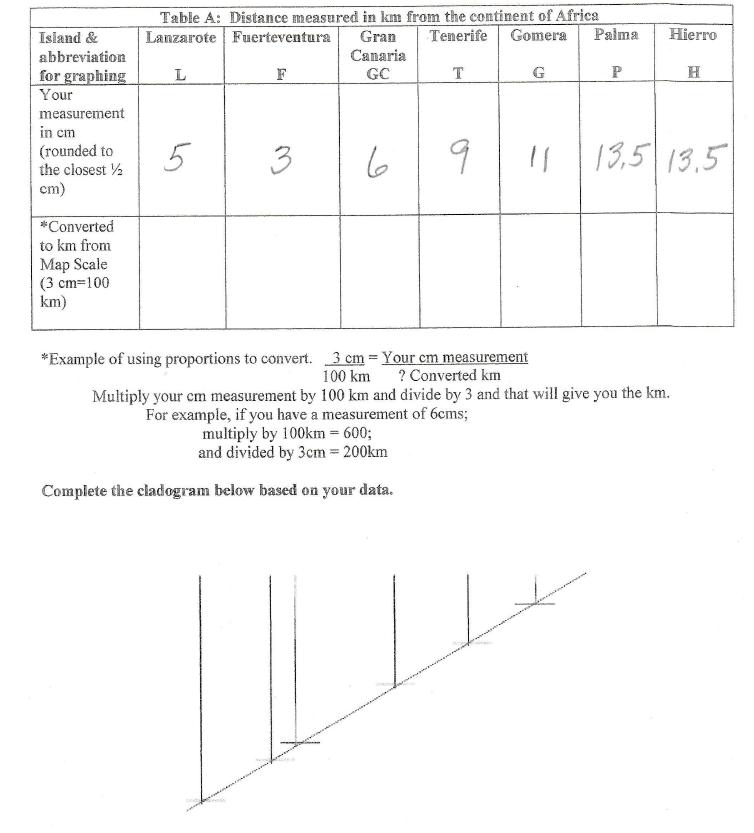
    1. Completed for you. Select the point on the continent of Africa that protrudes the most into the ocean towards the islands. This will be your starting point for each measurement.
    2. Completed for you. Measure the distance from your starting point to each of the islands in cm and place in your Table A (round to the nearest ½ cm).
    3. You need to do the conversion to km based on the scale on the map (3 cms = 100 km) and enter it into your table. An example is provided on the worksheet.
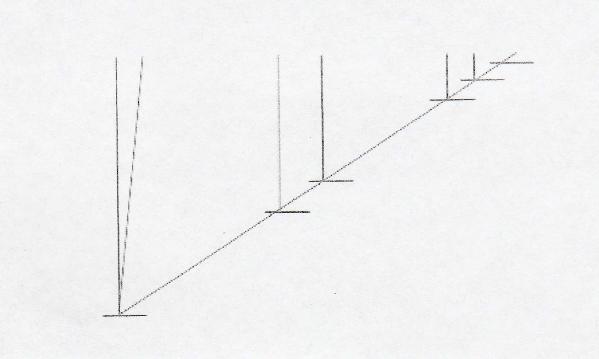
    4. You need to complete the cladogram showing which island you think was colonized first, second, and so forth based on the information you collected in Table A and Principle #1 of Island Colonization: The closer the island is to another land mass, the higher the probability of colonization. The island that is the closest to Africa would be in the “ancestral” location on the cladogram and the island that is the farest away from Africa would be in the “most recent” location.
      1. Hash marks (nodes) will be the km from Table A
1
1
1
1
1
2
0
0
1
1
1
1
1
1
1
1
1
1
1
Pitanje 37
37.

Pitanje 38
38.

Pitanje 39
39.

Ancestry based on age of rocks.
  • The maximum age of each island was estimated by sampling volcanic rocks found on all islands. The ratio of radioactive potassium to its breakdown product, argon, was used to estimate the age of the rocks (radiometric dating). The results are listed in Table 1.
  • Using the data in Table 1 complete he cladogram based on age of rock. The oldest rocks should be located at the “ancestral” location on the cladogram and the newest/youngest rocks should be located at the “recent” location.
    • Hash marks (nodes) will be the rock age in the Table 1
Table 1. Maximum age of the Canary Islands in millions of years (mya) (Anguita et al., 1986)
L&F
Lanzarote & Fuerteventura
GC

Gran Canaria
T

Tenerife
G

Gomera
P

Palma
H

Hierro
24.0 mya17.1 mya15.1 mya5.3 mya2.0 mya0.8 mya
Pitanje 40
40.

Pitanje 41
41.

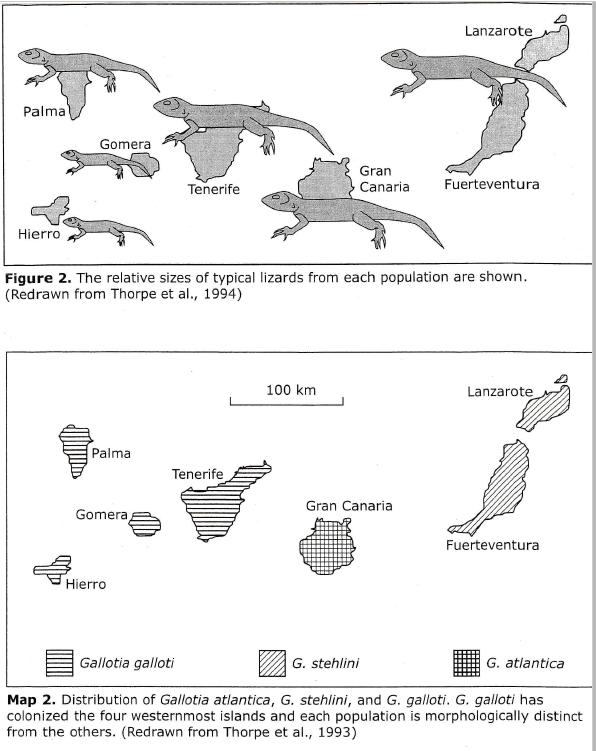
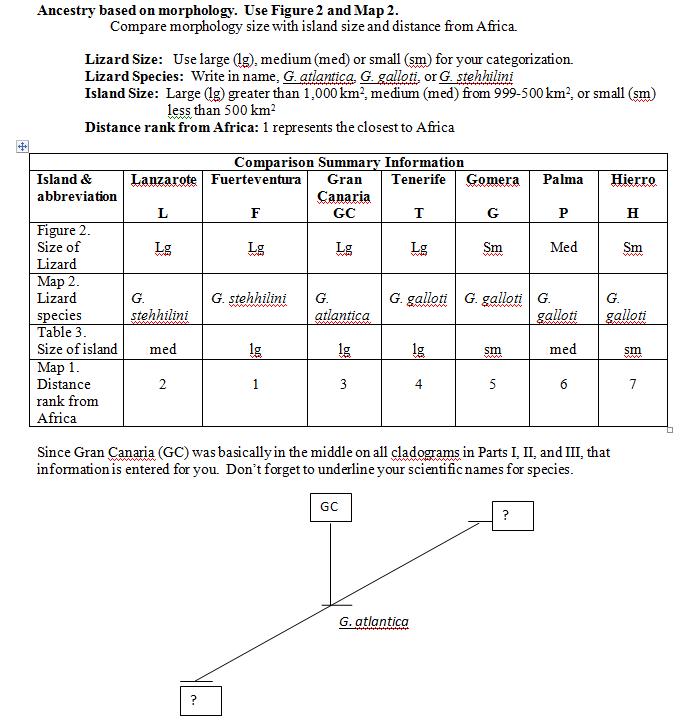
  • Study the drawings from each lizard population in Fig. 2 and Map 2 above. Researchers collected individuals from all island populations and bred and raised them in captivity. Their offspring still displayed differences according to their parental characteristics; therefore, there were three distinct species.
  • Complete the cladogram below based on morphology. You will have to decide whether you think large or small body size is “ancestral” or “recent” when placing your islands on the cladogram. Hash marks (nodes) are the lizard species

Hint from Genetics Unit: We talked about human height being a result of genes as well as environmental conditions, including the health of the individual; i.e., if you don’t have good nutrition, enough food, or a disease, you can not reach your DNA potential. Height in humans could be equated to body size in lizards.

4
Pitanje 42
42.

Pitanje 43
43.

Pitanje 44
44.

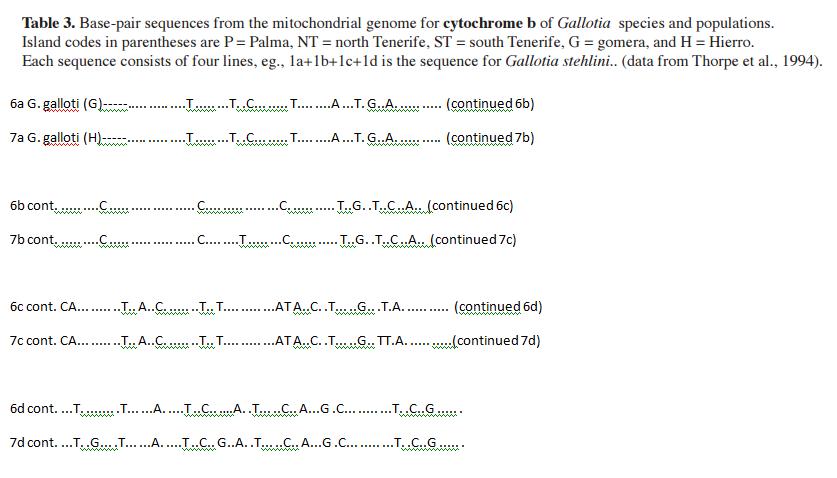
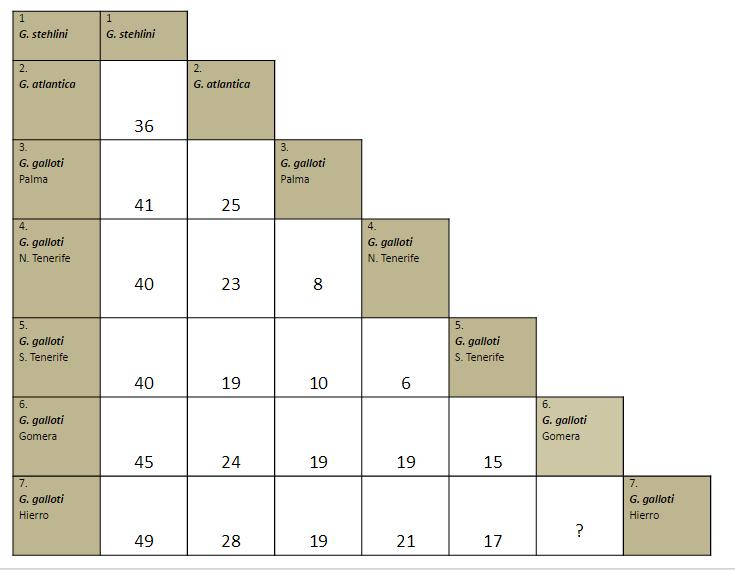
  • Species from the Canary Islands and the data is given in Table 3. All of the differences have already been counted for you except one: G. galloti (G) and G. galloti (H). Count the differences. Enter directly into matrix, blue box #41.
    • Note: Thorpe tested two populations on Tenerife to see if ecological differences were part of the story. North Tenerife is moist and lush while South Tenerife is arid and barren. He thought populations in the two different areas may have some genetic differences and there could be two sources of supplying colonizing lizards from two different directions to the islands Palma, Gomera, and Hierra.
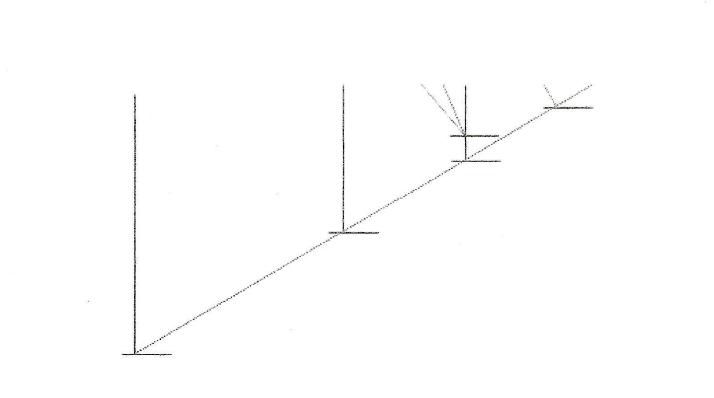
  • Construct a final cladogram based on genetic similarities and differences. Hash marks (nodes) are the number of differences from your Table 2.
    • Note: Low numbers indicate genetic similarity and imply more recent common ancestry. High numbers are said to have greater genetic distance between them and therefore have a more distant ancestry.
2
Pitanje 45
45.

Hash marks (nodes) are numbers of differences from your completed Table 2. This means the smaller the number the more closely the organisms are related.


Islands with species on them go across the top. Each is only used once. Use the following abbreviations from Table 2:

GsF&L = G. stehlini Fuerteventura & Lanzarote Islands

GaGC = G. atlantica Gran Canaria Island

GgNT = G. galloti North Tenerife Island

GgST = G. galloti South Tenerife Island

GgP = G. galloti Palma Island

GgG = G. galloti Gomera Island

GgH = G.galloti Hierro Island
1
Pitanje 46
46.

1
Pitanje 47
47.

1
Pitanje 48
48.

1
1
2
Pitanje 52
52.

Pitanje 53
53.

Pitanje 54
54.

Pitanje 55
55.

Pitanje 18
18.

Pitanje 19
19.

Pitanje 20
20.

Pitanje 21
21.

Pitanje 22
22.

Pitanje 23
23.

Pitanje 24
24.

Pitanje 25
25.

Pitanje 26
26.

Pitanje 27
27.

Pitanje 28
28.

Pitanje 29
29.

Pitanje 30
30.

Pitanje 31
31.

Pitanje 32
32.

Pitanje 33
33.

Pitanje 34
34.

Pitanje 35
35.

Pitanje 36
36.

Pitanje 49
49.

Pitanje 50
50.

Pitanje 51
51.