Algebra 2 1-1 Complete Lesson: Patterns and Expressions

Last updated almost 4 years ago
29 questions
Note from the author:
A complete formative lesson with embedded slideshow, mini lecture screencasts, checks for understanding, practice items, mixed review, and reflection. I create these assignments to supplement each lesson of Pearson's Common Core Edition Algebra 1, Algebra 2, and Geometry courses. See also mathquest.net and twitter.com/mathquestEDU.

10

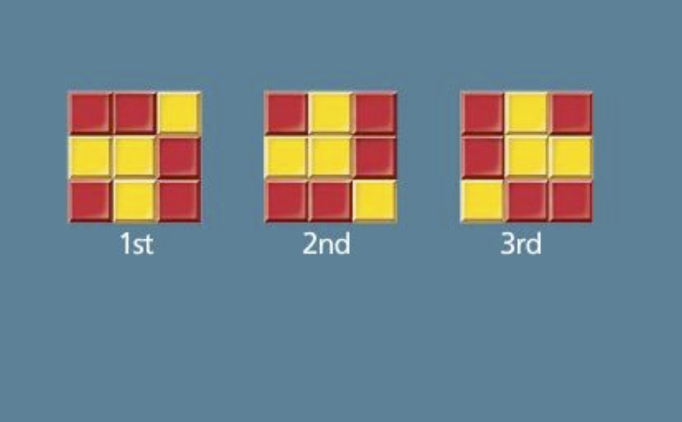
Solve It! You are playing a video game. You reach a locked gate. The lock is square with 9 sections. You can make a key by placing a red or yellow block in each section. Near the gate is a carving of a pattern of squares.

The key to the gate is the eighth image in the pattern. Sketch the key to the gate on the canvas.

10

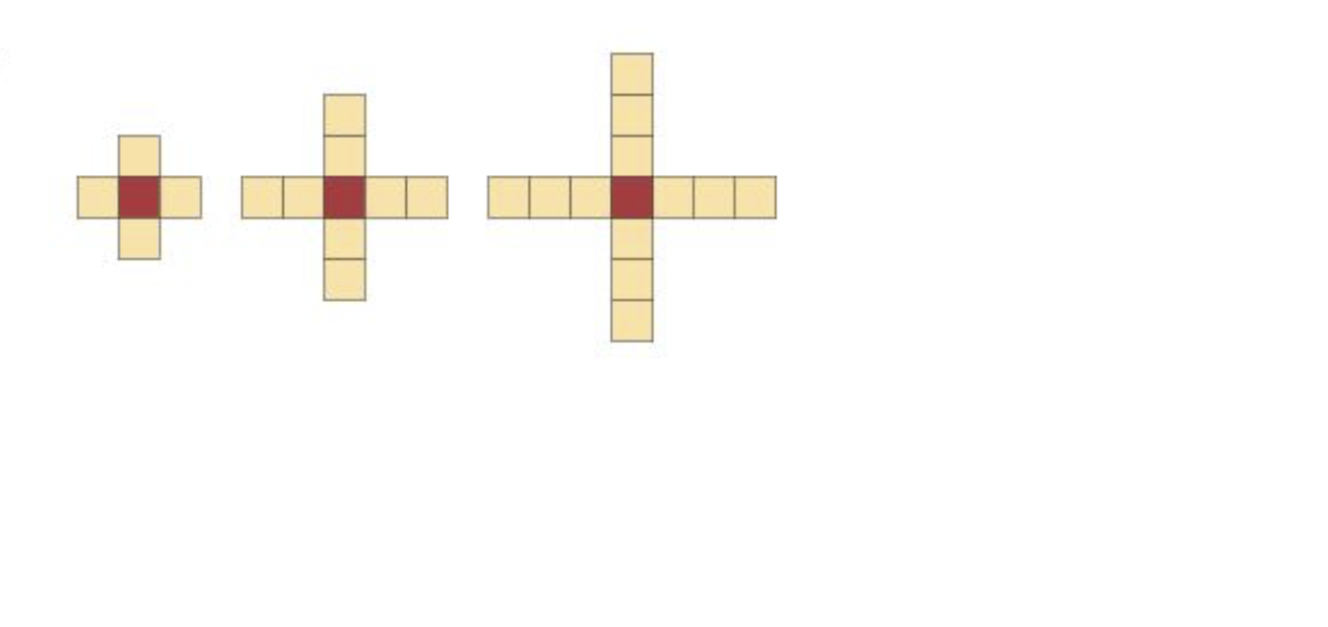
Problem 1 Got It? Look at the figures from left to right. What is the pattern?

10

Problem 1 Got It? Look at the figures from left to right. Sketch the next figure in the pattern on the canvas.

10

Vocabulary: In your own words, compare and contrast constants and variables (aka variable quantities).

10

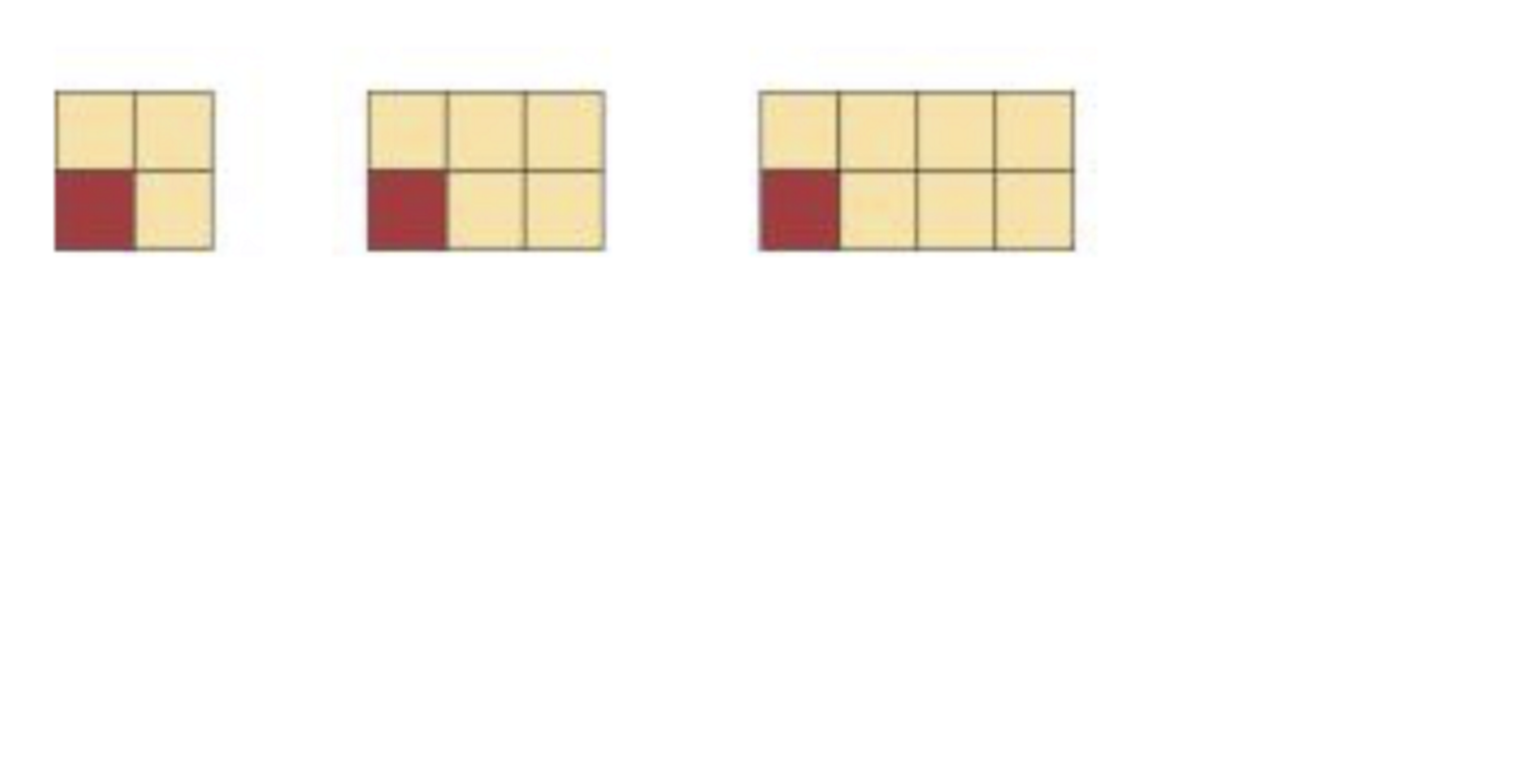
Problem 2 Got It? How many tiles are in the 25th figure in this pattern? Use a table of values with a process column.

Respond with only a number and no spaces.

10
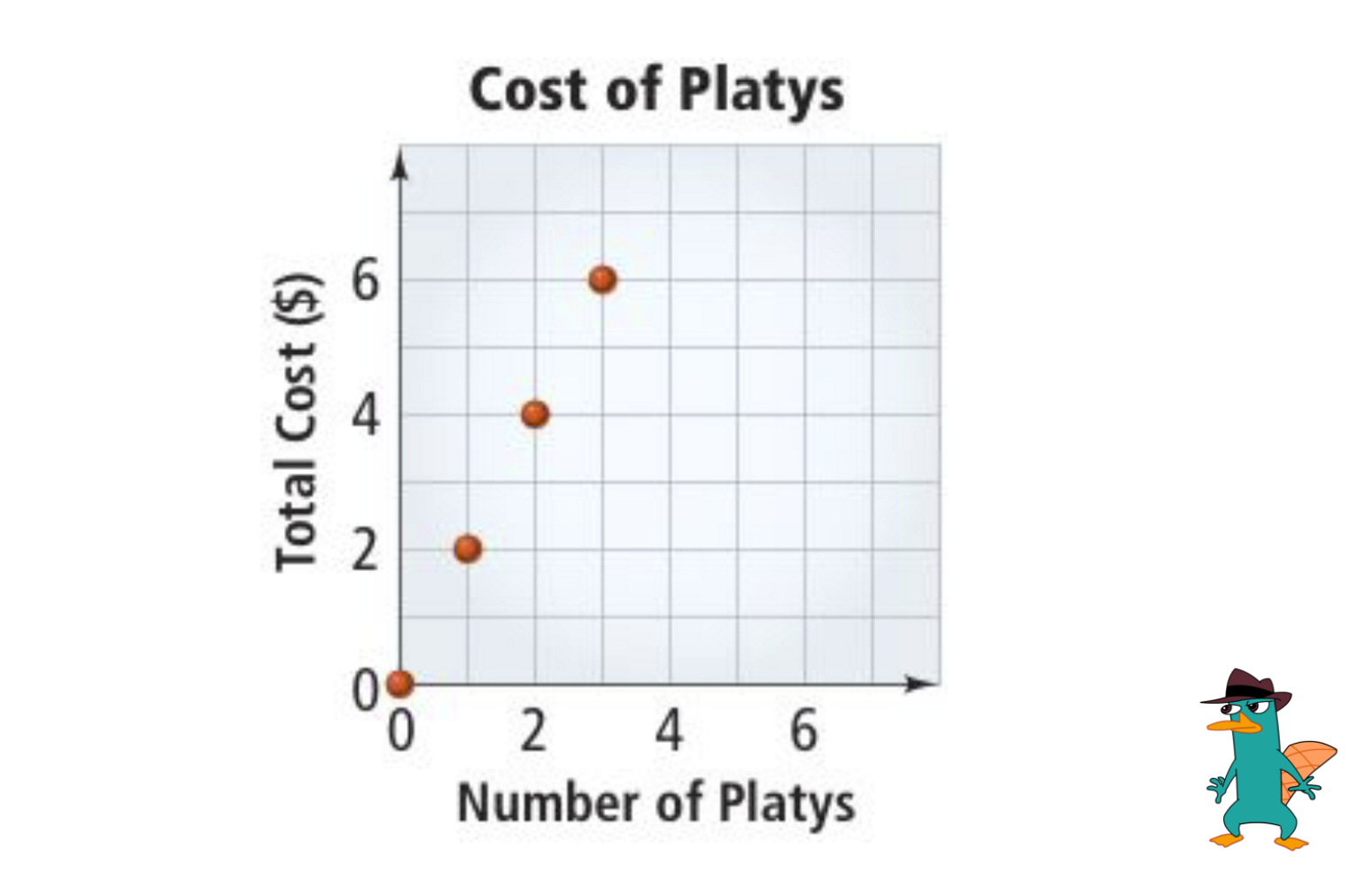
Problem 3 Got It? The graph shows the cost of platys at the aquarium shop. Use a table to answer the questions.
10

Problem 3 Got It? How much do six platy's cost? Enter only a whole dollar amount with a dollar sign. Use this format: $21

10

Problem 3 Got It? How much do ten platy's cost? Enter only a whole dollar amount with a dollar sign. Use this format: $21

10

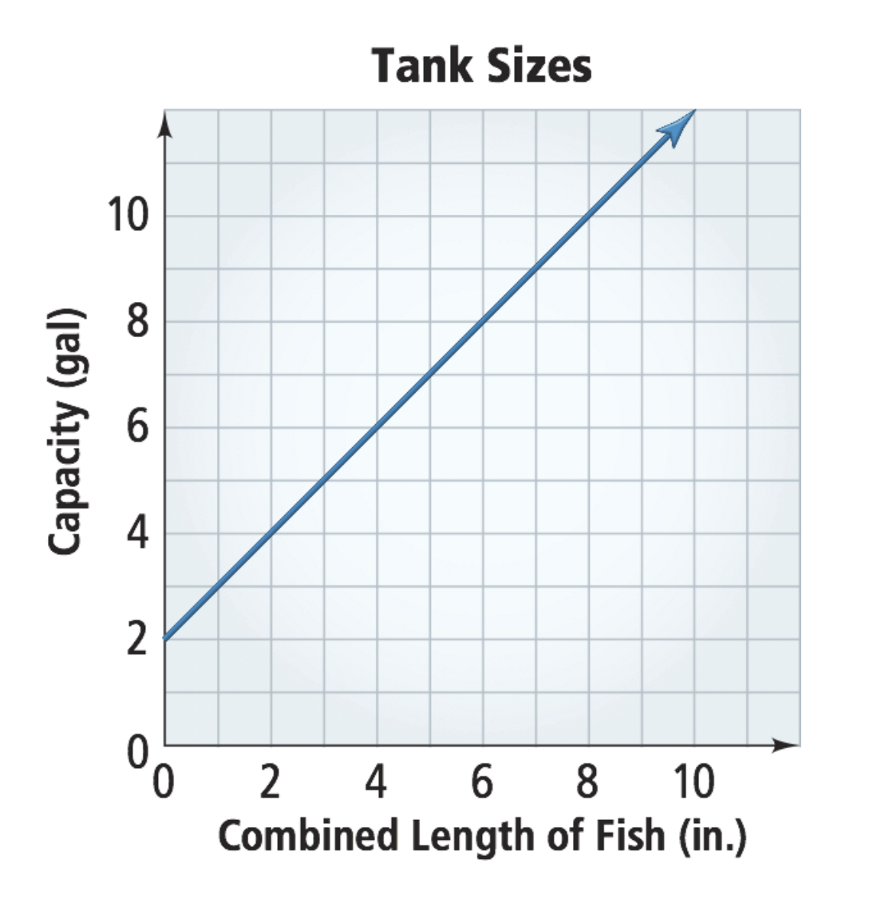
Problem 3 Got It? Reasoning: Why is the graph in Problem 3, shown below, a line while the graph shown here is a set of points?

10

Describe a rule for the pattern below.

10

Describe a rule for the pattern shown at the left.

10

Make a table to represent the pattern on the canvas. Use a process column.

10

Make a table to represent the pattern on the canvas. Use a process column.

10

Explain the strategy you use to identify a pattern.

10
10

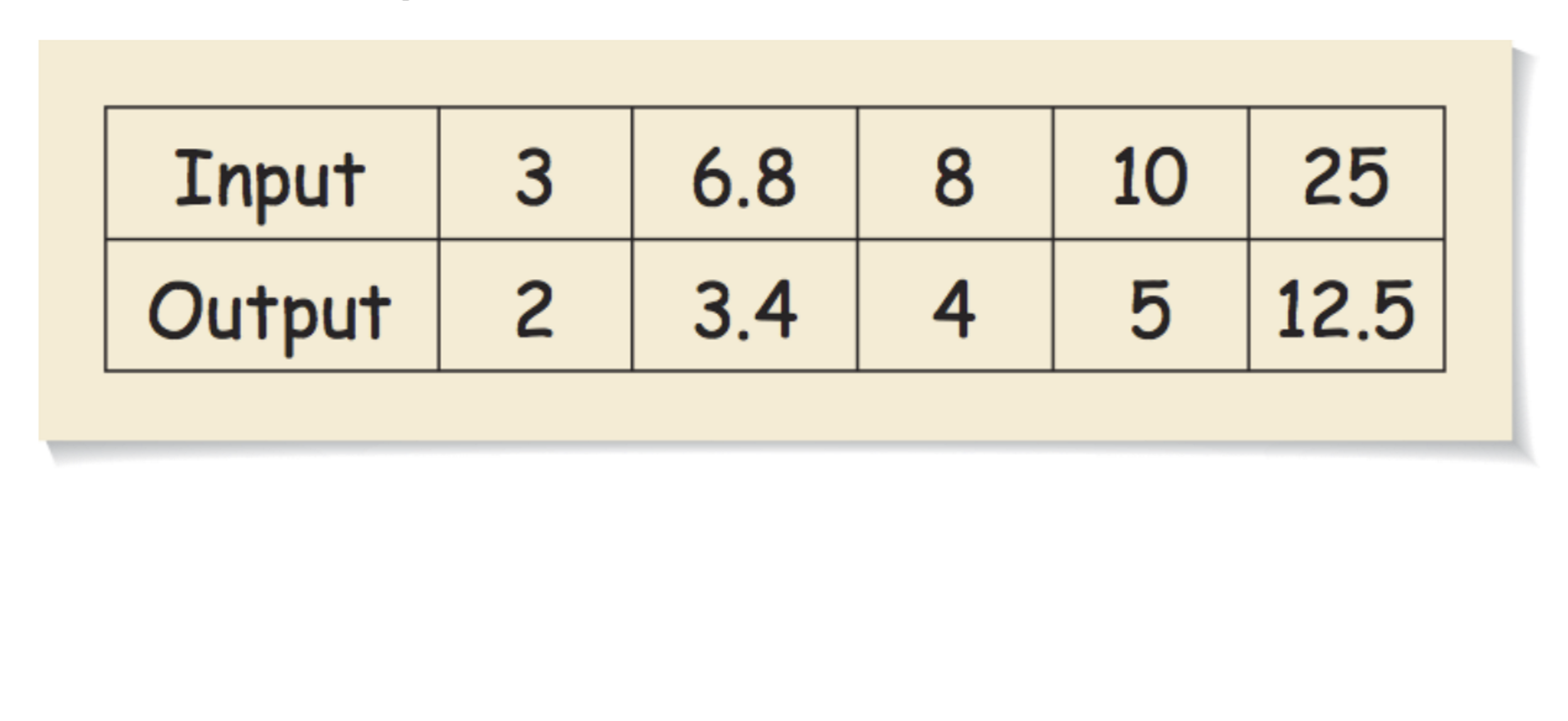
Error Analysis: Your friend looks for a pattern in the table below and claims that the output equals the input divided by 2. Is your friend correct? Explain.

2

Arithmetic Review: Simplify the expression. Enter only a number for your response.

2

Arithmetic Review: Simplify the expression. Enter only a number for your response.

2

Arithmetic Review: Simplify the expression. Enter only a number for your response.

2

Arithmetic Review: Simplify the expression. Enter only a number for your response.

2

Arithmetic Review: Simplify the expression. Enter only a number for your response. Include a digit in the ones place. For example: 0.3

2

Arithmetic Review: Simplify the expression. Enter only a number for your response.

2

Percentages Review: Write the number as a percent. Enter only a number and percent sign in your response.

2

Percentages Review: Write the number as a percent. Enter only a number and percent sign in your response.

2

Percentages Review: Write the number as a percent. Enter only a number and percent sign in your response.

5

Vocabulary Review: Complete each pattern on the right by dragging and matching the correct word from the list on the left.

  • Monday
  • April
  • red
  • Thursday
  • February
  • yellow
  • octagon
  • triangle
  • Monday, Wednesday, Friday, Sunday, Tuesday, ...
  • January, April, July, October, January, ...
  • red, blue, yellow, red, blue,...
  • circle, square, triangle, circle, square, ...
5

Use Your Vocabulary: Classify each expression as a numerical expression or an algebraic expression.

  • Numerical expression(s)
  • Algebraic expression(s)
5

Use Your Vocabulary: Circle the variables in each algebraic expression on the canvas. Use a color other than black.

100

Notes: Take a clear picture or screenshot of your Cornell notes for this lesson. Upload it to the canvas. Zoom and pan as needed.

For a refresher on the Cornell note-taking system, click here.

10

Reflection: Math Success
Reflect on your learning and complete the items on the canvas.