PACE Final Exam, 2015-2016
star
star
star
star
star
Last updated about 3 years ago
53 Nsɛmmisa
1
1
1
1
1
1
1
1
1
1
1
1
1
1
1
1
1
1
1
1
1
1
1
1
6
6
6
6
6
8
1
1
1
1
4
10
1
1
1
5
1
1
1
1
1
1
1
1
1
1
1
1
1
Which best describes the American colonists' reaction to British rule after the French and Indian War?
Which belief was included in the Declaration of Independence?
Read George Hewes' recollection of the Boston Tea Party. Then, answer the following question: Based on the details in the recollection, what is an additional action the colonists could have taken the night of the Boston Tea Party to express their frustration? [https://lh5.googleusercontent.com/--YLuldjOt7lp132ZXKtPVdJENS0A0z_tS-TimYKsYo27HKWkvTfvDvnXCvnfuD_inw3UNqqIcH3ZecEccXZtHjHGxe0fzhuU8My_w849q7K5EG85D4kkAX30OXA0sxU_0P1w8dn]
The election of 1800 was important because it was the first and only time
Which of these issues led to the development of political parties in the United States in the late 1700's?
Which was a source of conflict between Native Americans and European settles on the Great Plains between 1860-1877?
Between 1754 and 1801, how did life in the southern and northern states differ?
$500 Reward Ran away on or about the 25th of May 2 NEGRO SLAVES JACK JONES is a very large man, being perhaps six feet two inches tall, weighing about 200 pounds, and is very broad across the shoulders. He is a very dark color and stutters when he talks. His left arm bears a large scar from an accident with a mowing machine. He is about 45 years of age. BILL PARKER is about 25 or 30 years of age. He is about five feet four inches tall, black in color, and is nearly bald. He has several scars from the lash on his back. He usually wears an earring. He speaks with a strong accent. I will give for the apprehension and detention of these slaves or $250 apiece if captured separately. I believe they crossed the Rappahannock River at Harper’s Ferry in Maryland. Fred Hawkins, Owner Based on the information in the wanted poster, what was the perspective of the slave owner?
What was an impact of the Thirteenth, Fourteenth, and Fifteenth Amendments on the United States?
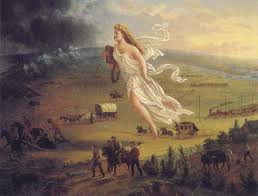
Which best describes the impact of Manifest Destiny on the United States?
Meeting Town Hall, July 1, 1854 Kansas Territory, Free of Slaves ABOLITIONIST SETTLERS needed in Kansas Territory The Kansas-Nebraska Act passed by Congress in May did not decide the question of whether this territory would be slave or free. A compromise included The Doctrine of Popular Sovereignty. This means the people living in the territory will decide if slavery will be allowed. We must stop Kansas from entering the Union as a slave state. The New England Emigrant Aid Company is being formed to assist families in moving to Kansas to help decide this important question. Come to the meeting to find out how you can be part of the company. Come to the meeting if you have been thinking of emigrating to the Kansas Territory. To maintain a balance of free and slave states in Congress, Slavery must not be allowed in Kansas! Read the meeting notice above. Based on the information in the meeting notice, what was the goal of the people setting up the New England Emigrant Aid Company?
Which is a legal method that all citizens can use to influence decisions in a representative democracy?
Citizens best participate in a democracy in the United States by?
Which is a right of citizenship in the United States?
Why is there a separation of powers among the branches of government?
Analyze the following scenarios. Which is legal according to the Bill of Rights?
How did the Mississippi River affect the economic development of the United States in the eighteenth and nineteenth centuries?
What impact did the railroad have on the economy of the United States in the mid-1800s?
[https://lh5.googleusercontent.com/yIeE-xG_fwma9M6ZhqeDLv5E5boSocD8JKFJ0BN3BJF1KCL1QobC9jS75bsFDUwFh_pqqD1vXDC9iuJ2IrlpfAdE1MbvhoaZq_E1Jy_BpohasL_djVxdOL5qgCNRIr6ye2tHUlDL] Look at the population map of the United States above. When comparing the cities on the map, what do each of them have in common? All are located near...
[https://lh3.googleusercontent.com/WpsduGjqJufByL6xc6LmtCwCC-TDex4DXJMPb-l7kAG20LTNghsQ54U7kLo4VgXCqd6vUevIQcvUOzdNY6zrzFgpmeu0pkpRyu6w4uQMwzJPVGY0zaQTNUR0dwNNjR2dVPS7GIYT] When interpreting the map above, how did the United States change between 1792-1867?
Summarize why, during the Civil War era, cotton was grown in the South.
Which is a characteristic of a market economy in the United States?
Which was an economic motivation behind the American Revolution?
Increase in the Size of Industrial Establishments Average Number of Workers per Establishment Industry 1860 1900 Agricultural implements 8 65 Cotton goods 112 287 Iron and steel 65 333 Paper 15 65 Shipbuilding 15 42 Meatpacking 20 61 Tobacco 30 67 Analyze the table above. Based on the information in the table, which statement is true about changes in the United States between 1860-1900?
Read the statements below. Then answer the question. American Patriot: “England should not force us to pay taxes if we do not have a vote in Parliament. There should be no taxation without representation!” British Loyalist: “England went into debt because it spent so much money defending the American colonists during the French and Indian War. It is only fair that American colonists pay taxes to England in order to help the country get out of debt!” In at least one well-thought out comment per character, continue the discussion between the American Patriot and the British Loyalist. What are other things they may disagree about besides what they have already said?
Excerpt of Declaration of Sentiments and Resolutions of the Seneca Falls Convention: “Now, in view of this entire disenfranchisement of one-half the people of this country, their social and religious degradation - in view of the unjust laws above mentioned, and because women do feel themselves aggrieved, pooressed, and fraudulently deprived of their most sacred rights, we insist that they have immediate admission to all the rights and privileges which belong to them as citizens of the United States.” Construct a defense of this opinion of women held at the Seneca Falls Convention. Should they have equal rights? Can you point to any documents which would suggest this? Are there any female historical figures who have done extraordinary things?
[https://lh4.googleusercontent.com/xq02wgwKlFJzQ_pg9y8531NF7fdcT6YIc3StoMqmHXSqd1pTNndv46jtLis_JZqbGwkMpmP7qIds7swPVtp6v3FK_i2MUo1u8V_YjXqJ4gYEKfNaIieaJ8Oe1tj8B64_gNdJ8s5U] Based on the map, in your opinion, which piece of land acquisition was most important to the United States? Support the answer with facts and details including a discussion of the topic of Manifest Destiny.
What might happen if the rules of citizenship were changed in the United States? Before you begin to suggest specific rule changes, be sure to discuss what it takes according to the law now to become a citizen.
Develop a proposal to send to a government official to change the economic system of the United States. Your proposal must include details of the current system, what you think might work better, and why.
Directions: Use the following chart to compare the powers of the different levels of government. Place the powers under the category they are associated with: federal, state, or local by placing an 'X' is the correct space.
During the Civil War what was the number one killer of soldiers
What tactic during the Civil War is Sherman famous for using?
What tragedy occurred after the war was over?
After the Battle of Gettysburg
Describe the Union and Confederacy's strategy to win the Civil War?
Write an essay about why the Civil War happened. Include at least 5 individual causes that led to the war.
The Emancipation Proclamation
What ended up saving Jamestown?
The settlement at Plymouth was started primarily
Describe what the picture above represents and how this image could be used to justify this idea.
By 1863, control of most of the Mississippi River was in Union hands. To gain control of the last major port city serving as an open shipping door to the South, Grant weakened the enemy with a military campaign that lasted several months.First he isolated the port city by gaining control of the railroad, and then he began a seven-week artillery siege to force surrender. What is the port city described above?
Which of the following describes why Lincoln was worried about winning re-election in 1864?
This key Civil War leader claimed to be fighting to preserve the Union, not to abolish slavery. However, on January 1, 1863, after a show of Union strength at Antietam, he issued the Emancipation Proclamation, which declared certain slaves "forever free." Which famous Civil War figure is described above?
This leader was once offered the command of all Union troops. Choosing instead to remain loyal to his home state, Virginia, he became the South's greatest military figure. Which famous Civil War figure is described above?
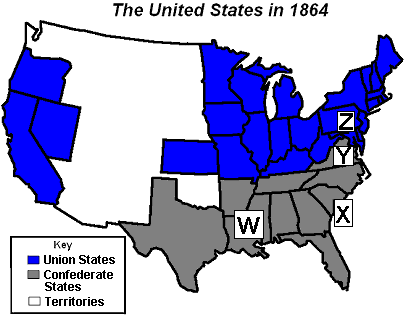
Referring to the map above, which letter represents the Battle of Gettysburg in 1863?
Using the map above, which letter represents Fort Sumter where the first shots of the Civil War were fired?
Often named the single greatest northern military leader in the Civil War, this West Point graduate was known for his victory at Vicksburg in 1863 and his leadership over the Union Army during the latter half of the war. Which famous Civil War figure is described above?
Which person was named the Confederacy's president when the first Southern states seceded from the Union in February of 1861?
Where did Robert E. Lee's surrender on April 9, 1865,
Following the Civil War, Southern states passed laws severely restricting the rights of African-Americans. These laws varied from state to state and included the prohibiting of interracial marriages and restrictions on land ownership. These laws served as a way for white Southerners to control the recently freed African-Americans. These laws were known as
After the Civil War, Lincoln supported a mild Reconstruction of the South. Which group favored a much harsher reconstruction plan in the South?
Why was the Freedmen's Bureau established by Congress during Southern Reconstruction?
The three items listed below are called the Reconstruction Amendments. What was the main purpose of these three amendments? • The Thirteenth Amendment • The Fourteenth Amendment • The Fifteenth Amendment