1
1
1
1
1
1
1
1
1
1
1
1
2
1
1
1
Last Name
Class Period
First Name
All organisms rely on enzymes to catalyze chemical reactions. An enzyme is a biological catalyst that increases the rate of chemical reactions by lowering the level of activation energy necessary to start the reaction. Without enzymes, many of the chemical reactions that occur within living things would proceed too slowly to be useful. Enzymes speed up these reactions by bringing the reactants into close proximity and facilitating their interaction.
Liver contains a specific enzyme called catalase. When hydrogen peroxide (H202) is added to liver, a chemical reaction happens which results in the production of oxygen gas (O2) and liquid water (H20).

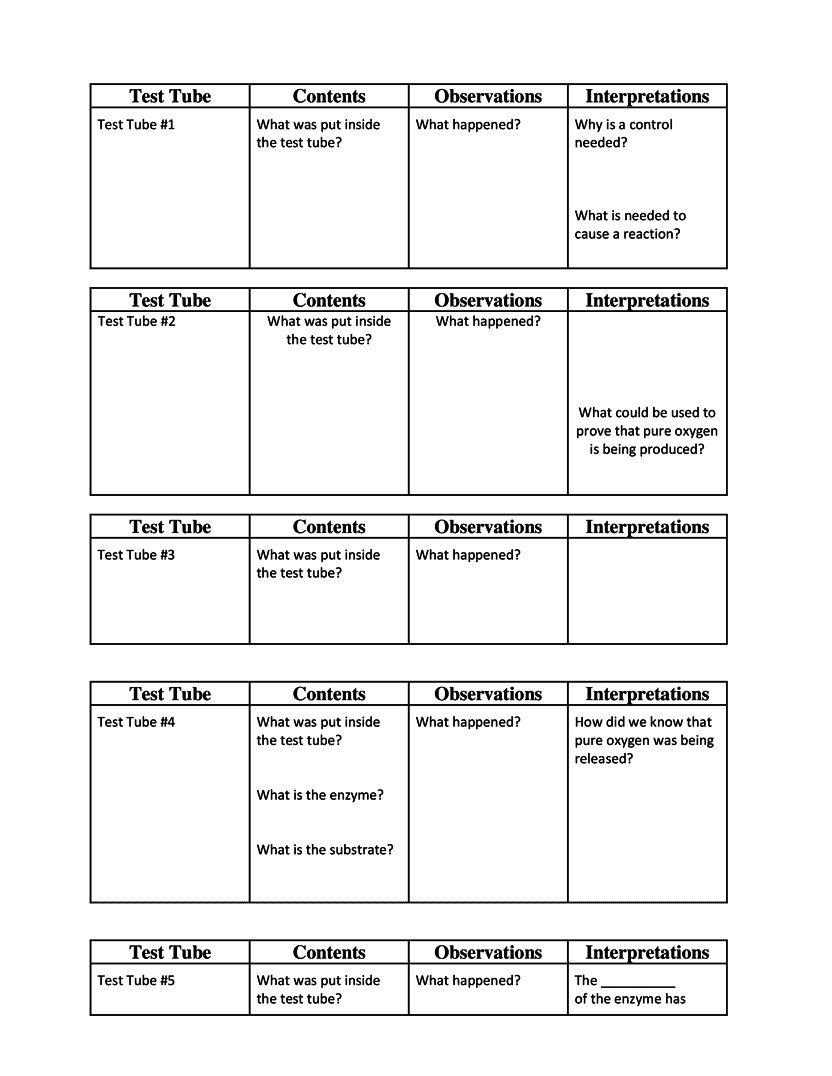
water and liver
This test tube was the control. A control creates a benchmark or standard to use to compare the other reactions against.
Liver and hydrogen peroxide were put in the second test tube.
Bubbles formed and rose up inside the test tube.
The prediction is that the bubbles have oxygen in them.
Since oxygen is flammable, we could see if the bubbles would burn.
Bubbles formed and rose to the top of the test tube. A burning wood splint was placed inside the test tube and it caught on fire.
Liver and hydrogen peroxide were added to the 4th test tube.
The same reaction as Test Tube #2. When the burning wood splint is put near the bubbles they catch fire. After several times catching fire, the splint burns out.
There had to be oxygen in the bubbles for them to burn when the wood splint was placed near them. There is also water in the bubbles because the fire was put out.
There was no reaction.
shape
function; meaning it won't work.
The temperature wasn't cold enough to denature the enzyme, so there will still be a reaction but it will take longer to react.