Which of the following is NOT a sign of a chemical reaction?
What causes chemical bonds in molecules to break?
A calcium carbonate molecule has 1 calcium (Ca) atom, 3 oxygen (O) atoms, and 1 carbon (C) atom. Which of the following shows the chemical formula for calcium carbonate?
What is the charge of an ionic compound?
Which of the following uses coefficients correctly to balance the equation N2 + H2 ------> NH3 ?
Which of the following states the law of conservation of mass?
Nitrogen dioxide is a covalent compound. How many oxygen atoms are in a nitrogen dioxide molecule?
An ion is
Which of the following will NOT increase the rate of a chemical reaction?
Which of the following chemical equations shows an endothermic reaction?
Which of the following is NOT an example of a chemical reaction?
Which of the following phrases describes a catalyst?
Which of the following examples shows where a coefficient is used correctly to balance the equation?
In which kind of chemical reaction do two or more substances combine to form one new compound?
Which of the following is an example of a chemical reaction?
What is O2 an example of?
Which of the following equations is an example of a single-displacement reaction?
How can the rate of a reaction be increased?
How can you be sure a chemical reaction is happening?
Which of the following is an example of a diatomic molecule?
What does a prefix in a chemical formula represent in an element?
Which of the following usually increases the rate of a reaction?
Which of the following chemical reactions illustrates a decomposition reaction?
Which of the following chemical reactions illustrates an endothermic reaction?
Which of the following is an example of chemical bonds breaking?
COMPLETION
-Complete the following questions by selecting the correct answer from the word bank for questions 32 - 40. Questions 26 - 31 have no word bank. Misspelled words will be marked as incorrect. Some answers may be used more than once, others may not be used at all. (2 pts. each)
A(n) ____________________ is used to balance chemical equations.
The number that cannot change to balance a chemical equation is the ______________________.
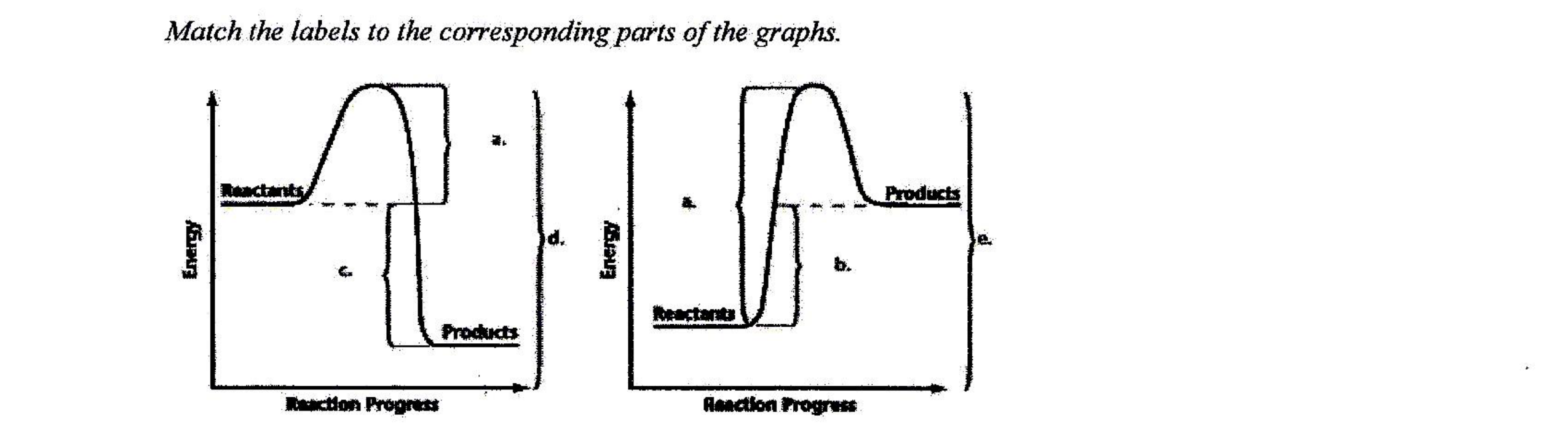
If an energy diagram shows products at a lower energy than the reactants, the diagram shows an ___________________ reaction.
In a double-displacement reaction, _______________________ from two compounds exchange places.
Energy released in exothermic reactions was first stored in chemical bonds in the ___________________________.
Paper will burn at 451o F. For this chemical reaction to begin, 451oF is the _____________________________.
Word Bank
chemical formula double-displacement coefficient inhibitor chemical reaction
activation energy single-displacement catalyst subscript diatomic
chemical bond substances molecules synthesis decomposition
endothermic exothermic ions reactants products
A shorthand notation that represents a compound or diatomic molecule is called a(n) __________________________.
Word Bank
chemical formula double-displacement coefficient inhibitor chemical reaction
activation energy single-displacement catalyst subscript diatomic
chemical bond substances molecules synthesis decomposition
endothermic exothermic ions reactants products
The minimum amount of energy needed to start a reaction is called _________________________.
Word Bank
chemical formula double-displacement coefficient inhibitor chemical reaction
activation energy single-displacement catalyst subscript diatomic
chemical bond substances molecules synthesis decomposition
endothermic exothermic ions reactants products
In a(n) __________________________ reaction, ions in different compounds switch places.
Word Bank
chemical formula double-displacement coefficient inhibitor chemical reaction
activation energy single-displacement catalyst subscript diatomic
chemical bond substances molecules synthesis decomposition
endothermic exothermic ions reactants products
In a chemical formula, if no ___________________ is written after an element, then only one atom of the element is present.
Word Bank
chemical formula double-displacement coefficient inhibitor chemical reaction
activation energy single-displacement catalyst subscript diatomic
chemical bond substances molecules synthesis decomposition
endothermic exothermic ions reactants products
A substance that slows down or stops a chemical reaction is called a(n) ________________________.
Word Bank
chemical formula double-displacement coefficient inhibitor chemical reaction
activation energy single-displacement catalyst subscript diatomic
chemical bond substances molecules synthesis decomposition
endothermic exothermic ions reactants products
The force that holds two atoms together is called a ____________________________.
Word Bank
chemical formula double-displacement coefficient inhibitor chemical reaction
activation energy single-displacement catalyst subscript diatomic
chemical bond substances molecules synthesis decomposition
endothermic exothermic ions reactants products
When _____________________ bump into one another with enough energy, chemical bonds break.
Word Bank
chemical formula double-displacement coefficient inhibitor chemical reaction
activation energy single-displacement catalyst subscript diatomic
chemical bond substances molecules synthesis decomposition
endothermic exothermic ions reactants products
When chemical bonds break, the atoms rearrange to form new ____________________.
Word Bank
chemical formula double-displacement coefficient inhibitor chemical reaction
activation energy single-displacement catalyst subscript diatomic
chemical bond substances molecules synthesis decomposition
endothermic exothermic ions reactants products
A molecule made up of two atoms is ___________________.
something that is needed to break chemical bonds in reactants
the smallest amount of energy needed to start a chemical reaction
the speed at which new particles form in a chemical reaction
something that slows a chemical reaction
something that speeds up a chemical reaction
exothermic reaction
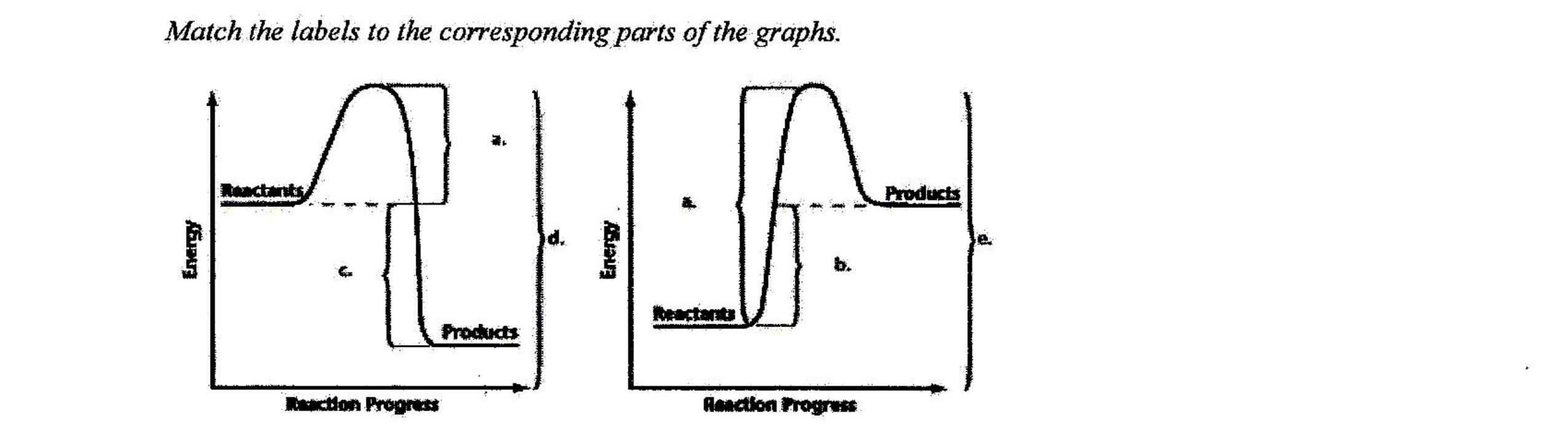
endothermic reaction
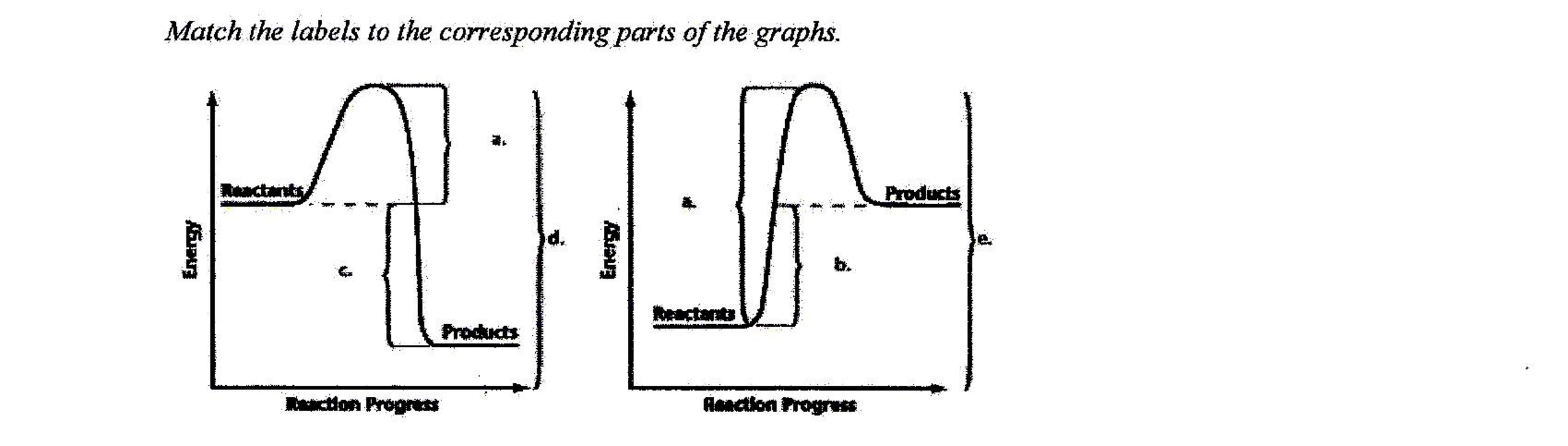
activation energy
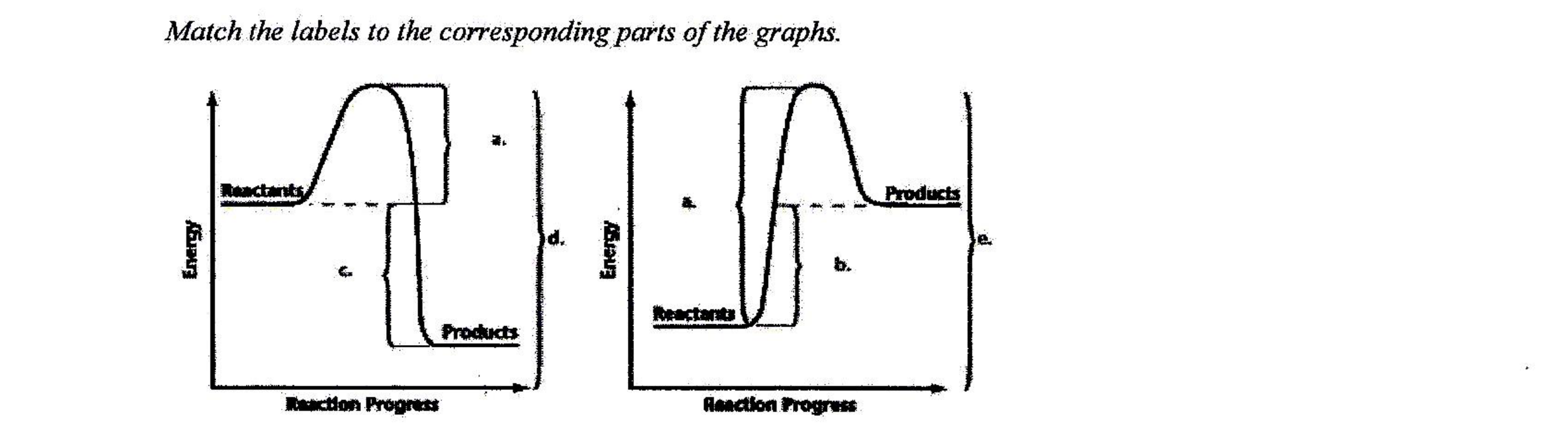
energy absorbed
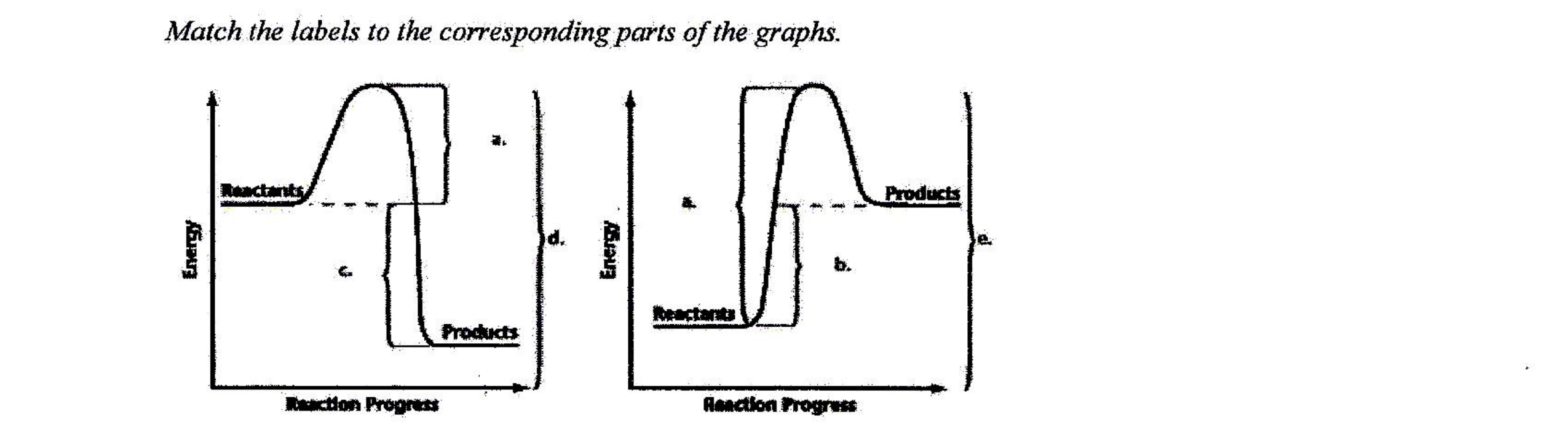
energy released