The surface of a plane mirror
The surface of a convex mirror
The surface of a concave mirror
Which of the following is true of a person who is farsighted?
Which of the following is true of a person who is nearsighted?
Which of the following is true of a person who has color deficiency?
Surgical eye correction uses a laser to reshape a person’s
An optical instrument that uses lenses to see detailed images of large, distant objects is a
An optical instrument used to see magnified images of tiny nearby objects is a
An optical instrument that uses light sensors to record images is a
Intense light of only one color is produced by a(n)
A hologram is made by using
The complete reflection of light along the inside surface of optical fibers is called
Polarized light consists of
A type of communications technology that uses radio waves is a
The aperture of a camera works most like an eye’s
Light is kept inside an optical fiber due to
Polarizing filters produce light waves that
Which of the following is a true statement about the lens of the eye?
A convex mirror and a concave lens both cause light rays to
Which one of the following problems would a driver who has red-green color deficiency face?
What type of light does a laser produce?
What is a thin, glass thread used to send light over long distances?
Which of the following parts of the eye refracts light?
A vision problem that happems when light is focused in front of the retina is
Word Bank
convex lens nearsightedness plane mirror concave mirror farsightedness real virtual cornea color deficiency concave lens convex mirror ray retina iris lens pupil rods cones telescope stimulated emission optical fibers polarized light microscope GPS
A person whose eyes are too long and whose glasses have concave lenses has the condition called ____________.
Word Bank
convex lens nearsightedness plane mirror concave mirror farsightedness real virtual cornea color deficiency concave lens convex mirror ray retina iris lens pupil rods cones telescope stimulated emission optical fibers polarized light microscope GPS
An image through which light passes is a _________________image.
Word Bank
convex lens nearsightedness plane mirror concave mirror farsightedness real virtual cornea color deficiency concave lens convex mirror ray retina iris lens pupil rods cones telescope stimulated emission optical fibers polarized light microscope GPS
The only images produced by a _____________are virtual images.
Word Bank
convex lens nearsightedness plane mirror concave mirror farsightedness real virtual cornea color deficiency concave lens convex mirror ray retina iris lens pupil rods cones telescope stimulated emission optical fibers polarized light microscope GPS
A lens that curves outward is a _________________.
Word Bank
convex lens nearsightedness plane mirror concave mirror farsightedness real virtual cornea color deficiency concave lens convex mirror ray retina iris lens pupil rods cones telescope stimulated emission optical fibers polarized light microscope GPS
A mirror that curves inward, like the inside of a bowl, is a ________________.
Word Bank
convex lens nearsightedness plane mirror concave mirror farsightedness real virtual cornea color deficiency concave lens convex mirror ray retina iris lens pupil rods cones telescope stimulated emission optical fibers polarized light microscope GPS
A ______________ is used to correct nearsightedness.
Word Bank
convex lens nearsightedness plane mirror concave mirror farsightedness real virtual cornea color deficiency concave lens convex mirror ray retina iris lens pupil rods cones telescope stimulated emission optical fibers polarized light microscope GPS
A ______________ is used to correct farsightedness.
Word Bank
convex lens nearsightedness plane mirror concave mirror farsightedness real virtual cornea color deficiency concave lens convex mirror ray retina iris lens pupil rods cones telescope stimulated emission optical fibers polarized light microscope GPS
The part of the eye that refracts and focuses an image is the _____________.
Word Bank
convex lens nearsightedness plane mirror concave mirror farsightedness real virtual cornea color deficiency concave lens convex mirror ray retina iris lens pupil rods cones telescope stimulated emission optical fibers polarized light microscope GPS
_____________ occurs when a photon strikes an atom in an excited state causing the atom to release another photon.
Word Bank
convex lens nearsightedness plane mirror concave mirror farsightedness real virtual cornea color deficiency concave lens convex mirror ray retina iris lens pupil rods cones telescope stimulated emission optical fibers polarized light microscope GPS
Total internal reflection is why __________________ can transmit light.
Word Bank
convex lens nearsightedness plane mirror concave mirror farsightedness real virtual cornea color deficiency concave lens convex mirror ray retina iris lens pupil rods cones telescope stimulated emission optical fibers polarized light microscope GPS
Light that vibrates in only one plane is called __________________.
Word Bank
convex lens nearsightedness plane mirror concave mirror farsightedness real virtual cornea color deficiency concave lens convex mirror ray retina iris lens pupil rods cones telescope stimulated emission optical fibers polarized light microscope GPS
A network of satellites that continuously sends position information with microwaves is called _____________.
Word Bank
convex lens nearsightedness plane mirror concave mirror farsightedness real virtual cornea color deficiency concave lens convex mirror ray retina iris lens pupil rods cones telescope stimulated emission optical fibers polarized light microscope GPS
An arrow called a _________________ is used to represent light waves.
Word Bank
convex lens nearsightedness plane mirror concave mirror farsightedness real virtual cornea color deficiency concave lens convex mirror ray retina iris lens pupil rods cones telescope stimulated emission optical fibers polarized light microscope GPS
Someone with _________________ has a problem with the rods and cones in their retina.
Word Bank
convex lens nearsightedness plane mirror concave mirror farsightedness real virtual cornea color deficiency concave lens convex mirror ray retina iris lens pupil rods cones telescope stimulated emission optical fibers polarized light microscope GPS
An image through which light travels is a __________ image.
Cornea
Iris
Lens
Pupil
Retina
Rods and cones
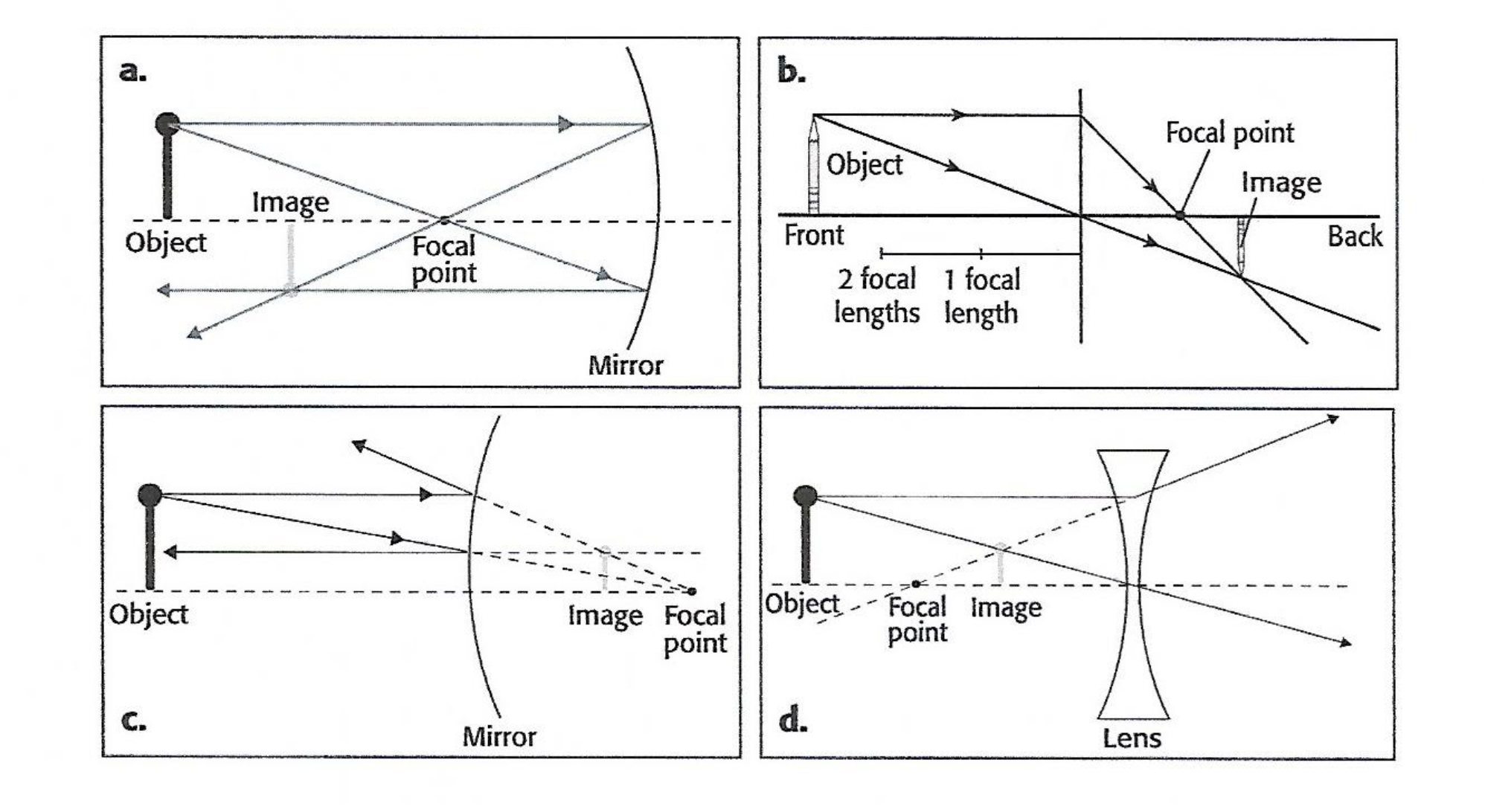
A convex mirror forming an image.
A concave lens forming an image.
A concave mirror forming an upside-down, real image.
A convex lens forming a real image.