Chapter 13 Test

Last updated about 5 years ago
50 questions
MULTIPLE CHOICE
-Choose the correct answer by clicking on your answer choice. Only one answer is correct. (2 pts. each)
2

What occurs between atoms that do not easily lose electrons?

2

How many valence electrons does helium need to have a filled valence shell?

2

What is a bond that forms when electrons are transferred from one atom to another?

2

What are the charged particles called that form when atoms gain or lose electrons?

2

What does a sodium atom become when it loses its only valence electron?

2

If the ending -ide is added to the name of an ion, what do we know about that ion?

2

Most molecules are composed of what?

2

How are electrons in an atom organized?

2

What are the only parts of an atom that make chemical bonds?

2

Why don't noble gases normally form chemical bonds?

2

What is the charge of a sodium ion with 11 protons and 10 electrons?

2

The more easily an atom gains an electron, what does it release more of?

2

What is the smallest particle into which a covalently bonded compound can be divided and still be the same compound?

2

What are elements found in nature as diatomic molecules called?

2

Which of the following is NOT an example of a diatomic element?

2

Why can metals be shaped?

2

Which of the following represents the number of protons in an atom?

2

Most atoms form bonds using which of the following?

2

Elements on the periodic table are grouped based on which of the following?

2

What do metal atoms form when they lose valence electrons?

2

What is the joining of atoms to form new substances called?

2

What is a molecule composed of two atoms called?

2

Which of the following is NOT a property of metals associated with metallic bonds?

2

Besides being valuable, gold is special because it can be hammered into a very thin foil. This property is called

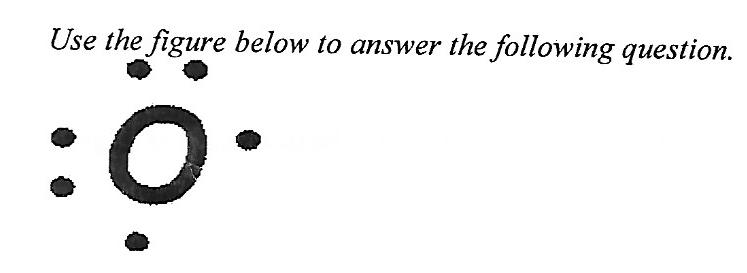
Lewis Diagram
2

In the Lewis Diagram above, how many electrons are needed for a full valence shell?

COMPLETION
-Complete the following questions by selecting the correct answer from the word bank. Misspelled words will be marked as incorrect. Some answers may be used more than once, others may not be used at all. (2 pts. each)
Word Bank for Questions 26 - 31​
valence electron, crystal lattice, chemical bond, metallic bond, ions, covalent bonds, molecule,
2

Atoms that do not easily lose electrons form ________________________.

Word Bank for Questions 26 - 31​
valence electron, crystal lattice, chemical bond, metallic bond, ions, covalent bonds, molecule,
2

When atoms gain or lose electrons, charged particles called ___________ are formed.

Word Bank for Questions 26 - 31​
valence electron, crystal lattice, chemical bond, metallic bond, ions, covalent bonds, molecule,
2

An interaction that holds two atoms together is called a(n) ______________________.

Word Bank for Questions 26 - 31
valence electron, crystal lattice, chemical bond, metallic bond, ions, covalent bonds, molecule,
2

An electron that is in the outermost energy level of an atom is called a(n) _____________________________.

Word Bank for Questions 26 - 31
valence electron, crystal lattice, chemical bond, metallic bond, ions, covalent bonds, molecule,
2

Neutral atoms covalently bonded together form a(n) _________________.

Word Bank for Questions 26 - 31
valence electron, crystal lattice, chemical bond, metallic bond, ions, covalent bonds, molecule,
2

The bond formed by the attraction between positively charged metal ions and the electrons around them is a(n) ___________________.

Word Bank for Questions 32 - 34
valence electron, period, group, atomic number,
2

The number of protons in an atom is its ______________________________.

Word Bank for Questions 32 - 34
valence electron, period, group, atomic number,
2

On the periodic table, atoms in the same ___________________ have the same number of valence electrons.

Word Bank for Questions 32 - 34
valence electron, period, group, atomic number,
2

An electron in the outermost energy level of an atom is called a(n) ____________________________.

Word Bank for Questions 35 - 40
positively, energy, ion, protons, electrons, lost, gained, shared, two, eight, four, diatomic molecules, negatively, diatomic elements,
2

If a potassium atom loses its only valence electron, it becomes a(n) __________________________.

Word Bank for Questions 35 - 40
positively, energy, ion, protons, electrons, lost, gained, shared, two, eight, four, diatomic molecules, negatively, diatomic elements,
2

When atoms lose electrons in an ionic bond, they become ________________________ charged.

Word Bank for Questions 35 - 40
positively, energy, ion, protons, electrons, lost, gained, shared, two, eight, four, diatomic molecules, negatively, diatomic elements,
2

Elements that are found in nature as diatomic molecules are called _________________.

Word Bank for Questions 35 - 40
positively, energy, ion, protons, electrons, lost, gained, shared, two, eight, four, diatomic molecules, negatively, diatomic elements,
2

In order to make the overall charge of an atom zero, there must be an equal number of protons and ___________________.

Word Bank for Questions 35 - 40
positively, energy, ion, protons, electrons, lost, gained, shared, two, eight, four, diatomic molecules, negatively, diatomic elements,
2

An atom will not normally form a chemical bond if it has _________________ valence electrons.

Word Bank for Questions 35 - 40
positively, energy, ion, protons, electrons, lost, gained, shared, two, eight, four, diatomic molecules, negatively, diatomic elements,
2

In a covalent bond, neither atom loses or gains an electron. Instead, one or more electrons are _________________ by the atoms.

MATCHING
-Complete the following matching questions by clicking on the correct answer. Only one answer is correct. (2 pts. each)
2

The number of protons in an atom

2

An interaction that holds two atoms together.

2

An electron in the outermost energy level of an atom.

2

Elements that have eight valence electrons and do not normally form chemical bonds.

2

Bond that forms when atoms share one or more pairs of electrons.

2

Smallest unit of a substance that still keeps the properties of the substance.

2

Model used to show the valence electrons of an atom.

2

Molecule made up of two atoms.

2

Bond formed by the attraction between positively charged metal ions and the electrons around them.

2

Ability of metal to be hammered into sheets.

Do NOT forget to turn in this assignment on Google Classroom after you have submitted it here! No credit will be awarded for unsubmitted assignments.