Study Guide Chapter 3.3-3.4
star
star
star
star
star
Last updated over 6 years ago
24 questions
5
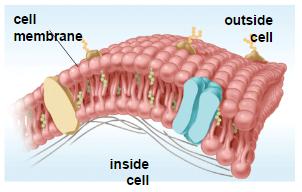
The cell membrane is made of a phospholipid bilayer. Label its three parts: 1)
charged phosphate group or head, 2) glycerol, and 3) the two fatty acid chains
or tails. Mark the end that is polar (likes water) and the end that is nonpolar
(doesn't like water). This is all review from Chapter 2.
The cell membrane is made of a phospholipid bilayer. Label its three parts: 1)
charged phosphate group or head, 2) glycerol, and 3) the two fatty acid chains
or tails. Mark the end that is polar (likes water) and the end that is nonpolar
(doesn't like water). This is all review from Chapter 2.
3
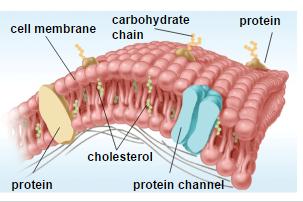
List the function of each of the main three molecules that are found in the cell
membrane.
List the function of each of the main three molecules that are found in the cell
membrane.
1
Some molecules can cross the membrane while others cannot. What term describes
this property: ________________ __________________(type the name of the term on
the figure below)
Some molecules can cross the membrane while others cannot. What term describes
this property: ________________ __________________(type the name of the term on
the figure below)
1
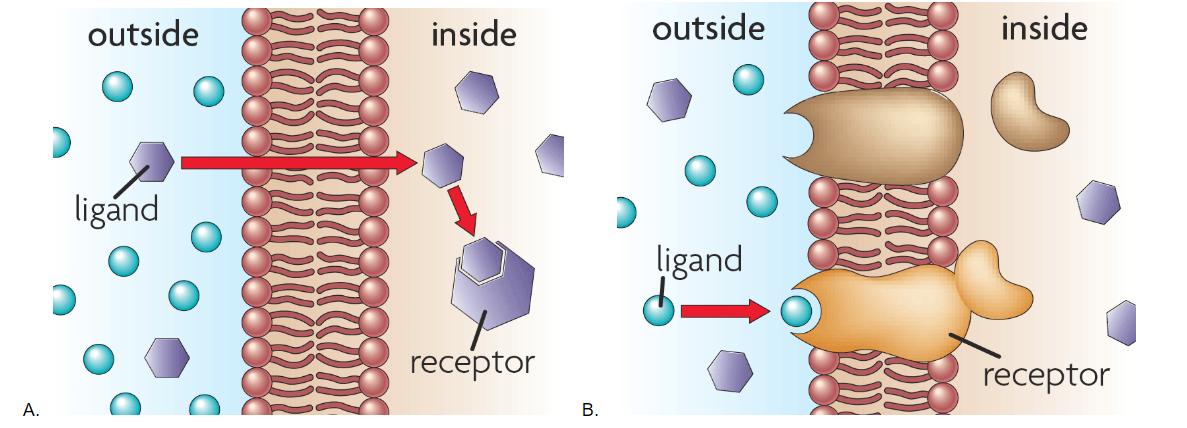
Figure A above is the Intracellular Receptor that is located inside the cell and
it is able to bind to a molecule to cross the membrane Figure B above is the
Membrane Receptor that is located in the membrane and the molecule binds to it,
causing a change of shape that transmits the molecule across the membrane
Figure A above is the Intracellular Receptor that is located inside the cell and
it is able to bind to a molecule to cross the membrane Figure B above is the
Membrane Receptor that is located in the membrane and the molecule binds to it,
causing a change of shape that transmits the molecule across the membrane
1
A concentration gradient means there is a difference in the concentration of a
substance in one location compared to another location.
A concentration gradient means there is a difference in the concentration of a
substance in one location compared to another location.
1
Describe what is meant by a molecule moving down a concentration gradient.
1
The higher the concentration of dissolved particles in a solution, means that
the concentration of water molecules in that solution is _______________.
The higher the concentration of dissolved particles in a solution, means that
the concentration of water molecules in that solution is _______________.
1
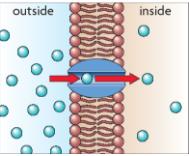
Facilitated diffusion differs from simple diffusion because it requires a transport protein to move it across the membrane.
1
In facilitated diffusion, do molecules move down a concentration gradient or against a concentration gradient?
1
Use the Table above with the cell conditions in Columns 3 and 4 to determine
movement of solutes and water for each condition.​ 5% salt inside the cell​ 10%
salt outside the cell. The answer to #1 and #2 in the Table is (remember column 1
will be diffusion of solutes; and column 2 will be osmosis of water):
Use the Table above with the cell conditions in Columns 3 and 4 to determine
movement of solutes and water for each condition.​ 5% salt inside the cell​ 10%
salt outside the cell. The answer to #1 and #2 in the Table is (remember column 1
will be diffusion of solutes; and column 2 will be osmosis of water):
1
Use the Table above with the cell conditions in Columns 3 and 4 to determine
movement of solutes and water for each condition. ​10% salt inside​ 10% salt
outside. The answer to #3 and #4 in the Table is:
Use the Table above with the cell conditions in Columns 3 and 4 to determine
movement of solutes and water for each condition. ​10% salt inside​ 10% salt
outside. The answer to #3 and #4 in the Table is:
1
Use the Table above with the cell conditions in Columns 3 and 4 to determine
movement of solutes and water for each condition. ​3% glucose inside​ 1% glucose
outside. The answer to #5 and #6 in the Table is:
Use the Table above with the cell conditions in Columns 3 and 4 to determine
movement of solutes and water for each condition. ​3% glucose inside​ 1% glucose
outside. The answer to #5 and #6 in the Table is:
1
Use the Table above with the cell conditions in Columns 3 and 4 to determine
movement of solutes and water for each condition. ​2% protein inside​ 1% protein
outside. The answer to #7 and #8 in the Table is:
Use the Table above with the cell conditions in Columns 3 and 4 to determine
movement of solutes and water for each condition. ​2% protein inside​ 1% protein
outside. The answer to #7 and #8 in the Table is:
1
Use the Table above with the cell conditions in Columns 3 and 4 to determine
movement of solutes and water for each condition. ​9% salt inside cell​ 9% salt
outside cell. The answer to #9 and #10 in the Table is:
Use the Table above with the cell conditions in Columns 3 and 4 to determine
movement of solutes and water for each condition. ​9% salt inside cell​ 9% salt
outside cell. The answer to #9 and #10 in the Table is:
1
Use the Table above with the cell conditions in Columns 3 and 4 to determine
movement of solutes and water for each condition. ​13% water inside cell​ 25%
water outside cell. The answer to #11 and #12 in the Table is:
Use the Table above with the cell conditions in Columns 3 and 4 to determine
movement of solutes and water for each condition. ​13% water inside cell​ 25%
water outside cell. The answer to #11 and #12 in the Table is:
1
Use the Table above with the cell conditions in Columns 3 and 4 to determine
movement of solutes and water for each condition. ​59% water inside cell ​45%
water outside cell. The answer to #13 and #14 in the Table is:
Use the Table above with the cell conditions in Columns 3 and 4 to determine
movement of solutes and water for each condition. ​59% water inside cell ​45%
water outside cell. The answer to #13 and #14 in the Table is:
1
Use the Table above with the cell conditions in Columns 3 and 4 to determine
movement of solutes and water for each condition. ​90% water inside cell​ 92%
water outside cell. The answer to #15 and #16 in the Table is:
Use the Table above with the cell conditions in Columns 3 and 4 to determine
movement of solutes and water for each condition. ​90% water inside cell​ 92%
water outside cell. The answer to #15 and #16 in the Table is:
1
Use the Table above with the cell conditions in Columns 3 and 4 to determine
movement of solutes and water for each condition. ​74% glucose inside cell​ 87%
glucose outside cell. The answer to #17 and #18 in the Table is:
Use the Table above with the cell conditions in Columns 3 and 4 to determine
movement of solutes and water for each condition. ​74% glucose inside cell​ 87%
glucose outside cell. The answer to #17 and #18 in the Table is:
1
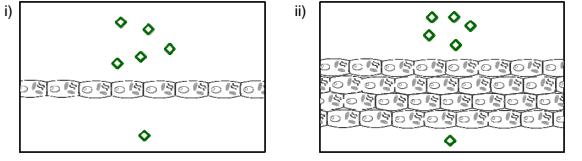
Refer to figure above
1
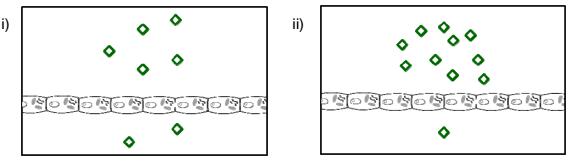
Use Figure above
Use Figure above
1
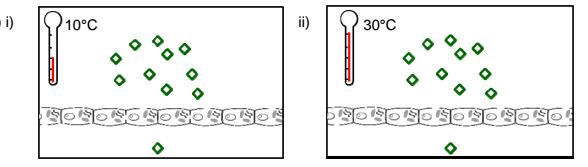
Use Figure above
Use Figure above
1
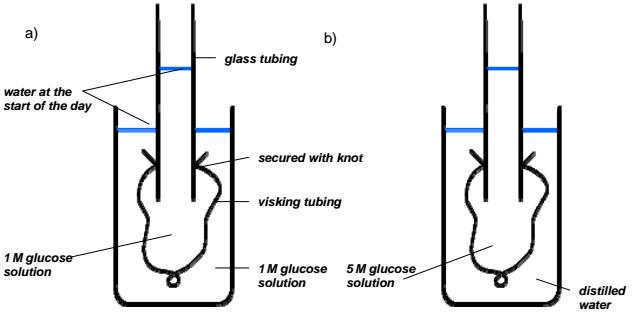
Experiment A. There was no change in the level of water in the visking tube or
beaker after a 24 hour period, because the glucose concentrations inside and
outside the visking tubing were the same.
Experiment A. There was no change in the level of water in the visking tube or
beaker after a 24 hour period, because the glucose concentrations inside and
outside the visking tubing were the same.
1
Experiment B. Water moved out of the visking tube into the beaker, so the water
level in the beaker rose higher and the water level in the glass tubing went
down.
Experiment B. Water moved out of the visking tube into the beaker, so the water
level in the beaker rose higher and the water level in the glass tubing went
down.
1
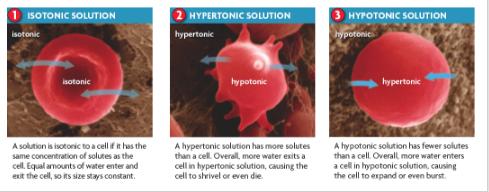
You become so dehydrated on a hot summer day that you go into shock and are
taken to an emergency room at a hospital. They start you on an IV of saline
solution to get you rehydrated. Why can't they give you an IV with just water in
it?
You become so dehydrated on a hot summer day that you go into shock and are
taken to an emergency room at a hospital. They start you on an IV of saline
solution to get you rehydrated. Why can't they give you an IV with just water in
it?