Log in
Sign up for FREE
arrow_back
Library
Semester 1 Test
By Greg Roth
star
star
star
star
star
Share
share
Last updated over 7 years ago
52 questions
Add this activity
1
1
1
1
1
1
1
1
1
1
1
1
1
1
1
1
1
1
1
1
1
1
1
1
1
1
1
1
1
1
1
1
1
1
1
1
1
1
1
1
1
1
1
1
1
1
1
1
1
1
1
1
Question 1
1.
Which of the following best characterizes Genghis Khan's conquests? (7.1.7)
A. Bloody attacks in which entire populations were often wiped out
B. slow, drawn-out attacks, often taking months
C. closely fought battles
D. mostly peaceful in which villages were either surrounded or retreated
Question 2
2.
China has moved from a ___ economy to a ____ economy. (7.4.3)
A. command, mixed
B. mixed, command
C. market, command
D. command, market
Question 3
3.
The Resurrection is the Christian belief that Jesus (7.1.2)
A. Taught about salvation
B. Rose from the dead
c. Performed micracles
D. was crucified
Question 4
4.
What led to the events at Tiananmen Square in 1989? (7.2.5)
a. Protesters demanded political rights and freedoms.
b. People rebelled in Tibet.
c. Foreign countries had begun to own Chinese businesses.
d. Foreign countries threatened to limit or stop trade with China.
Question 5
5.
What was the Gupta Empire's policy on religion? (7.1.1)
a. Buddhism was the main religion. Other religions had to pay special taxes.
b. Buddhism was the official religion. All other religions were banned.
c. Hinduism was the official religion. All other religions were banned.
d. Hinduism was the main religion. Other religions were tolerated as well.
Question 6
6.
What was the importance of Zheng He's 1405-1433 voyages? (7.1.10)
a. China was able to exchange goods and ideas with distant lands.
b. China became increasingly isolationist.
c. The Americas were discovered.
d. Foreign lands were conquered.
Question 7
7.
Which of the following cities is important to Judaism, Christianity, and Islam? (7.1.2)
a. Mecca
b. Baghdad
c. Jerusalem
d. Damascus
Question 8
8.
Which of the following is an Islamic belief? (7.1.2)
a. Muhammad's house in Medina is Islam's most sacred place.
b. Allah is the only God.
c. The Sunnah is the exact Word of God.
d. Muhammad was the son of God.
Question 9
9.
Islam changed from an Arab religion into a multicultural religion (7.1.5)
a. through the influence of Christians and Jews.
b. by order of Sultan Mehmed II.
c. through disputes between the Shia and the Sunni.
d. through the blending of cultures that occurred in lands conquered by the Arabs.
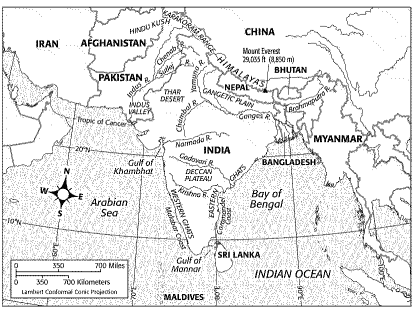
Study the map below to answer the question that follows.
Question 10
10.
Which mountain range covers Mt. Everest? (7.3.4)
a. Hindu Kush
b. Eastern Ghats
c. Himalayas
d. Karakoram Range
Question 11
11.
11. The issues of human rights and political freedom in China will probably (7.2.3)
a. strain relations with dictatorships.
b. improve if China's economy continues to grow.
c. strain relations with concerned countries.
d. improve if China can peacefully take over Taiwan.
Question 12
12.
12. Which of the following best describes the status of oil in Oman and Yemen? (7.3.6)
a. These countries have oil, but it has not made them rich
b. These countries have gotten rich from their oil deposits.
c. These countries have no oil and depend on other industries.
d. Oil has not yet been discovered in these countries, but they are actively searching.
Question 13
13.
What is the best recommendation on how to develop Central Asia's oil wealth? (7.4.4)
a. Invest in the construction and maintenance of oil pipelines.
b. Use the oil domestically so that it doesn't have to be exported.
c. Build tankers to ship the oil overseas.
d. Invest in better methods of moving oil over long distances.
Question 14
14.
The Three Gorges Dam creates power from (7.4.6)
A. Coal
B. Gasoline
C. Water
D. Wind
Question 15
15.
What island country is located to the south of China? (7.3.1)
A. Taiwan
B. Mongolia
C. Japan
D. South Korea
Question 16
16.
Which of the following would be the most likely outcome if Indian troops had not revolted against the British? (7.1.17)
a. India would not have been partitioned.
b. Mohandas Gandhi would have led peaceful protests.
c. India would have been granted independence much earlier.
d. The East India Company would have kept control of India.
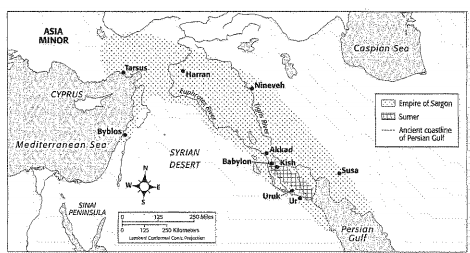
Study the map below to answer the question that follows.
Question 17
17.
What was the approximate distance in miles between Ur and Susa? (7.3.2)
A. 230 Miles
B. 190 Miles
C. 130 Miles
D. 170 Miles
Question 18
18.
According to Confucius, order would be maintained in society if (7.1.8)
a. fathers were honored in their families.
b. everyone knew their place.
c. everyone behaved appropriately.
d. All of the above responses are correct.
Question 19
19.
India and China both suffer from (7.3.7)
A. Monsoons
B. Sandstorms
C. Blizzards
D. Typhoons
Question 20
20.
The greatest achievements of the Qin dynasty were (7.1.8)
a. building projects such as the Great Wall.
b. inventions such as the seismograph.
c. the voyages of Zheng He.
d. canals that connected eastern and western China.
Question 21
21.
Which religion has an important role in the contemporary governments of many Middle Eastern countries? (7.2.2)
A. Judaism
B. Islam
C. Buddhism
D. Christianity
Question 22
22.
Which two physical features led to the development of the world's first civilization? (7.3.4)
a. the Sahara Desert and the Nile River
b. the Tigris River and the Euphrates River
c. the Fertile Crescent and the Mediterranean Sea
d. the Persian Gulf and the Mediterranean Sea
Question 23
23.
Women are now legally allowed to do this in Saudi Arabia (7.2.3)
a. drive cars.
b. go out in public.
c. make major purchases.
d. own businesses.
Question 24
24.
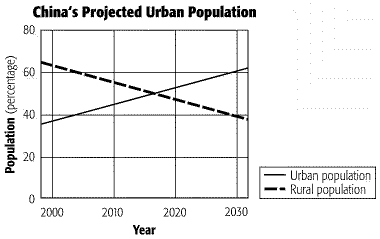
About what percentage of China's population is expected to be urban in 2030? (7.3.8)
A. 80%
B. 60%
C. 40%
D. 20%
Question 25
25.
Which system divided Indian society into groups based on birth or occupation? (7.1.1)
a. colonial system
b. urbanization system
c. partition system
d. caste system
Question 26
26.
During which Jewish holiday do Jews celebrate the Exodus? (7.1.2)
A. Passover
B. Rosh Hashannah
C. Yom Kippur
D. Hanukkah
Question 27
27.
The Palestinians consider the Jewish settlements in the West Bank (7.1.13)
a. an opportunity to develop their land.
b. an invasion of their land.
c. an act of terrorism.
d. an opportunity to become more diverse.
Question 28
28.
Which physical feature has contributed to the isolation of Central Asia? (7.3.7)
a. fertile plains
b. rugged mountains
c. numerous plateaus
d. the Silk Road
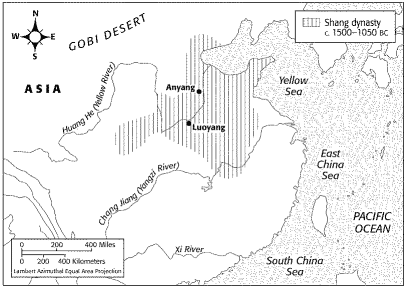
Study the map below to answer the question that follows.
Question 29
29.
Which natural feature formed part of the northern border of Shang China? (7.1.1)
a. Huang He River
b. Gobi Desert
c. Chang Jiang River
d. Japan
Question 30
30.
30. Turkey's acceptance into the European Union would most likely (7.4.1)
a. undo many of the reforms that have occurred in Turkey.
b. increase Turkey's available resources.
c. extend the boundary of Europe eastward.
d. improve Turkey's economy through increased trade with Europe.
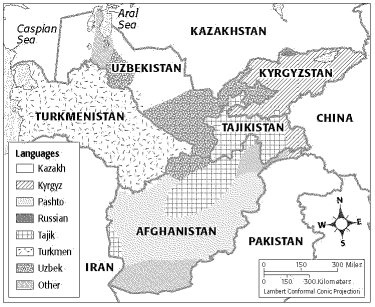
Study the map to answer the question
Question 31
31.
In which countries are more than three languages spoken? (7.3.1)
a. Uzbekistan and Afghanistan
b. Afghanistan and Turkmenistan
c. Uzbekistan and Tajikistan
d. Tajikistan and Kyrgyzstan
Question 32
32.
When the Soviets controlled Central Asia, they (7.1.13)
a. made Russian the official language of business and government.
b. tested nuclear weapons in the area.
c. built railroads and irrigation projects.
d. All of the above are correct responses.
Question 33
33.
What is the most sacred text of Judaism? (7.1.2)
a. the Koran
b. Hammurabi's Code
c. the New Testament
d. the Torah
Question 34
34.
Which of the following best describes Taiwan today? (7.4.4)
a. It is a respected member of the United Nations.
b. It is a sparsely populated and largely undeveloped country.
c. It relies on China for economic support.
d. It is one of the world's richest and most industrialized countries.
Question 35
35.
Which of the following statements about the contemporary governments of India and China is TRUE? (7.2.2)
a. India and China have communism.
b. India is a democracy and China has communism.
c. India and China are democracies.
d. China is a democracy and India has communism.
Question 36
36.
Division of labor is best described as a type of arrangement in which (7.1.1)
a. each person specializes in a particular job.
b. everyone does the same type of job.
c. the government assigns people different jobs.
d. there is large-scale unemployment.
Question 37
37.
What would be the best way for India to help its growing population? (7.3.10)
a. Import more food.
b. Encourage urbanization.
c. Encourage modern agricultural methods.
d. Control other countries in the region.
Question 38
38.
Recently Syria, Lebanon, and Jordan have experienced (7.1.13)
a. earthquakes.
b. increases in foreign aid.
c. democratic elections.
d. civil wars.
Question 39
39.
Which of these countries is a theocracy? (7.2.2)
a. Afghanistan
b. Iraq
c. Israel
d. Iran
Question 40
40.
Both Harappa and Mohenjo were located near the (7.1.1)
a. Arabian Sea.
b. Thar Desert.
c. Indus River.
d. city of Bodh Gaya.
Question 41
41.
China has been criticized by the United States and many other countries for building these in the South China Sea.
a. Nuclear Bombs
b. Coral Reefs
c. Artificial Islands
d. Alliances with neighboring countries
Question 42
42.
What is the name of the movement calling for the establishment of a Jewish state? (7.1.13)
a. Zionism
b. the Diaspora
c. the Exodus
d. Talmudism
Question 43
43.
Which two empires did the Silk Road connect? (7.1.4)
a. Tang and Egyptian
b. Song and Sumerian
c. Han and Roman
d. Yuan and Greek
Question 44
44.
There are many Christian denominations because (7.1.2)
a. people have interpreted Jesus's teachings in many different ways.
b. Paul encouraged churches to find their own truths.
c. the Roman Empire was divided into various states.
d. Jesus divided his followers into different groups.
Question 45
45.
An important difference between Christianity and Judaism is (7.1.2)
a. the Jewish belief in the Messiah.
b. the Christian belief that Jesus is the Messiah.
c. the importance of Abraham to Christianity.
d. the inclusion of the Psalms and Proverbs in the Hebrew Bible.
Question 46
46.
How did the development of an alphabet benefit the Phoenicians? (7.1.16)
a. It made writing easier.
b. It meant they would no longer need to trade goods.
c. It strengthened their military.
d. It helped them develop cuneiform.
Question 47
47.
According to Hinduism, people are reborn into new physical forms. The form one is born into depends on one's (7.1.16)
A. Karma
B. Moksha
C. Sutra
D. Dharma
Question 48
48.
Which radical Muslim group ruled Afghanistan in the 1990's? (7.1.13)
A. ISIS
B. the Mughals
C. the Taliban
D. OPEC
Question 49
49.
In the struggle for Indian independence, Mohandas Gandhi used ___ as a strategy. (7.1.11)
a. guerilla warfare
b. urbanization
c. nonviolent protest
d. partition
Question 50
50.
Which of the following events happened first? (7.1.15)
a. Muhammad went to the hills to pray and meditate.
b. Muhammad traveled to Medina.
c. Muhammad began to talk about his messages.
d. Mecca's rulers threatened Muhammad.
Question 51
51.
Which of the following events happened last? (7.1.15)
a. Siddhartha Gautama gained insight into human suffering.
b. Siddhartha Gautama wandered through forests for years.
c. Siddhartha Gautama meditated underneath a tree.
d. Siddhartha Gautama became disenchanted with life.
Question 52
52.
This was the first set of written laws. Many laws dealt with an "eye for an eye"
a. Constitution
b. The Code of Hammurabi
c. Cuneiform
d. Ziggurat