Chapter 11 Test
star
star
star
star
star
Last updated almost 8 years ago
50 questions
2
The smallest particle into which an element can be divided and still be the same
substance is called a(n)?
The smallest particle into which an element can be divided and still be the same
substance is called a(n)?
2
What particle did J.J. Thompson discover?
2
How would you describe the nucleus?
2
Where are electrons likely to be found?
2
Dalton believed that...
2
What did Democritus, Dalton, Thompson, Rutherford, and Bohr all have in common?
2
In Thompson's "plum-pudding" (our chocolate chip cookie dough) model of the
atom, the plums (chocolate chips) represent
In Thompson's "plum-pudding" (our chocolate chip cookie dough) model of the
atom, the plums (chocolate chips) represent
2
An atom of gold with 79 protons, 79 electrons, and 118 neutrons would have a
mass number of
An atom of gold with 79 protons, 79 electrons, and 118 neutrons would have a
mass number of
2
Which of the following has the least mass?
2
If an isotope of uranium, uranium-235, has 92 protons, how many protons does
uranium- 238 have?
If an isotope of uranium, uranium-235, has 92 protons, how many protons does
uranium- 238 have?
2
How did Democritus describe atoms?
2
Calculate the atomic mass of gallium, which consists of 60% gallium-69 and 40%
gallium-71.
Calculate the atomic mass of gallium, which consists of 60% gallium-69 and 40%
gallium-71.
2
What element and isotope results from the combination of two Be-10 isotopes?
2
An atom of carbon with 6 protons, 6 electrons and 6 neutrons would have a mass
number of?
An atom of carbon with 6 protons, 6 electrons and 6 neutrons would have a mass
number of?
2
In an atom, which has the least mass?
2
Which was one of Dalton's ideas?
2
What took place in the late 1880's?
2
What is the meaning of atom?
2
Which statement about atoms is true?
2
Which statement about isotopes is true?
2
According to Rutherford, what was in the center of an atom?
2
Which phrase describes radioactive isotopes?
2
The discovery of which particle proved that the atom is NOT indivisible?
2
Who proposed this new model of an atom?
2
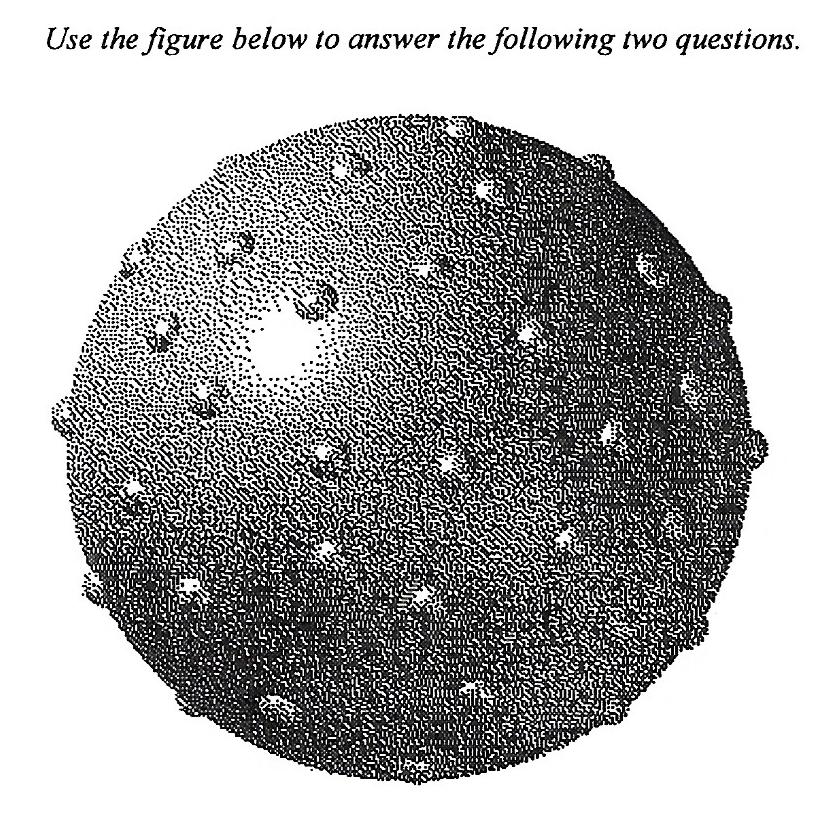
The raised surfaces show?
2
A positively charged particle in the nucleus of an atom is called a(n)
2
An atom of an element that has the same number of protons but different numbers
of neutrons is called a(n)
An atom of an element that has the same number of protons but different numbers
of neutrons is called a(n)
2
The smallest particle into which an element can be divided and still be the same
substance is a(an)
The smallest particle into which an element can be divided and still be the same
substance is a(an)
2
All substances are made of
2
Objects are pulled toward one another by ___________ force
2
Twentieth - Century scientists believe electrons are found in regions called
______
Twentieth - Century scientists believe electrons are found in regions called
______
2
The pushes and pulls between objects are called ______
2
Because the mass of an _________ is so small, it is usually thought of as almost
zero.
Because the mass of an _________ is so small, it is usually thought of as almost
zero.
2
A charged particle is called a(n) _________
2
All atoms of an element have the same
2
Particle that cannot be cut
2
Negatively charged particle discovered by Thomson
2
Central region of the atom
2
Region where electrons are likely to be found
2
Particle in the center of an atom that has no charge
2
Subatomic particle that has a positive charge
2
A unit of mass that describes the mass of an atom or molecule
2
The number of protons in the nucleus of an atom
2
Atom that has the same number of protons but different numbers of neutrons
2
The sum of protons and neutrons in an atom
2
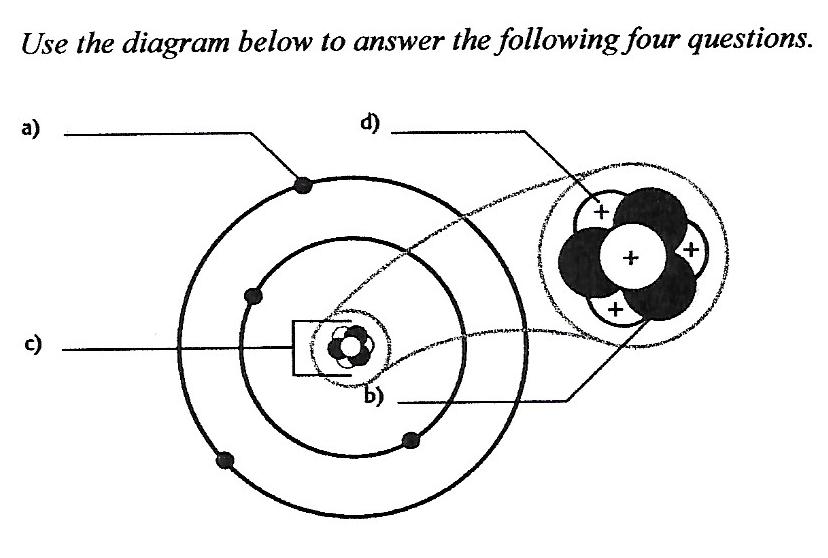
Which letter refers to the particle with no charge?
2
Which letter refers to the proton?
2
Which letter refers to the particle with a negative charge?
2
Which letter refers to the nucleus?
2
What would happen to a nucleus containing two or more protons if the strong
nuclear force were absent?
What would happen to a nucleus containing two or more protons if the strong
nuclear force were absent?