Genentic engineering to crash with evolution.
star
star
star
star
star
Last updated over 6 years ago
11 Nsɛmmisa
10
10
10
10
10
10
10
10
10
10
10
Explain in your own words what genetic engineering is. (Either in English or in Dutch).
Gene drives promise to spread a trait across an entire population — potentially even eradicating an entire species. But evolutionary forces are going to alter even the best-engineered plans.
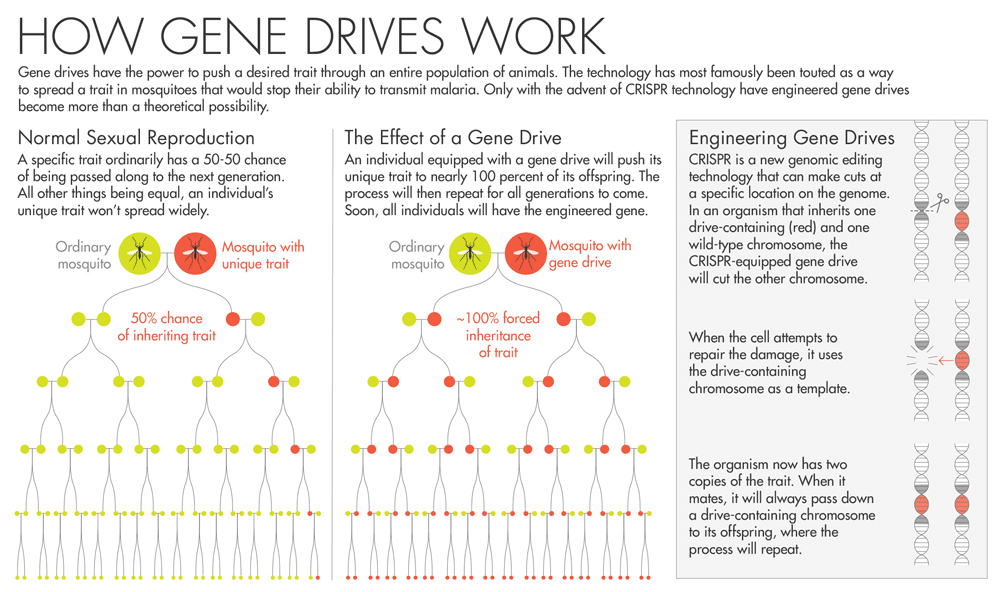
In a crowded auditorium at New York’s Cold Spring Harbor Laboratory in August, Philipp Messer, a population geneticist at Cornell University, took the stage to discuss a powerful and controversial new application for genetic engineering: gene drives.Gene drives can force a trait through a population, defying the usual rules of inheritance. A specific trait ordinarily has a 50-50 chance of being passed along to the next generation. A gene drive could push that rate to nearly 100 percent. The genetic dominance would then continue in all future generations. You want all the fruit flies in your lab to have light eyes? Engineer a drive for eye color, and soon enough, the fruit flies’ offspring will have light eyes, as will their offspring, and so on for all future generations. Gene drives may work in any species that reproduces sexually, and they have the potential to revolutionize disease control, agriculture, conservation and more. Scientists might be able to stop mosquitoes from spreading malaria, for example, or eradicate an invasive species.
Wat denk je dat een gene drive is, afgaande op bovenstaande alinea?
The technology represents the first time in history that humans have the ability to engineer the genes of a wild population. As such, it raises intense ethical and practical concerns, not only from critics but from the very scientists who are working with it.
Messer’s presentation highlighted a potential snag for plans to engineer wild ecosystems: Nature usually finds a way around our meddling. Pathogens evolve antibiotic resistance; insects and weeds evolve to thwart pesticides. Mosquitoes and invasive species reprogrammed with gene drives can be expected to adapt as well, especially if the gene drive is harmful to the organism — it’ll try to survive by breaking the drive.
What is a pathogen?
“In the long run, even with a gene drive, evolution wins in the end,” said Kevin Esvelt, an evolutionary engineer at the Massachusetts Institute of Technology. “On an evolutionary timescale, nothing we do matters. Except, of course, extinction. Evolution doesn’t come back from that one.”
Gene drives are a young technology, and none have been released into the wild. A handful of laboratory studies show that gene drives work in practice — in fruit flies, mosquitoes and yeast. Most of these experiments have found that the organisms begin to develop evolutionary resistance that should hinder the gene drives. But these proof-of-concept studies follow small populations of organisms. Large populations with more genetic diversity — like the millions of swarms of insects in the wild — pose the most opportunities for resistance to emerge.
Deze techniek is al uitgebreid getest.
It’s impossible — and unethical — to test a gene drive in a vast wild population to sort out the kinks. Once a gene drive has been released, there may be no way to take it back. (Some researchers have suggested the possibility of releasing a second gene drive to shut down a rogue one. But that approach is hypothetical, and even if it worked, the ecological damage done in the meantime would remain unchanged.)
The next best option is to build models to approximate how wild populations might respond to the introduction of a gene drive. Messer and other researchers are doing just that. “For us, it was clear that there was this discrepancy — a lot of geneticists have done a great job at trying to build these systems, but they were not concerned that much with what is happening on a population level,” Messer said. Instead, he wants to learn “what will happen on the population level, if you set these things free and they can evolve for many generations — that’s where resistance comes into play.”
A lot of scientists look at the bigger picture while doing work regarding gene drives.
At the meeting at Cold Spring Harbor Laboratory, Messer discussed a computer model his team developed, which they described in a paper posted in June on the scientific preprint site biorxiv.org. The work is one of three theoretical papers on gene drive resistance submitted to biorxiv.org in the last five months — the others are from a researcher at the University of Texas, Austin, and a joint team from Harvard University and MIT. (The authors are all working to publish their research through traditional peer-reviewed journals.) According to Messer, his model suggests “resistance will evolve almost inevitably in standard gene drive systems.”
It’s still unclear where all this interplay between resistance and gene drives will end up. It could be that resistance will render the gene drive impotent. On the one hand, this may mean that releasing the drive was a pointless exercise; on the other hand, some researchers argue, resistance could be an important natural safety feature. Evolution is unpredictable by its very nature, but a handful of biologists are using mathematical models and careful lab experiments to try to understand how this powerful genetic tool will behave when it’s set loose in the wild.
Wat wordt duidelijk na het lezen van bovenstaande alinea's?
Hoe kan gene drive er voor zorgen dat een muskiet niet langer malaria kan verspreiden?
Gene drives aren’t exclusively a human technology. They occasionally appear in nature. Researchers first thought of harnessing the natural versions of gene drives decades ago, proposing to re-create them with “crude means, like radiation” or chemicals, said Anna Buchman, a postdoctoral researcher in molecular biology at the University of California, Riverside. These genetic oddities, she adds, “could be manipulated to spread genes through a population or suppress a population.”
In 2003, Austin Burt, an evolutionary geneticist at Imperial College London, proposed a more finely tuned approach called a homing endonuclease gene drive, which would zero in on a specific section of DNA and alter it.
Burt mentioned the potential problem of resistance — and suggested some solutions — both in his seminal paper and in subsequent work. But for years, it was difficult to engineer a drive in the lab, because the available technology was cumbersome.
Geef een voorbeeld van een situatie waarin een gene drive spontaan optrad in de natuur.
With the advent of genetic engineering, Burt’s idea became reality. In 2012, scientists unveiled CRISPR, a gene-editing tool that has been described as a molecular word processor. It has given scientists the power to alter genetic information in every organism they have tried it on. CRISPR locates a specific bit of genetic code and then breaks both strands of the DNA at that site, allowing genes to be deleted, added or replaced.
CRISPR provides a relatively easy way to release a gene drive. First, researchers insert a CRISPR-powered gene drive into an organism. When the organism mates, its CRISPR-equipped chromosome cleaves the matching chromosome coming from the other parent. The offspring’s genetic machinery then attempts to sew up this cut. When it does, it copies over the relevant section of DNA from the first parent — the section that contains the CRISPR gene drive. In this way, the gene drive duplicates itself so that it ends up on both chromosomes, and this will occur with nearly every one of the original organism’s offspring.
Wat wordt bedoeld met "the advent of genetic engineering"?
Just three years after CRISPR’s unveiling, scientists at the University of California, San Diego, used CRISPR to insert inheritable gene drives into the DNA of fruit flies, thus building the system Burt had proposed. Now scientists can order the essential biological tools on the internet and build a working gene drive in mere weeks. “Anyone with some genetics knowledge and a few hundred dollars can do it,” Messer said. “That makes it even more important that we really study this technology.”
Although there are many different ways gene drives could work in practice, two approaches have garnered the most attention: replacement and suppression. A replacement gene drive alters a specific trait. For example, an anti-malaria gene drive might change a mosquito’s genome so that the insect no longer had the ability to pick up the malaria parasite. In this situation, the new genes would quickly spread through a wild population so that none of the mosquitoes could carry the parasite, effectively stopping the spread of the disease.
Welke twee manieren van gene drive hebben tot nu toe het meeste aandacht gekregen?
A suppression gene drive would wipe out an entire population. For example, a gene drive that forced all offspring to be male would make reproduction impossible.
But wild populations may resist gene drives in unpredictable ways. “We know from past experiences that mosquitoes, especially the malaria mosquitoes, have such peculiar biology and behavior,” said Flaminia Catteruccia, a molecular entomologist at the Harvard T.H. Chan School of Public Health. “Those mosquitoes are much more resilient than we make them. And engineering them will prove more difficult than we think.” In fact, such unpredictability could likely be found in any species.
What does unpredictable mean?