Log in
Sign up for FREE
arrow_back
Library

Chapter 12 Test

star
star
star
star
star
Last updated over 5 years ago
50 questions
2
2
2
2
2
2
2
2
2
2
2
2
2
2
2
2
2
2
2
2
2
2
2
2
2
halogens, period, group, alkali metals, actinide, periodic law, periodic, noble gases, alkaline-earth metals
2
halogens, period, group, alkali metals, actinide, periodic law, periodic, noble gases, alkaline-earth metals
2
halogens, period, group, alkali metals, actinide, periodic law, periodic, noble gases, alkaline-earth metals
2
halogens, period, group, alkali metals, actinide, periodic law, periodic, noble gases, alkaline-earth metals
2
aluminum, oxygen, hydrogen, silicon, carbon
2
aluminum, oxygen, hydrogen, silicon, carbon
2
elements, periodic law, period, transition, periodic, group, alkali
2
elements, periodic law, period, transition, periodic, group, alkali
2
elements, periodic law, period, transition, periodic, group, alkali
2
elements, periodic law, period, transition, periodic, group, alkali
2
elements, periodic law, period, transition, periodic, group, alkali
2
alkali, lanthanides, metalloids, actinides, transition, alkaline-earth, halogens
2
alkali, lanthanides, metalloids, actinides, transition, alkaline-earth, halogens
2
alkali, lanthanides, metalloids, actinides, transition, alkaline-earth, halogens
2
alkali, lanthanides, metalloids, actinides, transition, alkaline-earth, halogens
2
2
2
2
2
2
2
2
2
2
2
MULTIPLE CHOICE
-Choose the correct answer by clicking on your answer choice. Only one answer is correct. (2 pts. each)
Question 1
1.

Question 2
2.

Question 3
3.

Question 4
4.

Question 5
5.

Question 6
6.

Question 7
7.

Question 8
8.

Question 9
9.

Question 10
10.

Question 11
11.

Question 12
12.

Question 13
13.

Question 14
14.

Question 15
15.

Question 16
16.

Question 17
17.

Question 18
18.

Question 19
19.

Question 20
20.

Periodic Trends
Question 21
21.

Question 22
22.

Question 23
23.

Element Symbol
Question 24
24.

Question 25
25.

COMPLETION
-Complete the following questions by selecting the correct answer from the word bank. Misspelled words will be marked as incorrect. Some answers may be used more than once, others may not be used at all. (2 pts. each)
Word Bank for Questions 26 - 29
Question 26
26.

A rule that states that repeating chemical and physical properties of elements change periodically with the atomic number of the elements is the

Word Bank for Questions 26 - 29
Question 27
27.

Iodine and chlorine are examples of

Word Bank for Questions 26 - 29
Question 28
28.

Pure _________________ are often stored in oil to keep them from reacting with water and oxygen.

Word Bank for Questions 26 - 29
Question 29
29.

Atoms of ______________________have two outer level (valence) electrons.

Word Bank for Questions 30 & 31
Question 30
30.

Proteins, fats & carbohydrates, which are compounds of ______________, are necessary for life on Earth.

Word Bank for Questions 30 & 31
Question 31
31.

Nitrogen and ___________________ can be combined to make ammonia.

Word Bank for Questions 32 - 36
Question 32
32.

When something is __________________, it occurs or repeats at regular intervals.

Word Bank for Questions 32 - 36
Question 33
33.

Mendeleev's table became known as the periodic table of the ________________.

Word Bank for Questions 32 - 36
Question 34
34.

All of the more than 40 elements discovered since 1914 follow the _____________________.

Word Bank for Questions 32 - 36
Question 35
35.

A family is also called a __________________.

Word Bank for Questions 32 - 36
Question 36
36.

The elements in groups 3 - 12 are known as _______________metals.

Word Bank for Questions 37 - 40
Question 37
37.

Sodium and potassium are _________________________ metals.

Word Bank for Questions 37 - 40
Question 38
38.

All the atoms of ___________________ are unstable.

Word Bank for Questions 37 - 40
Question 39
39.

Semiconductors, also known as ________________________, have some properties of metals and some properties of nonmetals.

Word Bank for Questions 37 - 40
Question 40
40.

Magnesium, calcium and barium are ___________________ metals.

Matching
-Complete the following matching questions by clicking on the correct answer. Only one answer is correct. (2 pts. each)
Question 41
41.

Question 42
42.

Question 43
43.

Question 44
44.

Question 45
45.

Question 46
46.

Question 47
47.

Question 48
48.

Question 49
49.

Question 50
50.

Do NOT forget to turn in this assignment on Google Classroom after you have submitted it here! No credit will be awarded for unsubmitted assignments.
Periodic means
A happening at regular intervals
B happening very rarely
C happening frequently
D happening three or four times a year
Periodic law states that
A Elements are either gases, solids, or liquids.
B Mercury is a liquid at room temperature.
C properties of elements change periodically with the elements' atomic numbers.
D Some elements stay in a liquid state only for short periods.
Each vertical column on the periodic table is called a(n)
A period .
B group.
C element .
D property.
The elements to the right of the zigzag line on the periodic table are called
A nonmetals
B metals
C metalloids
D conductors
Most metals are
A solid at room temperature.
B bad conductors.
C dull.
D not malleable.
A horizontal row on the periodic table is called a(n)
A group.
B family.
C period.
D atomic number.
Which one of the following tells the physical state of an element at room temperature?
A the atomic number
B the color of the chemical symbol
C the atomic mass
D the element name
What element is necessary for substances to burn?
A hydrogen
B oxygen
C helium
D carbon
Transition metals are
A good conductors of thermal energy
B more reactive than alkali metals
C not good conductors of electric current
D used to make aluminum
Mendeleev found that the properties of the known elements followed a pattern that repeated every
A 7 elements
B 5 elements
C 14 elements
D 10 elements
What element makes up about 20% of the air we breathe?
A Nitrogen
B Bromine
C Oxygen
D Sulfur
The carbon group has two metalloids, both of which are used to make
A dinerware
B foil
C cans
D computer chips
What element is used to make the most widely used compound in the chemical industry?
A sulfur
B tellurium
C selenium
D polonium
How did Mendeleev group the elements?
A by density
B by melting point
C by appearance
D by increasing atomic mass
Which of the following statements about elements is true?
A Every element occurs naturally.
B All elements are found in their uncombined form in nature.
C All of the elements exist in approximately equal quantities.
D Each element has a unique chemical symbol.
How many of the recently discovered elements follow periodic law?
A none of them
B all of them
C every eighth element
D half of them
Mendeleev's periodic table was useful because it
A had no empty spaces.
B showed the elements arranged by atomic number.
C allowed for the prediction of the properties of missing elements.
D showed the electron arrangement of the elements.
Which of the following is a property of alkali metals?
A they are so hard they cannot be cut
B they are very reactive
C they are stored in water
D they have few uses
When a halogen reacts with a metal, what is formed?
A a salt
B a mixture
C a nonmetal
D an electron
What helps incandescent light bulbs last longer?
A helium
B radon
C argon
D neon
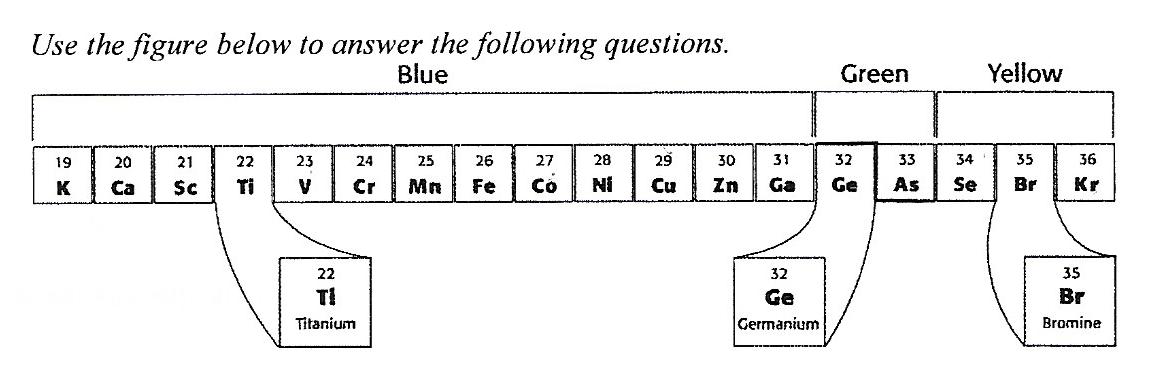
Which of the following elements is the most metallic?
A K
B Kr
C Fe
D Cu
Which of these elements is the least metallic?
A V
B Zn
C Co
D Se
Which element group has all nonmetals?
A K, Ca, Sc
B Se, Br, Kr
C V, Cr, Mn
D As, Se, Br
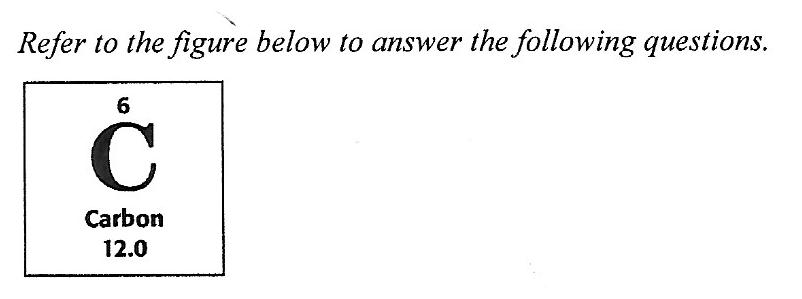
The number beneath carbon indicates the
A atomic number.
B atomic mass.
C chemical symbol.
D element name.
The number at the top is the
A atomic number.
B element name.
C atomic mass.
D chemical symbol.
These metals react with water to form hydrogen
A aluminum
B argon
C halogens
D nitrogen
E oxygen
F alkali metals
G calcium
H carbon
I hydrogen
J lanthanides
This metal, part of the Boron Group is used for aircraft parts.
A aluminum
B argon
C halogens
D nitrogen
E oxygen
F alkali metals
G calcium
H carbon
I hydrogen
J lanthanides
This is important to most living things.
A aluminum
B argon
C halogens
D nitrogen
E oxygen
F alkali metals
G calcium
H carbon
I hydrogen
J lanthanides
Cement and chalk are compounds of this.
A aluminum
B argon
C halogens
D nitrogen
E oxygen
F alkali metals
G calcium
H carbon
I hydrogen
J lanthanides
Some of these reactive metals are used to make steel.
A aluminum
B argon
C halogens
D nitrogen
E oxygen
F alkali metals
G calcium
H carbon
I hydrogen
J lanthanides
Chlorine and iodine are these.
A aluminum
B argon
C halogens
D nitrogen
E oxygen
F alkali metals
G calcium
H carbon
I hydrogen
J lanthanides
This is a colorless, odorless gas.
A aluminum
B argon
C halogens
D nitrogen
E oxygen
F alkali metals
G calcium
H carbon
I hydrogen
J lanthanides
Diamond and soot are forms of this.
A aluminum
B argon
C halogens
D nitrogen
E oxygen
F alkali metals
G calcium
H carbon
I hydrogen
J lanthanides
This makes up about 80% of the air we breathe.
A aluminum
B argon
C halogens
D nitrogen
E oxygen
F alkali metals
G calcium
H carbon
I hydrogen
J lanthanides
Light bulbs last longer when they are filled with this gas.
A aluminum
B argon
C halogens
D nitrogen
E oxygen
F alkali metals
G calcium
H carbon
I hydrogen
J lanthanides