Log in
Sign up for FREE
arrow_back
Library
Genes & Genome: Understanding the Language of Our Genome
By Siok Liu Lim
star
star
star
star
star
Share
share
Last updated almost 8 years ago
20 questions
Add this activity
Note from the author:
10
10
10
10
10
10
10
10
5′ – TTAGGACCGATGCCG – 3′
3′ – AATCCTGGCTACGGC – 5′
10
10
10
10
10
10
10
10
10
10
10
10
A test of understanding for the terms used in describing genetics and genetic structures.
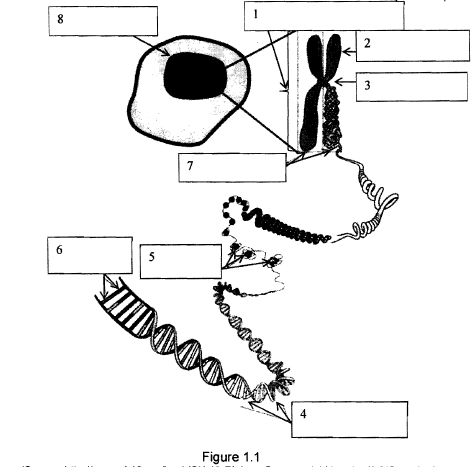
The Figure below shows a diagram of the chromosome.
Question 1
1.
Name structure 1 in the Figure above.
Question 2
2.
Name structure 2 in the Figure above.
Question 3
3.
Name structure 3 in the Figure above.
Question 4
4.
Name structure 4 in the Figure above.
Question 5
5.
Name structure 5 in the Figure above.
Question 6
6.
Name structure 6 in the Figure above.
Question 7
7.
Name structure 7 in the Figure above.
Question 8
8.
Name structure 8 in the Figure above.
A sequence of DNA is listed below:
Question 9
9.
How many codons are in the DNA sequence above?
Question 10
10.
How many amino acids would be produced if the DNA sequence is being expressed?
Question 11
11.
How many nucleotides are there in the sequence of DNA?
Question 12
12.
How many base pairs are there?
Question 13
13.
How many hydrogen bonds are there in total?
Question 14
14.
Gene is _______________.
A physical carriers of genetic materials.
B composed of DNA wrapped around proteins called histones.
C a discrete unit of hereditary information consisting of a specific nucleotide sequence in DNA.
D a double-stranded nucleic acid composed of two long, polymeric chains of deoxyribose-containing nucleotides.
Question 15
15.
Alleles are ________________________.
A the same as genes.
B alternative forms of a gene.
C located on the centromere.
D located on non-homologous chromosomes.
Question 16
16.
Chromosomes are ______________________.
A identical in the information they carry and attached to each other at the centromere to form the chromosome.
B tightly condensed structures which carry genetic materials and are composed of DNA wrapped around proteins called histones.
C discrete units of hereditary information consisting of a specific nucleotide sequence in DNA.
Question 17
17.
Chromatins are ________________________.
A all genetic information present in an individual or possessed by an organism
B identical in the information they carryand attached to each other at the centromere to form the chromosome.
C double-stranded nucleic acid composed of two polymeric chains of deoxyribose-containing nucleotides.
Question 18
18.
Genome refers to ____________________________.
A gene & chromosome or all genetic information present in an individual or possessed by an organism.
B a discrete unit of hereditary information consisting of a specific nucleotide sequence in DNA.
C alternative forms of a gene.
D physical carriers of genetic materials and are composed of DNA wrapped around proteins called histones.
Question 19
19.
Sister chromatids are _____________________.
A present in different chromosomes.
B alternative forms of a gene.
C identical in the information they carryand attached to each other at the centromere to form the chromosome.
D double-stranded nucleic acid composed of two long, polymeric chains of deoxyribose-containing nucleotides.
Question 20
20.
A gene encoded by 5 different alleles (A, B, C, D, E) exists in the human population. How many genotype combinations are possible? Show your working.
D double-stranded nucleic acids composed of two polymeric chains of deoxyribose-containing nucleotides.
D complexes of DNA and proteins in the nucleus, that condense to form chromosomes.