GED Reading Practice
star
star
star
star
star
Last updated about 6 years ago
18 Nsɛmmisa
10
10
10
10
10
10
10
10
10
10
10
10
10
10
10
10
10
10
Speech 1: The Gettysburg Address
by Abraham Lincoln
“Four score and seven years ago our fathers brought forth on this continent a new nation, conceived in liberty, and dedicated to the proposition that all men are created equal.
Now we are engaged in a great civil war, testing whether that nation, or any nation so conceived and so dedicated, can long endure. We are met on a great battlefield of that war. We have come to dedicate a portion of that field, as a final resting place for those who here gave their lives that that nation might live. It is altogether fitting and proper that we should do this.
But, in a larger sense, we cannot dedicate, we cannot consecrate, we cannot hallow this ground. The brave men, living and dead, who struggled here, have consecrated it, far above our poor power to add or detract. The world will little note, nor long remember what we say here, but it can never forget what they did here. It is for us the living, rather, to be dedicated here to the unfinished work which they who fought here have thus far so nobly advanced. It is rather for us to be here dedicated to the great task remaining before us — that from these honored dead we take increased devotion to that cause for which they gave the last full measure of devotion — that we here highly resolve that these dead shall not have died in vain — that this nation, under God, shall have a new birth of freedom — and that government of the people, by the people, for the people, shall not perish from the earth.”
Speech 2: Remarks on Signing the Bill of Rights Day Proclamation
by Ronald Reagan
“When Americans think about the nature of human rights, we begin with what Abraham Lincoln called ‘the definition and axioms of free society contained in the Declaration of Independence.’ Well, that testament of liberty declares that all men are created equal and are endowed by their Creator with inalienable rights. To secure these rights, it states ‘governments are instituted among men deriving their just powers from the consent of the governed.’ Well, those words reveal the meaning of human rights and our philosophy of liberty that is the essence of America.
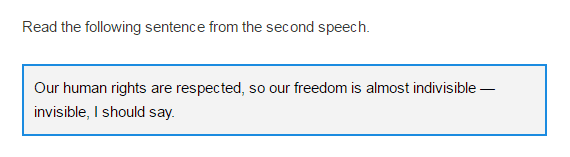
Sometimes we in free countries forget the richness of that precious possession. Our human rights are respected, so our freedom is almost indivisible — invisible, I should say. There are no walls, no troops or guns to prevent us from traveling. There are no guards at our churches or spies in our congregations. And there are no censors at the newspapers or universities.
People who live in tyranny, however, can see freedom much more clearly. It shines like a candle in the midst of darkness, and America’s freedom shines through a world of stormy seas, giving hope to tens of millions of people for a better way of life.”Reagan credits Lincoln with what he calls “the definition and axioms of free society contained in the Declaration of Independence.” Though this statement is not a part of the Gettysburg Address, what generalization or hypothesis can be drawn?
Lincoln delivered the Gettysburg Address on a battlefield, stating, “It is for us the living, rather, to be dedicated here to the unfinished work which they who fought here have thus far so nobly advanced.” The unfinished work to which Lincoln refers is the protection of
In Lincoln’s speech, how does paragraph 2 relate to paragraph 1?
How are Lincoln and Reagan’s speeches similar?
Replacing the word “invisible” with the word “undeniable” would change the meaning of the sentence to suggest that Reagan:
Which words would the Reagan use to describe his Lincoln’s interpretation of the Declaration of Independence?
Which of these word sets are used in both speeches to develop the main idea?
How to Paint a Floor Cloth
Floor cloths were used in the 18th century to protect wood floors from moisture in areas near an outside door, around the tub, or under the family table. Artists painted colorful designs on cloth that became popular because of their beauty as well as their usefulness.
Linoleum floors eventually replaced floor cloths in prevalence, but many people make floor cloths for their homes today or commission artists to create personalized floor cloths for them. Floor cloths are used under babies’ high chairs, near the kitchen sink, and even under the family pet’s water bowl. As it was in the early years of the floor cloth’s use, the ultimate goal for today’s floor cloth is to provide an attractive rug that protects the floor.
Artists apply color to a surface called a support base, or “support” for short. For floor cloths, the support is canvas that can be purchased from the fabric store, a hobby shop, or a boat supply company. Before painting, the artist will cut the fabric to the desired size and hem the edges. This can be done by hand stitching or by using a sewing machine. The fabric is tucked into the seams so that the fabric won’t unravel, leaving frayed edges.
Most artists apply two coats of sealant to the back side of the mat at 24-hour intervals and a single base coat to the front before applying even the first coat of paint. Both sides of the fabric are sealed so that water cannot seep into the cloth from the top or the underside. It is important for the floor cloth to be water resistant so that it doesn’t hold water next to the floor, causing damage to the wood, and this process begins with the first steps of its creation.
Next, the artist paints a background and allows this to dry thoroughly before adding the actual picture. Some artists paint scenes such as landscapes, animals, or floral arrangements. Others create designs or patterns that are comparable to those of the 18th century. Floor cloths can be painted with oil or acrylic paints, although the artist might want to consider that acrylic paint dries faster.
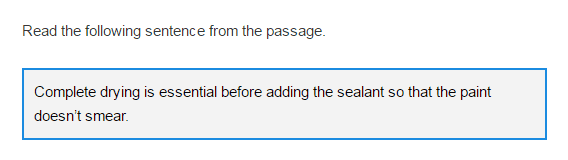
Complete drying is essential before adding the sealant so that the paint doesn’t smear. The artist applies at least two or three coats of sealant over the painted picture at 24-hour intervals. Some artists add as many as ten coats of sealant.
Polycrylic, varnish, and polyurethane are sealants that work well for floor cloths. Of the three, varnish requires more thought as to clean-up. Because varnish is oil-based, cleaning must include mineral spirits or paint thinner. Some artists feel it is worth the extra effort since the mats that are sealed with varnish tend to be stiffer than the mats sealed with protective topcoats that are water-based.
A floor cloth that is painted on canvas will last years with little visible wear.Which sentence from the passage supports the idea that the modern creation and use of floor cloths to protect floors is a revival of an old custom?
Which definition best matches the use of the word support in paragraph 3?
How does the author’s use of the words “most artists” in paragraph 4 function in the story?
Which fact can the reader infer about making a floor cloth?
Based on the article, what is NOT a step in preparing a floor cloth?
Replacing the word “essential” with the word “beneficial” changes the meaning of the sentence to suggest that
How does paragraph 5 relate to paragraph 4?
Dear Mr. Rogers:I visited your store to determine a price range for installing a new wood-burning stove in my home. I openly disclosed that my budget for the project was around $4,000, with $5,000 being the absolute limit of my funds. I was told that this would be enough. However, your subsequent proposal with amounts totaling over $6,800 Select from Question #15
I asked that my deposit check be returned as I could not afford the project. I then received a bill from you for $129 for consultation. While I understand that your time is valuable, none of your literature indicates a charge for the initial discussion of a potential project. Quite truthfully, I would not have scheduled the appointment Select from Question #16
I called to discuss the invoice and explained over the telephone that I feel I was Select from Question #17 to compromise by paying one-half the bill. The store representative told me that someone would call me back regarding the invoice and Select from Question #18 Since no one has called me to express non-acceptance of my offer, I am enclosing a check for $64.50.
Sincerely,
Select the option that correctly completes the sentence.
Select the option that correctly completes the sentence.
Select the option that correctly completes the sentence.
Select the option that correctly completes the sentence.