1
1
1
1
1
1
1
1
1
1
1
1
1
1
1
1
1
Video clip and text describing the process of transcription.
First Name Last Name
DNA provides the instructions needed by a cell to make proteins. But the instructions are not made directly into proteins. First, a DNA message is converted into RNA in a process called transcription. Then, the RNA message is converted into proteins in a process called translation. The relationship between these molecules and processes is summed up in the central dogma, which states that information flows in one direction, from DNA to RNA to proteins.
Like DNA, RNA is a nucleic acid. It is made of nucleotides that consist of a phosphate group, a sugar, and a nitrogen-containing base. However, RNA differs in important ways from DNA: (1) RNA contains the sugar ribose, not deoxyribose; (2) RNA is made up of the nucleotides A, C, G, and uracil, U, which forms base pairs with A; (3) RNA is usually single-stranded. This single-stranded structure enables RNA to fold back on itself into specific structures that can catalyze reactions, much like an enzyme.
During transcription, a gene is transferred into RNA. Specific DNA sequences and a combination of accessory proteins help RNA polymerase recognize the start of a gene. RNA polymerase is a large enzyme that bonds nucleotides together to make RNA. RNA polymerase, in combination with the other proteins, forms a large transcription complex that unwinds a segment of the DNA molecule. Using only one strand of DNA as a template, RNA polymerase strings together a complementary RNA strand that has U in place of T. The DNA strand zips back together as the transcription complex moves forward along the gene.
Transcription makes three main types of RNA.
• Messenger RNA (mRNA) is the intermediate message between DNA and proteins. It is the only type of RNA that will be translated to form a protein.
• Ribosomal RNA (rRNA) forms a significant part of ribosomes.
• Transfer RNA (tRNA) carries amino acids from the cytoplasm to the ribosome during translation.
The DNA of a cell therefore has genes that code for proteins, as well as genes that code for rRNA and tRNA.
Class Period
Date
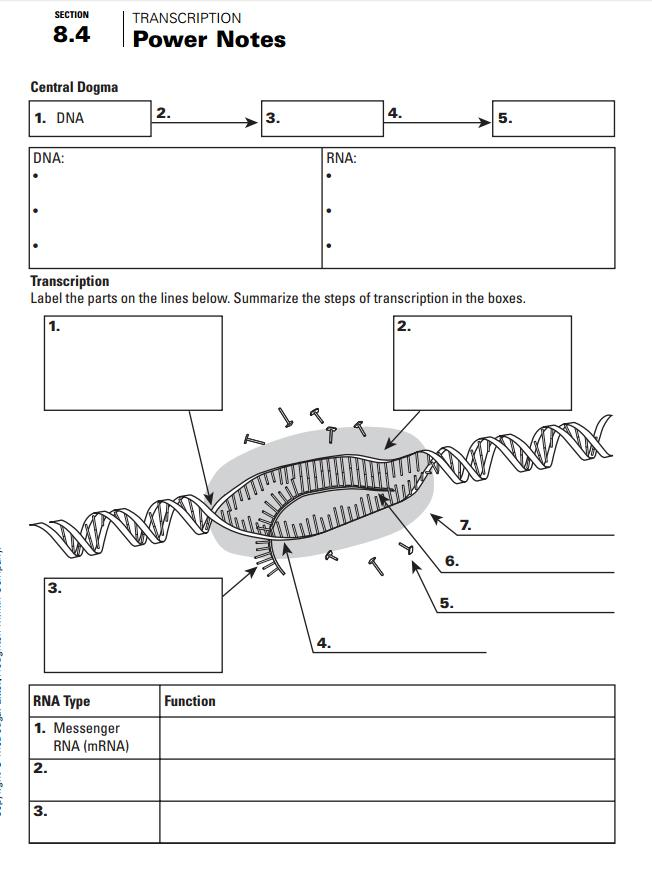
Describe the message that we are told from the "Central Dogma" about DNA.
#2 under Central Dogma: the process that gets DNA to RNA
#3 under Central Dogma: the message genetic material is called
#4 under Central Dogma: the process that gets the genetic material made into proteins
#5 under Central Dogma: the end product of the genetic messenger in the cytoplasm
Compare and contrast the three major structural properties between DNA and RNA. If the bullet at #9 under DNA is deoxyribose sugar, then the first bullet under RNA is
Compare and contrast the three major structural properties between DNA and RNA. If the second bullet at #10 under DNA is the nitrogen bases A, C, G, and T which follows the pairing rules: A pairs with T and C pairs with G; then the second bullet under RNA are the following bases in alphabetical order.
Compare and contrast the three major structural properties between DNA and RNA. If the third bullet under DNA #11is a double strand of DNA; then the third and last bullet under RNA is a
The boxes summarize the steps of transciprtion . Box 1 (#12)
RNA polymerase begins to undwind the DNA
The boxes summarize the steps of transciprtion . Box 2 (#13)
RNA polymerase reads one side of the DNA and strings together a complimentary strand of RNA nucleotides.
The boxes summarize the steps of transciprtion . Box 3 (#14)
Growing RNA strands hang freely and detach once the entire gene is transcribed.
labeling the parts of the structure are lines 4 through 7 (#15-18)
#4 line
#5 is pointing to the
#6 is pointing to the ______________that is being made
#7 is pointing to the large shaded oval, referred to as the
The Function of mRNA is providing an intermediate message that is translated to form a protein at ribosomes.
Another type of RNA is ribosomal RNA (rRNA). It's function is to form and assemble the ribosomes (ribosomes have a large and a small subunit).
The last type of RNA brings amino acids from the cytoplasm to a ribosome to help make the growing protein. It is called