Log in
Sign up for FREE
arrow_back
Library
Genetics Final
By Christopher Grigg
star
star
star
star
star
Share
share
Last updated over 3 years ago
32 questions
Add this activity
1
1
1
1
1
1
1
1
1
1
1
1
1
1
1
1
1
1
1
1
1
1
1
1
1
1
1
1
1
1
1
1
Question 1
1.
Offspring that are the result of sexual reproduction are:
never identical to the parents
sometimes identical to the parents
always identical to the parents
identical to other offspring
Question 2
2.
A trait can be determined by:
one gene
many genes
the environment
all of the above
Question 3
3.
Egg and sperm combine during:
asexual reproduction of plants
asexual reproduction of animals
sexual reproduction of plants and animals
reproduction of bacteria
Question 4
4.
Which of the following organisms reproduce sexually?
humans
plants
both a and b
none of the above
Question 5
5.
In the cells of most organisms, genetic information is contained in the:
cell wall
nucleus
organelle
cytoplasm
Question 6
6.
Scientists often use other organisms to study genetics. Fruit flies are sometimes chosen because:
they reproduce quickly
they cause disease
they do not have cells
they do not reproduce
Question 7
7.
Diseases that are inherited are
caused by genes
caused by viruses
caused by environmental factors
caused by stress
Question 8
8.
Which of the following is an example of asexual reproduction?
a fish releases sperm which unites with an egg of another fish
flowers from two different plants are mated to produce a seed
a gray cat is the offspring of a black cat and a white cat
an aomeba is split in two; each half grows back into a complete aomeba
Question 9
9.
Which of the following best describes how the human body is organized, from the
largest
to
smallest
structure?
DNA, chromosomes, cells
cells, chromosomes, DNA
cells, DNA, chromosomes
chromosomes, cells, DNA
Question 10
10.
The offspring of asexual reproduction is identical to the parent except in the case of:
a clone
a genetic mutation
fertilization
multicellular organisms
Question 11
11.
Which of the following statements is TRUE?
only single-celled organisms can reproduce sexually
only single-celled organisms can reproduce asexually
only multicellular organisms can reproduce asexually
none of the above
Question 12
12.
Process by which organisms make exact copies of themselves without the union of gametes (sperm and egg cells).
prototype
asexual reproduction
sexual reproduction
clone
Question 13
13.
A change in the DNA of a gene that can lead to a different trait.
regulation
prototype
range
mutation
Question 14
14.
An offspring produced by asexual reproduction, either naturally or through artificial processes.
gene
clone
regulation
prototype
Question 15
15.
An individual’s pair of alleles for a specific gene or group of genes that determine a trait.
heterozygous
homozygous
genotype
phenotype
Question 16
16.
An organism’s observable traits.
heterozygous
homozygous
genotype
phenotype
Question 17
17.
An organism that has two identical alleles for a specific trait. (example: AA)
heterozygous
homozygous
genotype
phenotype
Question 18
18.
An organism that has two different alleles for a specific trait.(Example: Aa)
homozygous
genotype
heterozygous
phenotype
Question 19
19.
A recessive genetic trait is represented by the letter “a.” Which of the following would most likely be used to represent the recessive condition?
AA
Aa
aa
none of the above
Question 20
20.
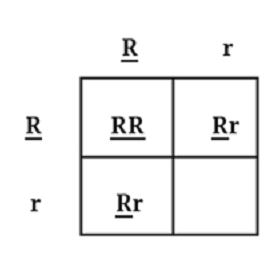
In the table shown above, the empty square should be filled in as:
RR
Rr
rr
RRrr
Question 21
21.
In the table shown above, among the offspring, what is the ratio of dominant to recessive for this trait?
3:1
1:3
2:2
1:2:3
Question 22
22.
In the table shown above, the dominant trait is represented by:
RR, Rr, and rr
RR and Rr
RR and rr
Rr and rr
Question 23
23.
In the table shown above, the probability of traits in offspring is a result of:
asexual reproduction
sexual reproduction
both a and b
none of the above
Question 24
24.
One of the first people to study patterns of heredity scientifically was:
Mary-Claire King
Robert Hooke
Antoine Marfan
Gregor Mendel
Question 25
25.
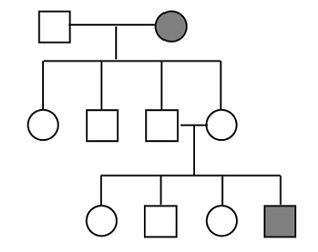
Look at the shaded inividuals. By studying the diagram, you can conclude that the trait is:
dominant
recessive
co-dominant
both dominant and recessive
Question 26
26.
Most human cells have ____ copies of each chromosome.
2
4
10
25
Question 27
27.
Which genotype is homozygous recessive
Bo
Bb
bb
BB
Question 28
28.
Which genotype is homozygous dominant
Bo
Bb
bb
BB
Question 29
29.
Which blood genotype is co-dominant?
Ao
Bo
AB
BB
Question 30
30.
Two parents are both carriers for a genetic trait that is based on only one gene. This means that their offspring:
cannot have the trait
will all be carriers for the trait
have a 25% chance of inheriting the trait
have a 50% chance of inheriting the trait
Question 31
31.
The trade-offs in choosing to be tested for a genetic disease include:
you might find out you have the disease
it may become difficult to get health insurance
both a and b
there are no trade-offs with this decision
Question 32
32.
The offspring of sexual reproduction:
receives half of its genetic material from each parent
receives all of its genetic material from one parent
receives genetic material from an outside source
develops genetic material independent of any other source