Log in
Sign up for FREE
arrow_back
Library

Elisa's Diary Comprehension

star
star
star
star
star
Last updated over 6 years ago
12 questions
1
1
1
1
1
1
1
1
1
1
5
5
Question 1
1.

Question 2
2.

Question 3
3.

Question 4
4.

Question 5
5.

Question 6
6.

Question 7
7.

Question 8
8.

Use the passage "Elisa's Diary" and the poem "Words Free As Confetti" to answer Numbers 9 and 10.
Question 9
9.

Question 10
10.

Question 11
11.

Jessica was distraught at being assigned to work on a group art project with Susan. They were complete opposites, and she knew they would not get along. Jessica soon discovered that Susan was fantastic at sketching real life objects, which was a skill that Jessica had never mastered. Together, the two girls put together a great project.

What is the theme of the passage above? How does it compare with Elisa's Diary?

Question 12
12.

A homeless man didn't have a dime to his name. He was so poor that he didn't even have dinner most nights, but he was very happy. He had friends and fond memories of his life before the war. His brother was rich and lived in a mansion with expensive cars. However, he was miserable and alone. He wished that he could switch places with his homeless brother to see what it would be like to be happy.

What is the theme of this passage?

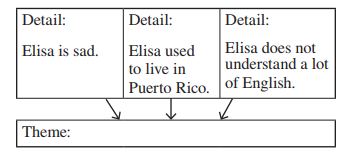
Which of these best completes the graphic organizer above?
It can be fun to learn new things.
It is important to be loyal to friends.
It can be helpful to work with other people.
It is difficult to adjust to living in a new place.
Which event happens first?
Elisa's teacher mispronounces her name.
Elisa moves to the United States permanently.
Elisa meets Jose at the beginning of the school year.
Elisa enjoys watching squirrels with her grandmother.
What is the difference about Elisa staying with her grandmother this time?
She is staying by herself with the grandmother.
She is helping her grandmother move to a new home.
She is living with her grandmother rather than visiting her.
She is learning how to take care of the squirrels from her grandmother.
What happens after Jose tells about the customs and traditions of his country?
The students clap.
The students mock him.
Elisa feels embarrassed.
Elisa volunteers to go next.
What does Elisa learn from Jose?
It takes a special talent to be an artist.
Cultural traditions do not really matter.
People should speak only one language.
Everyone has strengths and weaknesses.
Read these sentences from the passage.

-"Speaking is one thing and writing is another."
- "And vice-versa," said Elisa.
-"And the opposite."
-"And the other way around."

The section of dialogue above
appears at the very end of the story.
shows that Elisa is upset about speaking English.
signals the beginning of Elisa and Jose's friendship.
is Elisa's way of competing with Jose in their native language.
Read these sentences from the passage.

-"It will be right here waiting for you when you get back."
-"I'll be back soon, Grandma. I love this place. Maybe someday I'll come and live with you."

The narrator does not state the names of the speakers in the sentences above because
Grandma is embarrassed about getting Elisa's name wrong.
The author wants the characters in the story to be a mystery.
It is clear from the context that Elisa and Grandma are speaking.
Elisa decides to change her name after moving to the United States.
What is Elisa at the end of the passage?
a tourist
a teacher
a grandmother
a high school student
How are the themes of the passage and the poem similar?
The are both about moving to a new country.
They both involve appreciating language and culture.
They are both about the pain of giving up one's past.
They both involve learning new words from teachers.
How is the passage different from the poem?
The poem does not use similes.
The passage uses both English and Spanish words.
The poem contains dialogue and the passage does not.
The passage deals with the challenges of adjusting to a new culture and language.