1
1
1
1
1
1
The Renaissance occurred
Which of these statements is NOT correct?
During the Renaissance
The word "renaissance" means
During the Renaissance, there were many advances in the fields of (Check all that apply.)
The Renaissance BEGAN
The period of time when Europeans began to search for a sea trade route between Europe and Asia is called
Which of the following statements are true regarding the Age of Exploration? (Check all that apply.)
The period from 1000 to 1500 CE included the beginning of
The fall of Rome occurred almost 1000 years before the Renaissance. Why then do we talk so much about Greek & Roman culture when we discuss the Renaissance?
________________ can be credited with giving people more access to reading materials and encouraging literacy
Which of the following was NOT a way that art was advanced during the Renaissance?
Two new ways of thinking that emerged during the Renaissance were (Select TWO.)
During the Medieval period (Middle Ages) (Check all that apply.)
Which statement is NOT true about Mercantilism?
Two big names in astronomy - and the understanding that the earth orbits the sun (not the other way around) were
The printing press was invented
Patrons of the arts __________.
The Medici family
The Renaissance was a time of
At the time of the Renaissance, city-states were ruled by
The main center of the Renaissance in Europe was _________.
When the conditions were just right and people became free to spend their time and energy on special activities (like reading and writing, the arts, exploring the mysteries of the natural world, etc.) rather than just trying to survive, this occured
Renaissance paintings were more realistic than paintings of the Middle Ages
We discussed the term "renaissance man" and what it means in today's usage. Choose one of the men we studied from the Renaissance period and explain how he fits the definition of a "renaissance man."
Place the following events/ eras in the correct order.
Roman Empire at its peak
Renaissance
Fall of the Roman Empire
European Dark Ages
Sort the following terms according to whether they are characteristics of the Medieval or Renaissance periods.
heavy, dark, gothic architecture
light, open architecture
rediscovery of classical knowledge
advances in arts and culture
people struggling to survive
the Age of Exploration
the Reformation
the Bubonic Plague
the invention of the printing press
Feudalism practiced
learning was focused on the Church and spiritual matters
Humanism
learning focused on humanity and the external, physical world
growth in Christianity
growth in literacy
flat, unrealistic art
art that uses shading and perspective
lack of strong, centralized governments
Medieval Era
Renaissance Era
Match each term to its correct definition.
city-state
Papal state
renaissance
dark age
theology
Humanism
Latin
Medici
region under control of the Pope and the Catholic Church
a time of chaos, insecurity, and little or no advancement in learning and the arts
system of thought attaching importance to human rather than divine or supernatural matters
the Italian family who were patrons of the arts and who contributed to the Italian Renaissance
the language spoken by the Roman Empire and the Church
a small, independent nation under the control of a city
a rebirth in culture and learning
the study of and belief in a god or gods
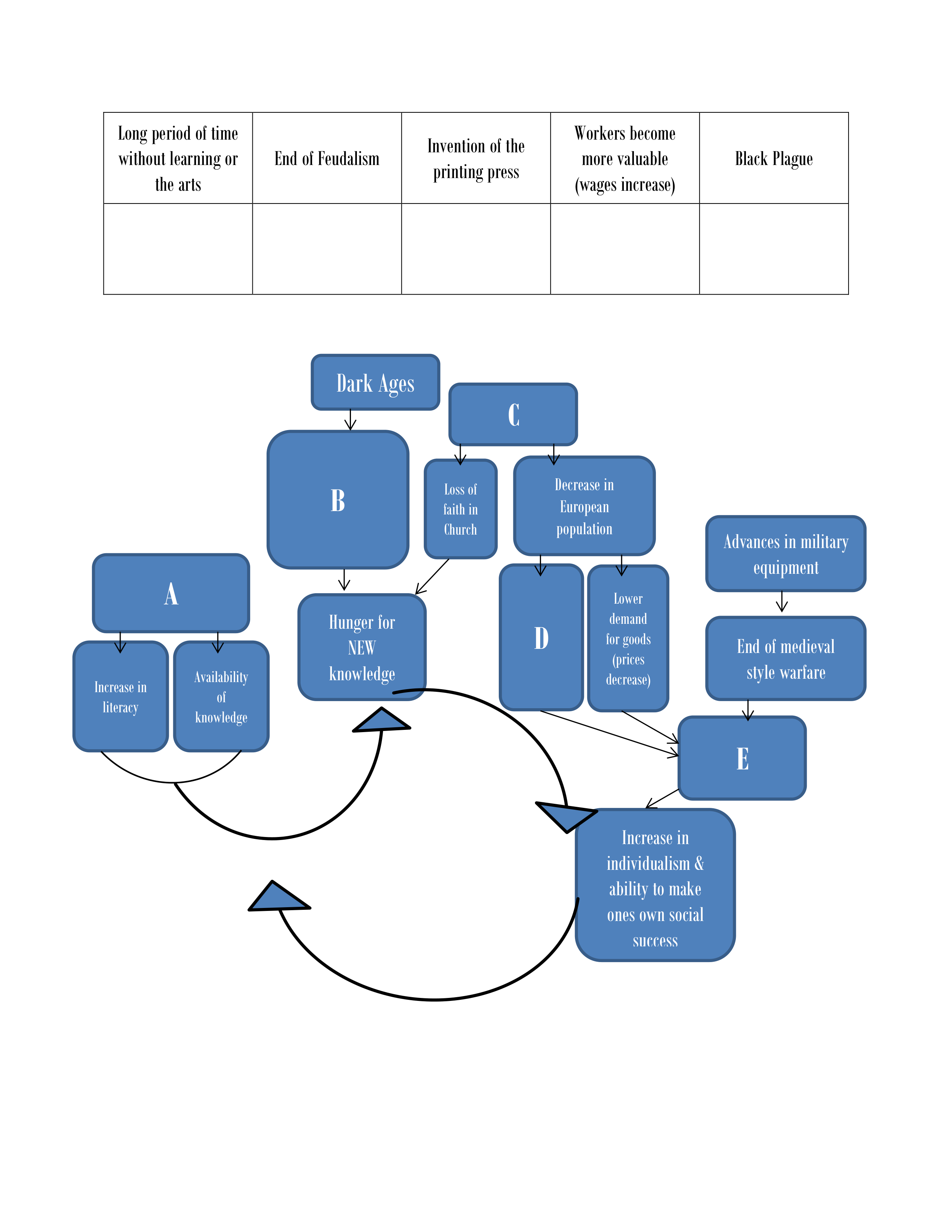
Which space on the flowchart would be correctly filled with this text?
Which space on the flowchart would be correctly filled with this text?
Which space on the flowchart would be correctly filled with this text?
Which space on the flowchart would be correctly filled with this text?
Which space on the flowchart would be correctly filled with this text?
This cycle of learning, growth and desire for more knowldge was the fuel that led to