Life During the Cold War (1950s)
star
star
star
star
star
Last updated over 8 years ago
12 Nsɛmmisa
Hyɛ no nsow a efi ɔkyerɛwfo no hɔ:
Cold War/1950s Part II

1
1
1
1
1
1
1
1
1
1
1
1
Cold War/1950s Part II
For the millions of soldiers who came back from WWII, life was vastly different than it was before the war began. The Great Depression - the worldwide economic downturn that caused much suffering and hardship during the 1930s - had ended with the war. Except for Europe, where recovery was a steady but difficult process, much of the world rebounded. In the U.S., economic recovery meant almost full employment. Women who had worked in factories and elsewhere during the war years now yielded to a different reality as soldiers became civilians once again and took over their jobs. Thanks to the Marshall Plan, Europe's bombed out cities and industry began to rebuild, modernizing in the process and becoming vastly more efficient. Money from the Marshall Plan also helped the U.S. economy to reach stunning heights it had never reached before. And where radio, the telegraph, and newspapers had once dominated, now a new invention began to capture the world's attention: television. Technology also led to the "space race" between the USSR and the United States.
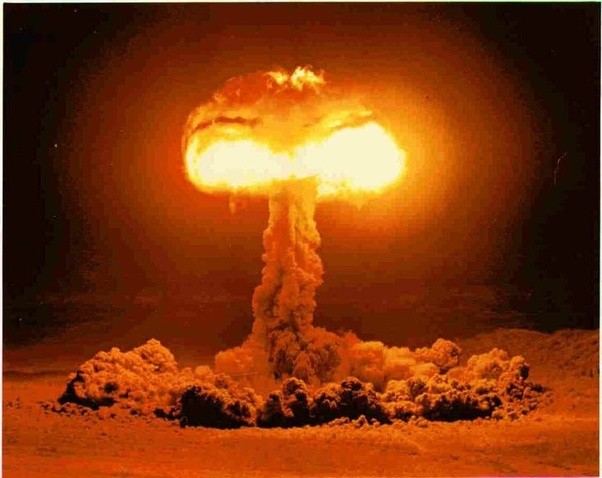
The main concern, however, remained with growing worldwide tensions that occurred at the end of WWII between the free world and one that espoused communism; notably, between the United States, the USSR, and China. Improvements in technology meant improvements in rocketry and nuclear weapons, culminating in the production of the hydrogen bomb - a much more powerful weapon than the atomic bombs dropped on Hiroshima and Nagasaki, Japan. With so much more at stake, the hidden world of espionage soon began to dominate.
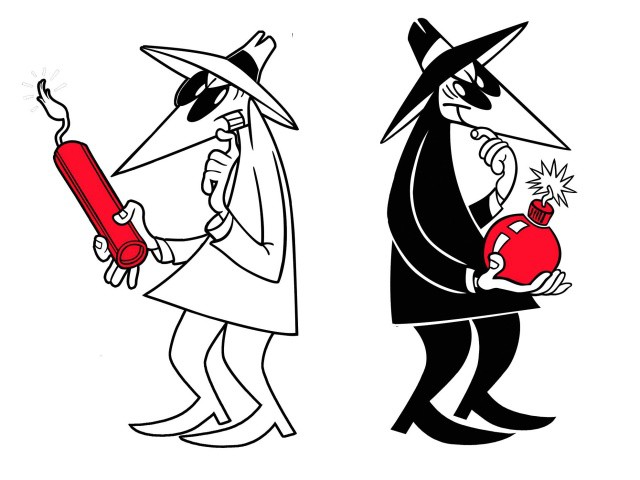
As spies began to infiltrate the US (esp. Los Alamos, New Mexico) to steal atom bomb secrets for the Soviets, Allied armies and the army of the Soviet Union had divided up not only Germany after WWII but also Berlin, Germany's capital. What had once been a united effort among the "Big Three" (US, Britain, USSR) to defeat Nazi Germany now became a "cold war" that pitted the US & Britain against the Soviets. Watch the following video and then respond to the questions afterward:
At the conclusion of WWII, Germany was divided into how many zones of occupation?
The city of Berlin (Germany's capital) was inside the Soviet zone, divided into ____________ segments at first:
Later the Allies decided to combine their three segments of Berlin into one, called
The Soviets in East Berlin cut all supply routes to Allied West Berlin, and cut resources such as electricity in response to what?
With routes to West Berlin cut by the Soviets, and food & heating supplies down to only a month and a half, what did the Allies finally do?
In what year did the Soviets first explode an atomic bomb?
According to legend, how were the scientists who developed the Soviet bomb honored?
How did the Soviets obtain US nuclear secrets that led to the building of the bomb?
How did the US react to the Soviet nuclear test?
The US successfully tested the first hydrogen bomb in 1952. How soon afterward did the Soviets test theirs?
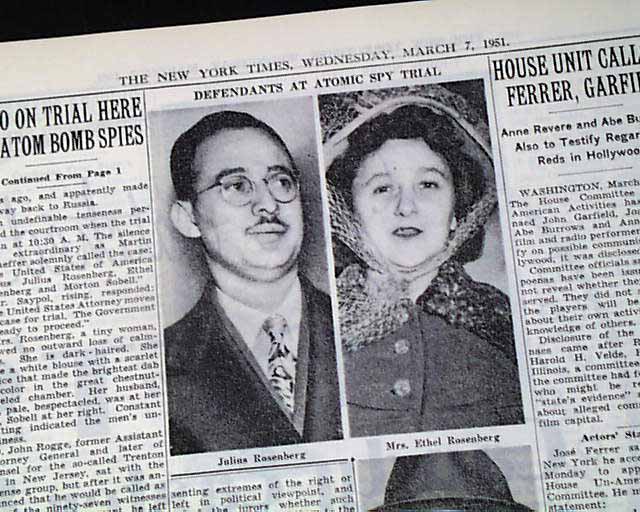
Read the following article and briefly summarize the trial of Julius & Ethel Rosenberg:
https://goformative.com/formatives/tg7dstQbq7B75cLwA
While actual spies stole American nuclear secrets, and as the United States and its allies confronted the growing threat of communism, many Americans became concerned that Soviet agents were inflitrating the US government. This concern found its perfect expression in "McCarthyism", a period during the 1950s in which a US Senator from Wisconsin named Joseph McCarthy began to accuse a wide variety of people of being communists or communist agents. Watch the following video and then write one to two paragraphs on what McCarthyism was, and the lessons we can learn from that period:
https://www.youtube.com/watch?v=N35IugBYH04&t=195s
Despite some of the tensions of the times (including the Korean War), the 1950s were also a period that saw most people turn their attention toward other things. A great increase in the number of births occurred as GI's returned from WWII, mustered out of the army, and concentrated on building lives, careers, and families. One of the most loved tv shows of the times was "I Love Lucy", featuring the real-life husband/wife team of Lucille Ball and Ricky Ricardo. Their popular weekly show during the 1950s illustrated a renewed focus on love, friendship, family, and daily life: