Final Exam Review
star
star
star
star
star
Last updated about 8 years ago
11 Nsɛmmisa
1
3
6
1
1
2
5
1
1
2
1
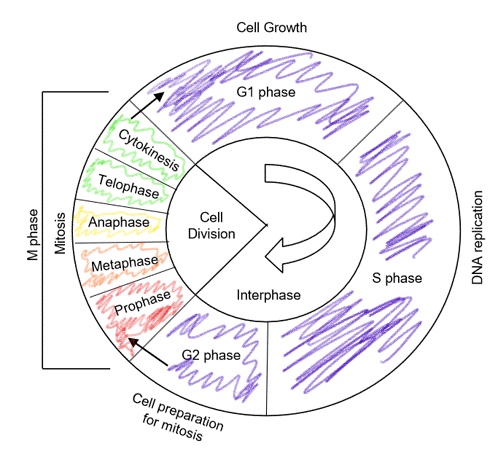
Look at the picture above. What does it show?
What is the purpose of mitosis?
Draw a flower and label the petal, sepal, pistil and stamen.
I recently conducted an experiment to test how much sunlight would be best for growing watermelon plants. I planted 50 watermelon seeds. 10 in a shady spot, 10 in a spot that receives two hours of sunlight a day, 10 in a spot that receives 4 hours of sunlight a day, 10 in a spot that receives 6 hours of sunlight a day and 10 in a spot that receives 8 hours of sunlight a day. All plants were given equal amounts of soil, water and fertilizer and were protected from bugs and other pests. At the end of the experiment I counted the number of watermelons grown in each plot.
Based on the information above, what is the independent variable in this experiment?
Based on the information above, what is the dependent variable in this experiment?
Based on the information above, what are two controlled variables in the experiment?
Use Darwin's Theory of Evolution (VOCNE) to explain why sharks have such sharp teeth.
The equation for photosynthesis is
Two parents who both have Type A blood can have a child with Type O blood.
Explain your answer to the question above.
Which of the following is NOT found in DNA?