DNA Replication - Chapter 8.3 - 15 pts
star
star
star
star
star
Last updated over 6 years ago
16 questions
Note from the author:
Video clip and text explaining the process of DNA replication
1
Last Name, First Name
1
Class Period
Class Period
1
Date:
Date:

1
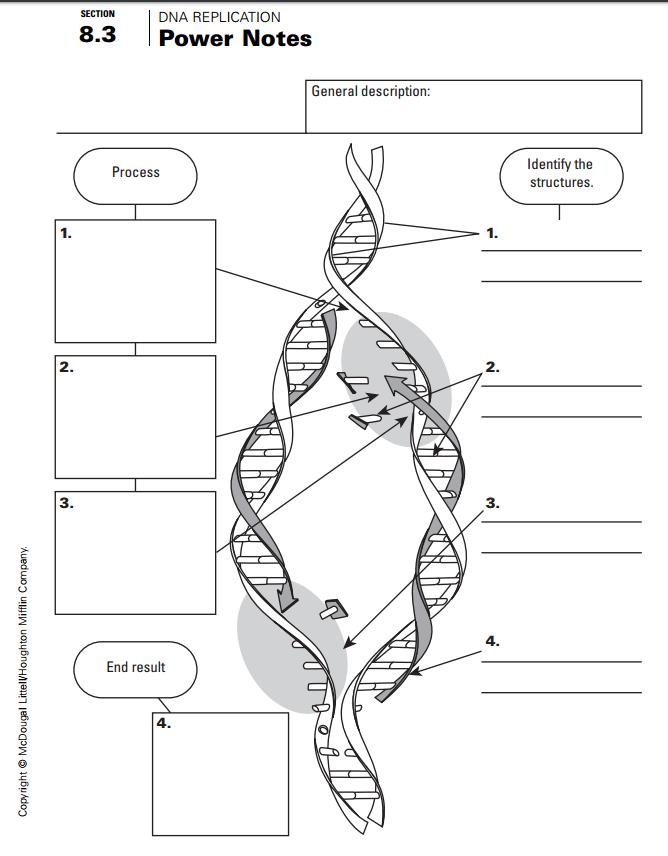
General Description box: Insert description of the process of DNA Replication and where it occurs
1
#1 under Identify the Structures
1
#2 under Identify the Structures
1
#3 under Identify the Structures
1
#4 under Identify the Structures
1
#1 under Process: The first step in replication is when enzymes unzip the DNA double helix in both directions at the same time.
1
#2 under Process: Free-floating phosphates pair with the exposed nitrogen bases on both sides of the original strand.
1
#2 under Process: Bases pair up quickly on the leading strand, however, the bases have to be filled in backwards on the lagging strand and so it takes longer to complete this half of the DNA strand.
1
#2 under Process: DNA is copied from the 3' prime to the '5 prime end.
1
#3 under Process: The DNA polymerase bonds the new nucleotides together to form the new strand which is bonded to one side of the original strand.
1
#4 under End Result: Two identical strands of DNA are made. Each strand has one of the original strands and one of the new strands.
1
#4 under End Result: Briefly describe what semiconservative means in relationship to the way DNA is copied.
1
What are major functions that DNA polymerase performs?